HNSC 1210 Ch.7 (pt. 1): Vitamins (Fat-soluble)
 Call Kai
 Learn
 Practice Test
 Spaced Repetition
 Match
 Flashcards
 Knowt Play
1/106

There's no tags or description
Looks like no tags are added yet.
107 Terms
Vitamins
Essential organic micronutrients (non-caloric) that your body requires in small quantities to maintain normal metabolic function, cellular growth, and tissue repair
Two distinct bichemical groups of vitamins
Fat soluble
Water soluble
Fat soluble vitamins
Dissolve in organic lipids (fats) and are absorbed via the lymphatic system in protein carriers
Where are fat-soluble vitamins stored?
Stored long-term in the liver and fatty tissues
Fat soluble vitamins (4)
A, D, E, K
Water soluble vitamins
Dissolve directly in water and are absorbed within water solutes pathways; able to circulate freely through your bloodstream
Water soluble vitamins (2)
8 B vitamins - Thiamin, Riboflavin, Niacin, Folate, B13, B6, Biotin, Pantothenic acid
Vitamin C
What happens to excess vitamins in your bloodstream? What does it mean?
Rapidly filtered by the kidneys and excreted through your urine, meaning they must be replenished continuously through daily diet
Danger of stable reserves of fat when it comes to absorbing fat soluble vitamins
Introduces a risk of toxicity if high-concentration supplements are overconsumed
Hypervitaminosis
Toxicity of excessive amounts of vitamins in tissues
How do fat-soluble vitamins travel through the body if it can’t dissolve in water?
Must remain encapsulated inside specialized lipoproteins or bind to specific carrier proteins

Chylomicrons
Largest lipoprotein where fat-soluble vitamins are packed inside after absorption and bypass the liver completely at first
Hepatic clearance and processing
Chylomicron remnants (shrunken chylomicrons from losing nutrients) are absorbed by the liver where remaining vitamins are sorted
Storage of Vitamin A
Liver
How much of the body’s total Vitamin A supply does the liver roughly hold?
80-90%
Storage of Vitamin D
Adipose tissue and liver
Storage of Vitamin E
Adipose tissue and small amounts in the liver
Storage of Vitamin K
Liver - significantly smaller than vitamins A or D
Re-exportation of fat-soluble vitamins
Livers binds fat-soluble vitamins to fresh transport vehicles to ship them back out to the body as needed
Vitamin A is the name of what group?
Fat-soluble retinoids
Groups of vitamin A and where they are derived from (2)
Preformed - animal-derived
Provitamin - plant-based
Preformed Vitamin A (2)
Retinol and retinyl esters
Retinoids
A family of synthetic and naturally occurring vitamin A derivatives
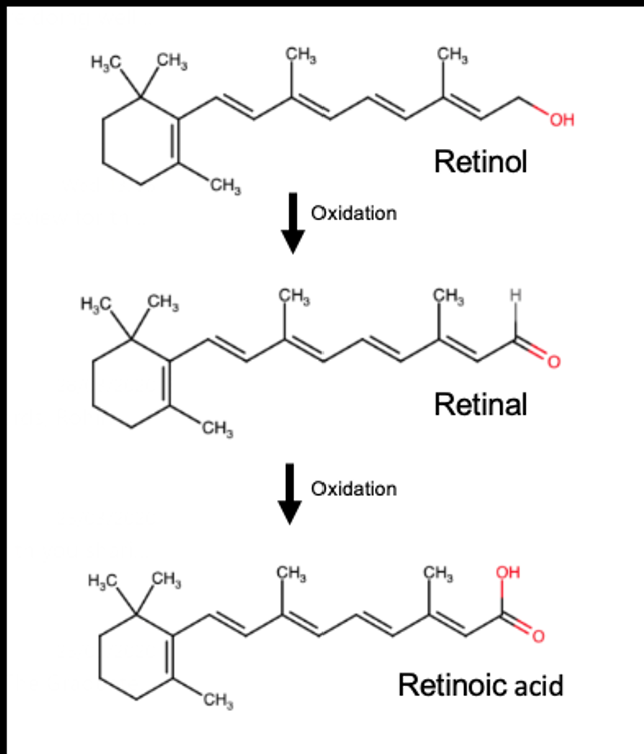
Retinol
Alcohol form of Vitamin A; considered a preformed vitamin A
Retinal
Aldehyde form of Vitamin A
Reversible Oxidation
Retinol is oxidized into retinal which can be fully reversible
Retinoic Acid
Acid of Vitamin A derived from an irreversible oxidation of retinal; minor component of human diet
Steps of retinoid progressive oxidation (5)
Retinol → oxidation → retinal → oxidation → retinoic acid
Pro-Vitamin A
Plant pigment carotenoids that the body converts into active vitamin A (retinol) in the gut
What is the most common and efficient provitamin A carotenoid?
Beta-carotene
Top food sources of provitamin A carotenoids (5)
Carrots
Sweet potatoes
Dark leafy greens (spinach, kale, collard greens)
Orange and yellow vegetables (butternut squash, pumpkin)
Oranges and red fruits (cantaloupe, apricots, mangoes, papayas)
What food source has the highest dietary sources of beta-carotene?
Carrots
Top food sources of retinoids (4)
Organ meats (especially liver)
Seafood and fish oils
Dairy products
Eggs
What food source has the highest dietary source of retinoid?
Beef liver
Provitamin A carotenoid function (2)
Antioxidant defense
Preventing lipid oxidation
Antioxidant defense of provitamin A carotenoid
Neutralize free radicals by absorbing its excess energy
Prevention of lip oxidation by provitamin A carotenoid
Carotenoid sit inside fat-soluble cell membranes, protecting the delicate fatty acids form going rancid or oxidizing
Roles of retinoids (6)
Vision
Gene expression
Epithelial tissue maintenance
Immune defenses
Growth of bone and body
Reproduction
Vision role of Vitamin A
Maintain a healthy cornea and process light reception
Vitamin A deficiency symptoms in vision (3)
Night blindness
Blindness
Xerosis
Gene expression role of Vitamin A
Regulate gene expression by directly binding to DNA, controlling the transcription of over 500 genes and altering cellular behaviour
Cell growth role of Vitamin A
Use direct genetic signaling guide cells specialization (what cells they will be), growth rate and cell death
Vitamin A deficiency symptoms in skin (3)
Skin problems
Dry skin (xerosis)
Keratin lumps on skin
How are keratin lumps on skin created?
Cells do not mature without vitamin A – they die off and secrete keratin

Vitamin A deficiency symptoms in bones (2)
Impaired bone growth
Easily decayed teeth
Immunity role of Vitamin A
Essential molecular regulators of immunity and known as “anti-infective vitamin”
Vitamin A deficiency for immunity can lead to what infections? (3)
Respiratory tract infection
Gastrointestinal infections
Ocular infections
Reproduction role of Vitamin A (4)
Essential signaling molecules for the normal functioning of both male and female reproductive systems
Plays a role in:
Germ cell development
Fertilization
Pregnancy
Retinoid function in male fertility
Strictly required to sustain the production and maturation of sperm
Retinoid function in female fertility
Foundational role in the development of ovarian follicles, egg quality and uterine health
Retinoid function in embryonic development
Maternal retinol are essential for fetal tissue growth, organ development, and placentation
Ways to prevent Vitamin A deficiency (2)
Vitamin A supplements
Eat food richer in Vitamin A
Vitamin A deficiency and toxicity (image)

Vitamin A toxicity is almost exclusively seen from what sources? (2)
Supplements and fortified foods
What is the only natural source of Vitamin A that can cause toxicity?
Liver - including fish livers and the livers of animals that each whole fish
Symptoms of Vitamin A toxicity (12)
Stunted growth
Muscle/bone soreness
Headaches
Edema
Fatigue
Blurred vision
Anorexia
Nausea
Diarrhea
Skin disorders, rashes, itching
Enlargement of spleen
Liver damage
Beta carotene toxicity symptoms (1)
Yellowing of the skin
Vitamin A as other applications (3)
Retinoic acid: drug applied to skin for rapid turnover of skin cells
Retin-A: acne
Renova:: anti-wrinkle
Vitamin D chemical name and other names (3)
Cholecalciferol / calciferol / calciol
How do you get Vitamin D through sunlight?
UV light converts a cholesterol compound in human skin into a vitamin D precursor and is directly absorbed into the blood where the liver and kidney finish converting to active vitamin D
Factors affecting sun exposure and vitamin D synthesis (5)
Clouds, smog, heavy clothing, window glass or screens
Geography
Sunscreen
Time of day
Lifestyle
How much sun is needed for each individual?
10-30 minutes of midday sunlight a few times a week
Why is dietary vitamin D unique?
Very few whole foods contain vitamin D naturally; most foods need to be fortified
Vitamin D food sources (6)
Eggs
Butter
Fish
Animal sources
Fortified milk
Fortified margarine
Vitamin D functions (5)
Hormone regulating cellular metabolism
Regulation of blood and bone calcium and phosphorus levels
Bone formation and maintenance
Immunity
Modulates cells of the: brain, heart, stomach, pancreas, skin, and reproductive organs
Of the cell:
Cellular differentiation (specialization)
Halting proliferation (brake)
Programmed cell death (death)
Vitamin D deficiency symptoms relating to bone diseases (3)
Children - rickets
Ostemalacia - adults
Osteoperosis - older adults
Rickets
Newly formed bone matrix of children remain soft, unmineralized and pliable, leading the long bones of the legs to bend and ribcage weakend
Osteomalacia
Lack of bone mineralization (soft bones) causing deep, aching bone pain, severe muscle weakness and highly fragile skeletal frame
Osteoperosis
Loss of total bone mass and architecture increasing risk of injuries and the dangers of falls
Immunity role of Vitamin D
Bind to Vitamin D Receptors (VDR) of white blood cells to balance the body’s ability to destroy pathogens while preventing an overactive, self-destructive immune response
Vitamin D deficiency symptoms (7)
Increase of:
High blood pressure
Some cancers
Type 1 diabetes
Heart disease
Rheumatoid arthritis
Inflammatory bowel disease
Multiple sclerosis
Vitamin D toxicity acute symptoms (4)
Appetite loss
Nausea/vomiting
Increased thirst and urination
Severe depression
Vitamin D toxicity long-term symptoms (5)
Calcium deposits in:
Heart
Blood vessels
Lungs
Kidneys
Death
Two distinct groups of Vitamin E
Tocopherols and tocotrienols
How many classes of fat-soluble compounds do tocopherols and tocotrienols form together?
8 classes with alpha, beta, gamma, and delta forms for each group
Tocopherols
Class of fat-soluble organic compounds that make up some of the primary forms of Vitamin E
Tocopherols structure
Have a long, saturated tail with no double bonds
Tocotrienols
Lesser-known group of unsaturated chemical compounds of Vitamin E family
Tocotrienols structure
Have a long, unsaturated side chain with 3 double bonds
Which vitamin has the highest Vitamin E activity?
Alpha-tocopherol (a-tocopherol)
Why is alpha-tocopherol the primary Vitamin E?
Liver preferentially selects a-tocopherol to be distributed into the blood stream as they are cleared more quickly and maintain lower systemic concentrations
Vitamin E food sources (6)
Vegetable oils
Peanut butter
Eggs
Fortified cereals and grains
Fatty fish
Milk products
Highest natural concentration of Vitamin E in which food sources? (3)
Plant oils, nuts and seeds
What can destroy/remove vitamin E in foods?
High temperatuers - cooking and deep frying
How do high temperatures cause the loss of Vitamin E?
High cooking heat pairs with rapid oil oxygenation, breaking down the nutrient
Vitamin E function (1)
Antioxidant
Inhibit lipid peroxidation
Free radicals
Unstable and highly reactive molecules that try to “steal” electrons from healthy molecules in cell walls, proteins, and DNA - cell damage
Antioxidant
Stable molecular protectors that possess an abundance of electrons and can safely donate an electron to a free radical to neutralise them; remains stable even after giving up its electron
Lipid peroxidation
Process by which free radicals steal electrons from the lipids (fats) in cell membranes, causing severe cellular degradation; primarily targets polyunsaturated fatty acids (PUFAs) because bonds are easily broken.
Vitamin E role in inhibiting lipid peroxidation
Effective against PUFAs which are highly susceptible to lipid peroxidation
As Vitamin E neutralizes a lipid peroxyl free radical, what does it leave behind?
An oxidized, relatively stable tocopheroxyl radical
Tocopheroxyl radical (Vitamin E radical)
The unpaired electron is delocalized across the molecule's aromatic ring structure, rendering it stable and completely incapable of attacking adjacent fatty acids
Cellular regeneratoin network
Process of reducing back a Vitamin E radical into its active form to continue acting as an antioxidant
Vitamin E deficiency symptoms (3)
Red blood cells hemolysis in premature infants
Muscle weakness
Impaired nerve reflexes
Vitamin E toxicity symptoms (5)
Nausea
Fatigue
Gastrointestinal distress
Blurred vision
More than 400 IU/day: increased risk of death form all causes
Two natural form and synthetic variant of Vitamin K
K1 (Phylloquinone) - primary dietary form
K2 (Menaquinone)
K3 (Menadione) - synthetic
What is Vitamin K1 synthesized by?
Plants
Where is Vitamin K2 found and what is synthesized by?
Found in fermented foods and animal products and synthesized by bacteria
Vitamin K3
A synthetic form of Vitamin K previously used in supplements - phased out for human use due to risks of liver toxicity and hemolytic anemia
Vitamin K food sources (5)
K1:
Green leafy vegetables
K2:
Pulses/legumes
Liver
Eggs
Milk