Energy: Part 1
 Call Kai
 Learn
 Practice Test
 Spaced Repetition
 Match
 Flashcards
 Knowt Play
1/15

There's no tags or description
Looks like no tags are added yet.
16 Terms
Identify the components of an ATP molecule
An adenine base, ribose sugar, and three phosphates (triphosphates)
Identify the components of an ADP molecule
An adenine base, ribose sugar, and two phosphates (diphosphates)
Define exothermic reaction
Reaction where energy is released
Define endothermic reaction
Reaction where energy is stored
Describe how energy is stored in the ATP/ADP cycle
Energy is stored in the third phosphate bond as the bond is formed by dehydration synthesis
Describe how energy is released in the ATP/ADP cycle
Energy stored in the third phosphate bond is released when the bond is broken by hydrolysis
Enzymes are describes as…
Organic catalysts
Which type of macromolecule are enzymes?
Protein
Describe how an enzyme speeds up a chemical reaction
An enzyme speeds up a chemical reaction by reducing the amount of activation energy.
Which structures make up the “lock and key” analogy
The substrate and active site
Identify what can cause an object to denature
Temperature and pH
Describe how the enzyme catalase functions in metabolic reactions. What does the enzyme help to break down
The enzyme catalase functions in metabolic reactions by breaking down hydrogen peroxide
From most energy to least energy, place ADP, AMP, and ATP in the correct order
ATP, ADP, AMP
Define substrates
Substrates are reactant molecules being converted into new and different products
Define active site
An active site is the pocket or groove on the surface of an enzyme that the substrate molecule fits in
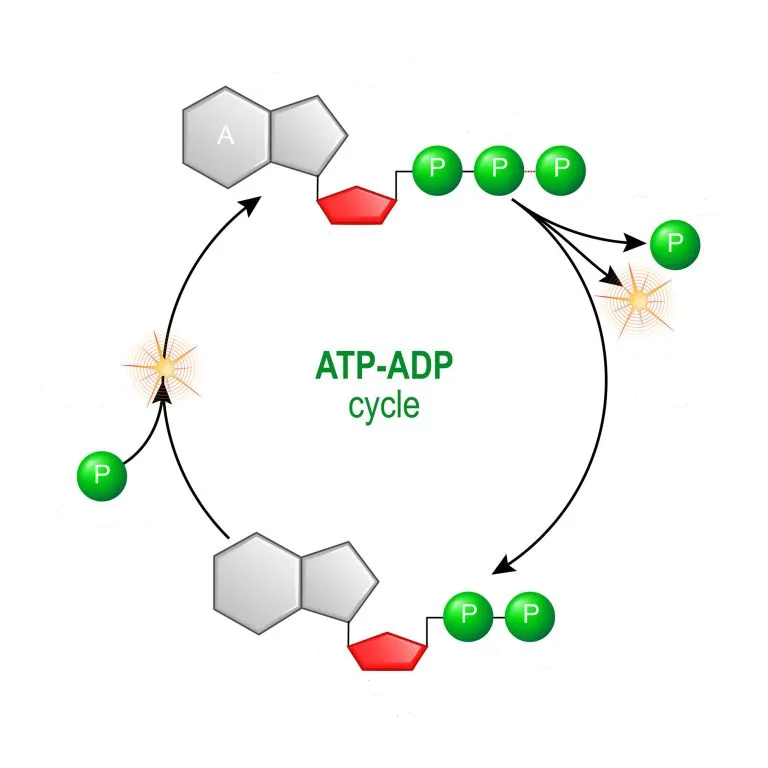
Lable the diagram
ATP, ADP, Ribose sugar, Adenine, Triphosphate + Diphosphate (phosphate group), Energy absorbed and released (exothermic + endothermic)
