unknown project lab quiz
 Call Kai
 Learn
 Practice Test
 Spaced Repetition
 Match
 Flashcards
 Knowt Play
1/43

There's no tags or description
Looks like no tags are added yet.
44 Terms

motility test medium with TTC (triphenyltetrazolium chloride) (MTM-TTC)
-contains 0.4% agar and 2, 3, 5- triphenyltetrazolium chloride (TTC).
-visible bacteria reduce TTC to form a red precipitate called formazan.
-distribution of formazan indicates the location of the bacteria in the tube
-used to determine an organisms motiltiy
oxygen requirements test with fluid thioglycollate medium (FTM)
-contains glucose as an energy source and cystine and sodium thioglycollate which act to create an oxygen gradient in the medium
-oxygen concentration is high at the surface of the medium (allowing aerobes to grow) and decreases towards the bottom of the medium (for anaerobic growth)
-used to determine oxygen requirements
what was the indicator dye used in the oxygen requirement test (FTM)?
resazurin; causes medium to turn pink in the presence of oxygen
during the oxygen requirement (FTM) test, what step must be taken before inoculation?
boil medium for 5 minutes with screw cap loose, then allow medium to cool to body temperature or below
obligate aerobe
growth at the top of medium; requires oxygen

facultative anaerobe
growth throughout the medium; can live with or without oxygen

obligate anaerobe
growth at the bottom of the medium; cannot grow with oxygen

list carbohydrates that were tested for fermentation
-glucose (GLU)
-lactose (LAC)
-maltose (MAL)
-mannitol (MAN)
-sucrose (SUC)
carbohydrate fermentation: acid production
-phenol red is used as an indicator in each medium. at a neutral pH, the medium is red (-). at a pH of less than 7 (acid), the medium is yellow (+).
-a positive test indicates the organisms ability to ferment the carbohydrate
carbohydrate fermentation: gas production
-a Durham tube in the broth captures some of the gas the organism produces, allowing gas production to be seen.
-in a bubble forms in the tube, the organism is positive for gas production

what was the pH indicator for the carbohydrate fermentation test?
phenol red
gelatin hydrolysis test (nutrient gelatin) (NG)
-medium contains gelatin, a semisolid substance
-gelatinase hydrolyzes (breaks down) gelatin, a large protein, into smaller components, which can then enter the organism and be metabolized
-used to determine the ability of an organism to produce the enzyme gelatinase, which liquefies gelatin

a (+) gelatinase test will be liquid, indicating ?, while a (-) gelatinase test is solid, indicating ?
the organism has the enzyme gelatinase; the organism lacks the enzyme gelatinase
urea hydrolysis (urea broth) (UB)
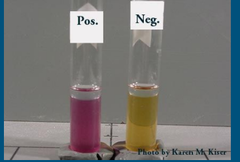
-medium contains urea and the pH indicator is phenol red, which turns bright pink at alkaline pH
-used to determine the ability of an organism to hydrolyze urea to form ammonia (an alkaline end product) by the enzyme, urease

a (+) urea hydrolysis test indicates that an organism produces the enzyme ?, which enables it to grow in the bladder.
urease
catalase test (TSA slant)
-hydrogen peroxide (H2O2) is formed as an end product of aerobic respiration of sugars. when it accumulates, it becomes toxic to the organism.
-catalase decomposes H2O2 and enables the organism to survive.
-only obligate anaerobes and aerotolerant bacteria such as Streptococci LACK this enzyme.
-used to test for presence of enzyme catalase

citrate utilization (simmon citrate agar) (CIT)
-medium contains citrate as the sole carbon source, ammonium salts as the sole nitrogen source, and brom thymol blue as the pH indicator
-an organism that produces citrase can break down citrate into pyruvate, and can also convert ammonium salts in the medium to ammonia, creating an alkaline pH
-used to determine if an organism is capable of using citrate as the sole source of carbon

which technique was used to test the simmons citrate agar slant?
A.) inoculation with loop
B.) streak with loop
C.) stab with needle
D.) streak with needle
C, D
nitrate reduction (nitrate broth) (NIT)
-the reduction of nitrate to nitrite or nitrogen gas and ammonia takes place under anaerobic conditions in which an organism derives its oxygen from nitrate
-used to determine an organisms abiltiy to reduce nitrate (NO3) to nitrite (NO2) or nitrogen gas (N2) and ammonia (NH3) by production of the enzyme nitrate reductase

if a nitrate reduction test reads negative, we must ? by adding a small amount of ? to the medium. if the medium is a confirmed negative, it will turn from clear/cloudy to ?.
conduct a confirmation test; zinc powder; red color (due to the zinc, not the organism)
a nitrate reduction test is performed using a/n (1) broth and tests for the enzyme (2). a (+) test will produce a (3) color, and a (-) test will produce a (4) color.
(1) NIT
(2) nitrate reductase
(3) red
(4) clear/cloudy

list the steps of the nitrate reduction test
1.) boil medium for 5 minutes with screw cap loose
2.) tighten cap and allow medium to cool to body temp or below
3.) inoculate nitrate broth with the organism using an inoculating loop
4.) incubate at 37 degrees C for 24-48 hours
5.) add 5 drops of Nitrate Reagent A and 5 drops of Nitrate Reagent B to the tube
methyl red test (MR-VP broth)
-medium contains glucose as a substrate for fermentation
-some organisms produce large amounts of various acids (lactic, acetic, succinic, formic) during fermentation, which lower pH to a level that can be detected by the pH indicator methyl red
-used to determine an organisms abiltiy to produce mixed acid end products from glucose fermentation

list the steps and results of the methyl red test
1.) label a tube of MR-VP broth with "MR test"
2.) inoculate MR-VP broth with the organism using an inoculating loop
3.) incubate at 37 degrees C for 3-5 days
4.) add 3-4 drops of methyl red reagent to the tube. swirl gently to mix
results:
(+): red color develops
(-): no red color; orange/yellow color may develop

voges-proskauer test (MR-VP broth)
-medium contains glucose as a substrate for fermentation
-some organisms produce acetoin, a precursor to 2,3-butanediol
-acetoin can be detected by Barritt's Reagents A and B
-used to determine an organism's ability to produce acetoin and 2,3-butanediol from glucose fermentation

list the steps of the Voges-Proskauer test
1.) label a tube of MR-VP broth with "VP test"
2.) inoculate MR-VP broth with the organism using an inoculating loop
3.) incubate at 37 degrees C for 3-5 days
4.) pipet 1 ml (20 drops) of culture into a clean test tube
5.) add 18 drops of Barritt's solution A and 18 drops of Barritt's solution B to the extracted culture
6.) agitate vigorously for 1-2 minutes. let stand for 30 minutes.
describe the results of the Voges-Proskauer test
(+): wine red (burgundy) color develops (can produce acetoin and 2,3-butanediol from glucose fermentation)
(-): brown color develops

indole test (tryptone broth) (TRP)
-medium contains the amino acid tryptophan
-bacteria producing the enzyme tryptophanase can hydrolyze tryptophan to indole, pyruvic acid, and ammonia
-indole production can be detected by the addition of Kovacs reagent
-used to determine an organisms ability to split indole from the amino acid tryptophan using the enzyme tryptophanase

in the indole test, the reagant is ? and a (+) test indicates that the organism has the enzyme ?
Kovacs Reagant; tryptophanase
hydrogen sulfide production (triple sugar iron agar) (TSI)
-used to determine the abiltiy of an organism to hydrolyze the sulfur-containing amino acid cysteine to produce pyruvic acid, ammonia, and hydrogn sulfide
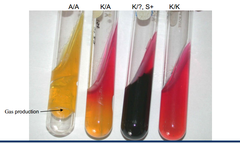
the TSI medium contains (1), (2), (3), (4), (5), and th pH indicator is (6). the initial step is the removal of the sulfide from cysteine which is catalyzed by the enzyme (7).
(1) cysteine
(2) sucrose
(3) lactose
(4) glucose
(5) ferrous sulfate
(6) phenol red
(7) cysteine desulfurase
describe the results of the hydrogen sulfide production test on the TSI slant
(+): black precipitate at bottom of slant
(-): no precipitate

list the steps of the hydrogen sulfide production test
1.) stab/streak TSI slant with organism using an inoculating needle
2.) incubate at 37 degrees C for 24-48 hours
what is the purpose of the phenylalanine deamination test (phenylalanine agar)?
to determine an organisms ability to deaminate the amino acid phenylalanine resulting in the production of phenylpyruvic acid and ammonia
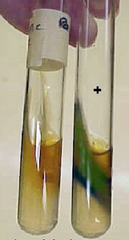
describe the phenylalanine deamination test (PHE)
-medium contains phenylalanine which is deaminated by the enzyme phenylalanine deaminase, producing phenylpyruvid acid and ammonia
-phenylpyruvic acid can be detected by the addition of ferric chloride

list the steps and results of the phenylalanine deamination test
1.) streak PHE slant with organism using a loop
2.) incubate at 37 degrees C for 24-48 hours
3.) place 5 drops of 1-% ferric chloride on the slant culture
4.) observe results withint 5-10 minutes
results:
(+): green color on surface of slant
(-): no color develops (any yellow color is due to ferric chloride)

what is the purpose of the lysine decarboxylase test?
to determine an organisms ability to decarboxylate the amino acid lysine, resulting in the production of the alkaline end-product cadaverine, by producing the enzyme lysine decarboxylase
the medium used for the lysine decarboxylase test was (1)/(1), and contained lysine, (2), and the pH indicator (3), which is purple at alkaline pH, and yellow at acid pH.
(1) lysine decarboxylase broth/LD
(2) glucose (as a substrate for fermentation)
(3) brom cresol purple

the enzyme lysine decarboxylase requires an acidic pH below 5 for activation. IF the organism is capable of glucose fermentation AND has the enzyme, what 3 events will occur?
1.) microbe ferments glucose, producing a low pH; indicator turns yellow
2.) lysine decarboxylase is activated
3.) cadaverine is formed, pH rises, and the medium returns to its original purple color
describe the results of the lysine decarboxylase test
(+): purple (verify organism ferments glucose by checking carbohydrate fermentaiton test, if the organism does NOT ferment glucose, then a purple color is negative)
(-): yellow

what is the purpose of the ornithine decarboxylase test?
to determine an organisms ability to decarboxylate the amino acid ornithine, resulting in the production of the alkaline end-product putrescine, by producing the enzyme ornithine decarboxylase
the ornithine decarboxylase test was done in an ornithine decarboxylase broth (OD). describe its contents and pH indicator.
the medium contains ornithine, glucose (as a substrate for fermentation), and the pH indicator brom cresol purple (purple at alkaline pH, yellow at acid pH)
the enzyme ornithine decarboxylase requires an acidic pH below 5 for activation. IF the organism is capable of glucose fermentation AND has the enzyme, what 3 events will occur?
1.) microbe ferments glucose, producing a low pH; indicator turns yellow.
2.) ornithine decarboxylase is activated
3.) putrescine is formed, pH rises and the medium returns to its original purple color
for the ornithine decarboxylase test, and ? color is positive, and a ? color is negative.
purple, yellow