S&S: intro from notes
 Call Kai
 Learn
 Practice Test
 Spaced Repetition
 Match
 Flashcards
 Knowt Play
1/151

Earn XP
Description and Tags
152 Terms
A signal is
any physical phenomenon which conveys information
a function of one or more variables that conveys information about some (usually physical) phenomenon.
For a function f , in the expression f (t1,t2, . . . ,tn), each of the {tk } is called an
while the function value itself is referred to as a
independent variable, dependent variable
Some examples of signals include:
A voltage or current in a circuit The position, velocity, or acceleration of an object A force or torque in a mechanical system A flow rate of a liquid or gas in a chemical process A digital image, digital video, or digital audio A stock market index
4 ways to Signal Representation
graphical
sequential
mathematical
tabular
A system is an entity that
processes one or more input signals in order to produce one or more output signals.
____ respond to signals and produce new signals
Systems
__________ signals are applied at system inputs
Excitation
_________ signals are produced at system outputs
response
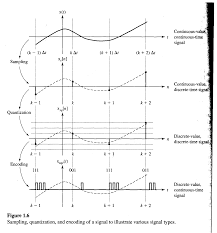
3 main steps involved in conversion of signal types namely
sampling
quantizing
encoding
give the steps with example of CTS to DTS
ct value, ct time
ct value, but discreet time signal
discreet value discreet time signal
discreet value cts time signal
Unit-Step Signal (u(t)) Defined as
u(t) = ( 1, t ≥ 0
0 , t < 0}
unit step best used as
test signal
area under U(t)
unity
Unit Impulse Signal (δ(t)) Defined as
δ(t) = ( 1 t = 0
0 t ̸= 0)
integra from −∞ to ∞ of δ(t)dt = __
u(t)
δ(t) = __/dt
du(t)
Properties of continuous-time unit impulse function
it is an even function of time t, i.e δ(t) = δ(−t)
if shifted by n-k, =1 at n=k and 0 elsewhere
for discreet, δ(n)=u(n)-u(n-1) cuz they cance out
multiplying it by signal gives f(0) i.e whatever is the function’s value at 0 will be and the rest is like the impulse
δ(t-to) f(t)=f(to)
integral ∞ −∞ x(t)δ(t)dt = x(0): intgr ∞ −∞ x(t)δ(t − t0)dt = x(t0)
time scaling it by k= 1/|k|*δ(t)
Area covered by all unit step functions is
1
Ramp Signal (r(t)) Defined as
r(t) = ( t, t ≥ 0
0,t < 0)
relation between unit step and ramp both integral and derivative form
intg ∞ −∞ u(t)dt = r(t)
u(t) = dr(t) dt
relation between unit impulse and ramp both integral and derivative form
double integral ZZ ∞ −∞ u(t)dt = r(t)
u(t) = dr²(t) dt²
area of ramp
1
is ramp even or odd?
neither
is ramp energy or power signal?
neither
Parabolic Signal Defined as
x(t) = ( t 2/2 ,t ≥ 0
0, t < 0)
reation ship with ramp unit and impulse
Z r(t)dt = x(t), r(t) = dx(t) dt
u(t) = d 2 x(t) dt2
triple integral for implse
is periogdic een or odd? power or energy
neither
signum reation with u(t)
sgn(t)=2u(t)-1
Exponential Signal defined as:
x(t) = e αt
The shape of exponential can be defined by
α
three cases depending on alpha
>0 raises
=0 dc (uniform at one)
<0 decays
The rectangular function (also called the unit-rectangular pulse function), denoted rect, is given by
rect(t) = 1 if −1 /2 ≤ t ≤ 1 /2
0 otherwise
another formula with amplitude and period
x(t)=A rect (t/T) while it ranges from -T/2 - T/2
is rect t an even or odd
even
is rect t a power or energy signal
energy, P=0
Triangular Signal given by
x(t) = A [1 − |t| /T ]
is rect t even or odd
even
is rect t power or energy signal
by formula calculation, E=2/3 thus energy
Sinusoidal Signal The form of
x(t) = Acos(ω0t + ϕ) or Asin(ω0t + ϕ) where A= amplitude
A (CT) real sinusoid is a function of the form
x(t) = Acos(ωt + θ),
where A, ω, and θ are real constants
Such a function is periodic with fundamental period
T = 2π |ω| and fundamental frequency |ω|.
sinc(t) Defined as
sinc(t) = sinπt πt = 0 for = ±1, ±2, ±3, . . .
sinc t is energy or power signal
energy, E=pi
at t= infinity,sinc t =
0
Sampling Signal (sa(t))
sa(t) = sint t = 0 for t = ±π, ±2π, ±3π, . . .s
There are five types of signals
1 Continuous-time and Discrete-time Signals
2 Even and Odd Signals.
3 Periodic and Non-periodic Signals.
4 Deterministic and Random Signals
5 Energy and Power Signals.
based on Number of independent variables (i.e., dimensionality):
A signal with one independent variable is said to be one dimensional (e.g.,audio).
A signal with more than one independent variable is said to be multi-dimensional (e.g., image).
continuous time (CT)
A signal with continuous independent variables
(e.g., voltage waveform).
discrete time (DT)
A signal with discrete independent variables
(e.g., stock market index).
continuous valued
A signal with a continuous dependent variable
(e.g., voltage waveform).
discrete valued
A signal with a discrete dependent variable
(e.g., digital image).
A continuous-valued CT signal is said to be
analog (e.g., voltage waveform)
. A discrete-valued DT signal is said to be
digital (e.g., digital audio).
continuous-time signal.
a signal defined for all instants of time,
discrete-time signal.x(n)
a signal defined only at specific instants of time,
Discrete-time signals are rare in nature and mostly obtained by sampling continuous-time signals
true
A continuous-time signal x(t) is said to be an even signal if it satisfies the condition:
x(−t) = x(t), for all t
A continuous-time signal x(t) is said to be an odd signal if it satisfies the condition:
x(−t) = −x(t), for all t
Even signals are symmetric about
the vertical axis whereas odd signals are asymmetric.
A general continuous-time signal x(t) can be decomposed into its even and components as follows
. x(t) = xe (t) + x0(t)
xe (t) =
1/ 2 [x(t) + x(−t)]
x0(t) =
1/ 2 [x(t) − x(−t)
A continuous-time signal x(t) is said to be periodic with period T if there is a positive non-zero value of T for which:
x(t) = x(t + T), for all t
If x(t) is periodic with period T, then it is also periodic for all integer multiples of T. That is: x(t) = x(t + kT), k is an integer
true
The smallest positive value T is known as the
fundamental period
All continuous-time sinusoidal signals are periodic.
true
sinusoidal signal is periodic for all values of t and its fundamental period is given by:
T = 2π/ ω0
The sum of two periodic continuous-time signals may not be always periodic.
true
two periodic sinosoidal CTS signals of the same frequency added give periodic
true
If x1(t) is periodic with fundamental period T1 and x2(t) is periodic with fundamental period T2, then x(t) is periodic if and only if:
T1 T2 = m/n = rational number
T = nT1 = mT2
In the above equation, the values of m and n must be chosen such that
the greatest common divisor (gcd) between m and n is 1.
A complex exponential signal x(t)=ej(ω0t+ϕ) is periodic if and only if
To be periodic, ω0/2π must be a rational number.
are linear at+b functions periodic or not
not
x(t)=e^at is periodic if and only if
a is purely imaginary
x(t)=eja is periodic because
it is constant or its real part doesn’t depend on t
when sum of multiple CTS are given how do you check for periodicity and find the fundamentals period?
check individual periodicity and find individual periods for components then the ratio of each must be rational no.(pi not involved). then to find T find LCM(T1,T2,T3…)
WHAT ABOUT fundamental frequency?
find HCF of each freq
The normalized energy E of a continuous-time signal x(t) is defined as:
E = Z ∞ −∞ |x(t)| ² dt
The normalized average power P of x(t) is defined as:
P = lim T→∞ 1 T Z ∞ −∞ |x(t)| ² dt
A signal is said to be an energy signal if the normalized total energy E has
a non-zero finite value, i.e., 0 < E < ∞.
On the other hand, a signal is said to be a power signal
if it has non-zero finite normalized average power, i.e., 0 < P < ∞.
A signal cannot be both an energy and a power signal simultaneously.
true
The energy signals have ___________ average power
zero
the power signals have_________ total energy
infinite
say the following power or energy signal
unit step
unit exponential of negative exponent
unit exponential of postive exponent
ramp signal
power
energy
neither
neither
Deterministic signals are those signals whose values are
completely specified for any given time. or can be described by some mathematical formula
a deterministic signal can be modeled by a known function of time t.
true
Random signals are those signals that take
random values at any given time and must be characterized statistically.
we do operations on which parameters of signals
amplitude and time
operations on amplitude are
scaling
addition
substruction
multiplication
operations on time are
scaling
reversal
time shift
amplitude scaling defined by
y(t) = Ax(t)
amplitude scaling by A , if |A|>1:
if |A|<1
increase upward
decrease downward
A physical example of a device that performs amplitude scaling is an
electronic amplifier.
time scaling
y(t) = x(at)
If a > 1, the signal y(t) is
If 0 < a < 1, the signal y(t)
a compressed version of x(t).
is an expanded version of x(t)
Time-reflection or reversal
A continuous-time signal x(t), The time-reflected version of x(t) is obtained by
replacing the time t with –t and is given by: y(t) = x(−t)
time shifting
y(t) = x(t − t0)
If t0 > 0, then
If t0 < 0, then
x(t) is shifted to the right. x-to
x(t) is shifted to the left.x+to