Hypothalamus
 Call Kai
 Learn
 Practice Test
 Spaced Repetition
 Match
 Flashcards
 Knowt Play
1/27

Earn XP
Description and Tags
Explain the embryological origins of the hypothalamus and pituitary gland Recognize the many inputs and outputs to and from the hypothalamus Understand biological rhythms Know the two major ways that the hypothalamus and pituitary communicate Describe the important releasing and inhibitory hormones
28 Terms
Where is the hypothalamus locaeted
Under the thalamus on floor of the 3rd ventricl e

What is the embryological origin of anterior pituarory gland
evagination of oral ectodermal cells (rathke pouch, from the mouth)
Therefore true endocrine organ
Posterior Pituitary gland embryoogical origin
neural crest ecotderm evagination. Nervous system origin, therefore has a storage function

What ways can the hypothalamus has different inputs
Receptor sensin
Indirectly via the blood (temp, osmotic pressure, hormones)
indirectly via nerves
what are the 6 hypothalami nuclei
Paraventrivular - oxytocin adh trh crh
Supraoptic - oxytocin and adh
suprachiasmatic - biological clock
lateral nucleaus - arousal adn hunger
arcuate - energy
mammillary - wakefullness
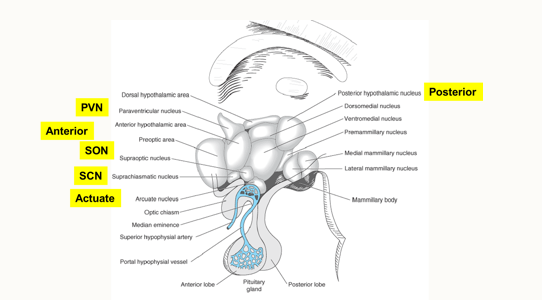
what are the 3 types of hypothalmi inputs and the 2 types of mechanisms for this..
Receptors
circulating hormones
Indirect sensing (nerves, emotions, limbic system..)
Humoral and neural pathways…
What are the 3 types of hypothalamic inputs..
Thermoreceptors
Osmoreceptors
energy balance (hunger control)
How is thermoregulation controlled in the hypothalamus..
Anterior hypothalamus = Heat detection, therefore will cool you down.. (anterior means the front!..)
Posterior hypothalamus = Cool detection (christmas post) therefore will warm up the dog, peropheral vasoconstriction, goosebumps, shivering
How do osmoreceptors in the hypothalamus respond
respond to dehydration
(ADH hormone from supraoptic nucleaus in the hypothalamus, dehydration stimulates the thirst center lateral hypothalamus..)
How does the hypothalamus regulate energy balance..
SENSES blood glucose..
Leptin causes ‘fullness’
Ghrelin ‘ hunger’
What are the 2 ‘food centres’ in the hypothalamus
Saitety centre - high glucose levels, stop eating
appetite centre - response to low glucose levels, stimulates eating
What are the hypothalmic regulations of feeding behaviours..
afferent inputs to hypothalamus, glucostat cells. Glucosee utilization..
CCK = chloecytokinin (pancreatic secretion and gall baldder contraction)
What is the 3 endocrine outputs of the hypothalamus
biological clock
pineal gland
melatonin
Secretory neurons (adh + Oxytocin..)
Inhibitory AND stimulatory hormones..
How and where is the biological clock regulated..
Light sensed by retina + transmited in nerve pathways - hypothalamus..
bio clock nucleas = the SUPRACHIASMATIC NUCLEAS —> stimulates pineal gland to make melatonin
What are the 3 different types of rhythmns..
Circadian rhtym —> 24 hr period
ultrafradian —> more regularly than 24hr (e.g. cortisol)
Infradian —> longer than 24 hrs, e.g. oestrus cycles..
What is important to remember if measuring cortisol…
Higher in the morning, the high cortisol triggers waking.. should decrease by 30% in a healthy individual..
What are the 3 parts of the pituatory gland
Anterior - pars tuberalise + pars distalis (adenohypophysis)
Intermdiate - Pars intemdi
posterior - pars nervosa (neurohypothesis)
What does the posterior pituatory gland secrete
adh + oxytoxin.. from son and pvn
axons descend and terminate at the blood vessels.
What does the posterior pituatory gland act as
Storage site for the hormone,s as originally a collection of nerves…
where are hte 2 plexi in the anterior pituatory gland
hypothalamis neurone
primary plexus
hypophyseal portal veins
secondary plexu
For referance exaples of releasing hormone
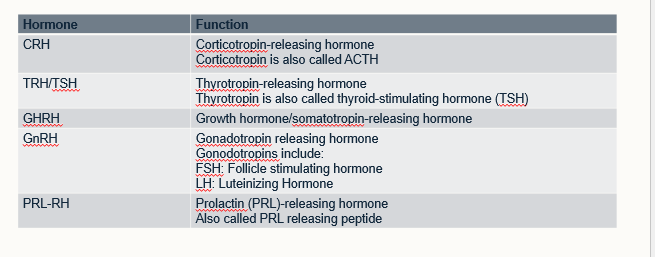
W?hat do inhibitory hormones fo
stop hunger signals.. stop the signal all the hormones will reach specific target tissues..
What is TOnic vs episodic secretion
TOnic = constant = e.g. dopamines
episodic = pulsating release of hormone - e.g. cortisol..
What is tonic inhibition
releasen and inhibition and sitmulates them /..
4 lecture integreation

Neurohormones

Dual opposing roles..
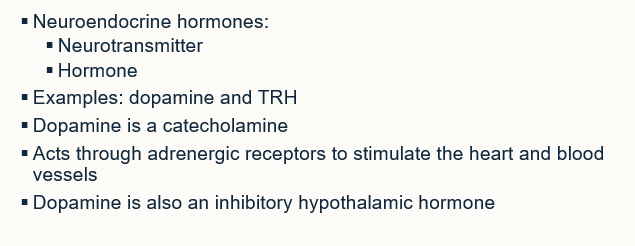
conclusions
