Cell Membranes
 Call Kai
 Learn
 Practice Test
 Spaced Repetition
 Match
 Flashcards
 Knowt Play
1/27

Earn XP
Description and Tags
Full revision notes
28 Terms
Glycoproteins
Intrinsic proteins with attached carbohydrate chains that are exposed at the cell surface act as recognition sites for hormones, neurotransmitters and other signalling molecules
Glycoproteins and glycolipids are involved in the following:
Cell adhesion - This is the attachment of cells to one another.
Cell recognition - This allows cells to recognise one another. - they have receptors for chemical signalls
Cell signalling - This is communication between cells.
If there is undigested sugars, milk, etc what would happen
undigested lactose would lower the water potential in the intestine, this means water would move across a partially permeable membrane the intestine lining from an area of high water potential to low water potential down the concentration gradient. Water moving into intestine can then cause diarrhoea.
Molecule of a phospholipid
ester bonds form between the fatty acids and glycerol, condensation reaction, releases a molecule of water per ester bond made
steriod vs non steriod hormones
steriod hormones are non polar, hydrophobic so their receptors are found inside cells as they can diffuse through the phospholipid bilayer
non steriod hormones are polar , hydrophyllic so their receptors are found on the outside of the cells, cell surface membranes.
Exam questions notes
phagocytosis cannot occur if there are too many cholestrol as this reduces fluidity, increases rigidity, less able to change shape and engulf
As temperature decreases what happens to absorbance of the pigment : as temperature decreases the kinetic energy of the phospholipids in the bilayer decreases, this reduced movement means there are less gaps between the phospholipids in the membrane, reduced permeabliltiy, pigment less absorbed.
not all membrane proteins span the entire layer, intirinsic are embedded throughout, extrinsic are just found on the surface membrane outer
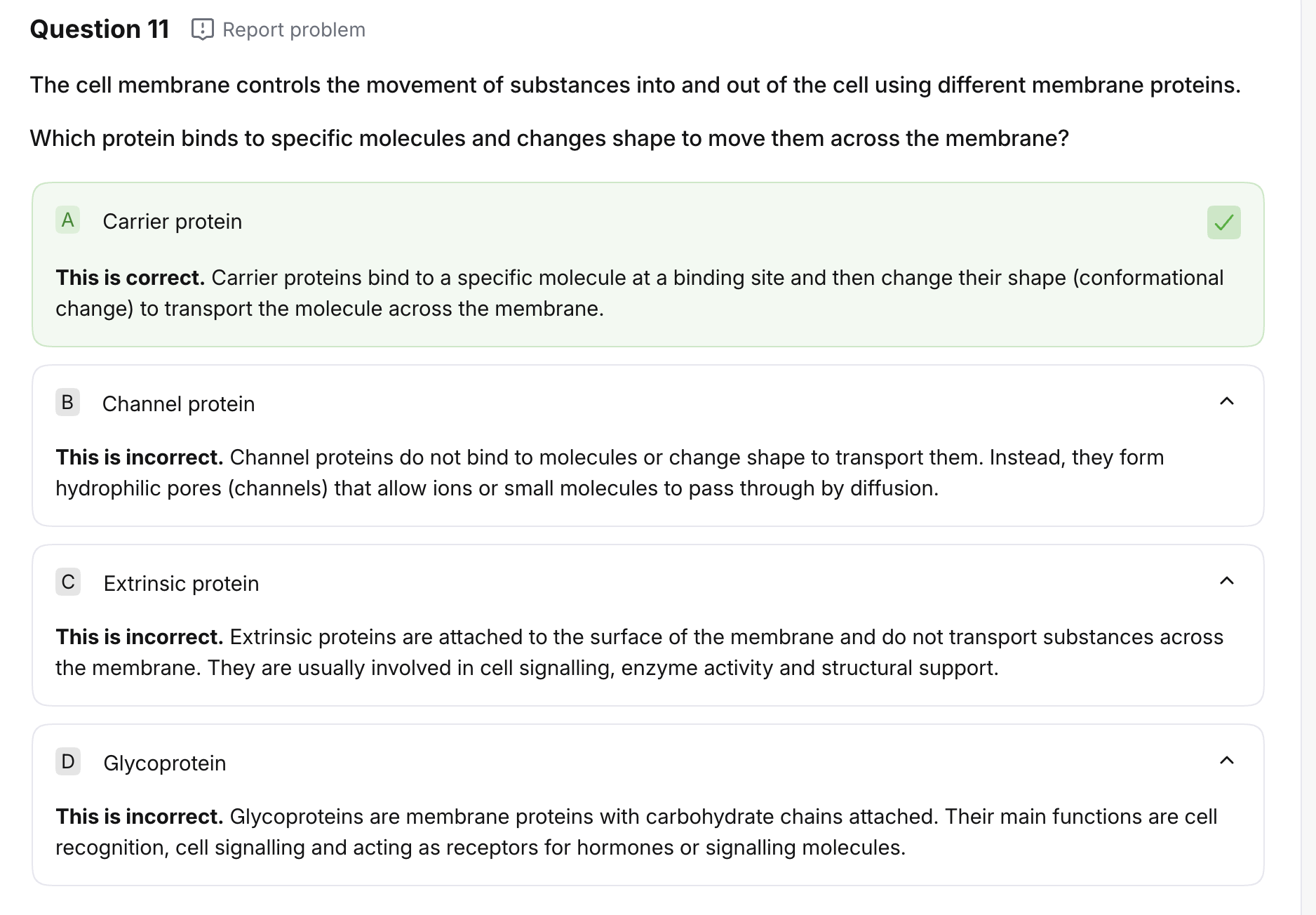
channel proteins and carrier proteins are specific to particular ions and molecules each type of protein only allows certain substances to pass through.
rate of faciliatated diffusion increases when there are more carrier and channel proteins, as more molecules transported per unit of time
channel proteins form hydrophyllic pores in which ions and specific molecules can move passively down their concentration gradient without ATP.
you change temp for betroot practical, then keep volume the same as otherwise concentration of pigment will change
proteins - CHON (s) nucleic acids - CHONP

Temperature effect on cell membranes
How temperature affects cell membranes:
At low temperatures (below 0°C) - Phospholipids do not have much kinetic energy. They are packed closely together to form a rigid cell membrane, decreasing the permeability of the membrane. If there is little effect say that the membrane is still intact , may be no change in absorbance.
At medium temperatures (0 - 40°C) - As temperature increases, phospholipids have more kinetic energy so they move faster and aren't packed as closely together. This increases the permeability of the membrane.
At high temperatures (above 40°C) - The phospholipid bilayer breaks down. Channel and carrier proteins denature, meaning they cannot control what enters or leaves the cell. These effects increase the permeability of the membrane.
as temperature increases, phospholipids ke increases, more movement due to fluidity, membrane becomes more permeable,
must link increase in pigment leakage into solution, this means the absorbance value on the colorimeter will increase.
Simple diffusion
Oxygen and carbon dioxide can diffuse into cells via simple diffusion.
This is because they are:
Small - This means that they can pass through the spaces between phospholipids.
Non-polar - This means that they can dissolve in the hydrophobic core of the cell membrane.
Factors affecting the rate of diffusion
Temperature - At higher temperatures, particles have more kinetic energy and diffuse faster.
Concentration gradient - The steeper the concentration gradient, the faster the rate of diffusion.
Thickness of membrane - The particles travel shorter distances through thin exchange surfaces, so diffuse faster.
Surface area - Larger surface areas mean more particles can cross the membrane at once, making diffusion faster.
Number of carrier or channel proteins - The more of these proteins, the faster the rate of facilitated diffusion.
facilitated diffusion rate will decrease if the number of carrier proteins become saturated.
Active Transport
Also requires carrier proteins
ATP binds one side, the molecule to the other
3. Hydrolysis of ATP to ADP and phosphate (Pi) causes the carrier protein to change shape. This releases the molecule or ion on the opposite side of the membrane.
4. The phosphate (Pi) is released from the carrier protein, causing the carrier protein to return to its original shape, ready to be used again.
1.molecule ion to be transported binds to receptors in the channel of the carrier protein on the outside of the cell. ATP binds to the otherside, it is hydrolsed into ADP and Phosphate. Binding of the phosphate molecule to the carrier protein causes the protein to change shape, it opens up and releases the molecule to the otherside. The phosphate molecule recombines with ADP to form ATP. carrier protein returns to orignal shape and ATP is reused.
FACTORS AFFECTING ACTIVE TRANSPORT
Temperature - At higher temperatures, particles have more kinetic energy and travel faster. Respiration also increases with temperature. Very high temperatures denature carrier proteins, decreasing the rate of active transport.Thickness of membrane - Particles travel shorter distances through thin exchange surfaces, so travel faster.
Number of carrier proteins - The more of these proteins, the faster the rate of active transport.
Rate of respiration - The more respiration, the more ATP available for active transport.
Past paper notes :
role of membranes plasms surface - partially permeable barrier, site of some reactions, allows for compartmentalisation keeps cell contents separate, controls what enters and leaves the cell, regulates the exchange of nutrients, ions, waste
Chemical reactions ATP enzyme - inner membrane of mitochondria, thylakoid membrane light dependent reactions.
active transport uses ATP , the ion/molecule to be transported binds to the receptor on the carrier protein. ATP binds to the other side of the carrier protein. The ATP is hydrolysed into Pi and ADP. The carrier protein undergoes a change in shape. The Pi molecule combines with ADP to form ATP to return to its original shape,
Must say net movement of x from a high to low , concentration gradient , partially permeable membrane
remember to be specific low concentraiton of the enzyme ‘catalase’ so there is less break down of x
facilitated diffusion - passive, driven by the natural kinetic energy of the molecules. - down cg
disaacharides require a digestive enzyme and a molecule of water to break the glycosidic bond
in general cholestrol regulates fluidity , must say regulates . it increases/decreases during temperature change
when phospholipids are put in water they form a micelle structure
remember energy is provided by the hydrolysis of ATP !
PAST PAPER - EXPERIMENT NOTES
apparatus for a controlled investigation : ruler, measuring cylinder, thermometer, ruler, pipette, stopwatch
with quesitons about rate on an axis, you must say faster rate.
Graph issues :
-sample size may be too small -correlation does not equal causation -there may be another cause for the factor
-anomalous data can increase the spread of the data around the mean value, spread of results, reduces repeatability of data
-often these days units aren’t included
-line graph should be drawn if both data types are continuous.
-for pecentage change questions you may need a NEGATIVE sign.
PRESENTING DATA IN A TABLE
-it should be ruled of, in the headings should have unit
-last column with an average should have same no. of decimal place. if there is a 0, then max do 0.0 if others have 2dp
HOW TO DESCRIBE HOW TO DRAW GRAPH
-explain name of axis
-line/bar - continous or discrete
-more than one line for each variable?
-
Dialysis Tubing experiment controls:
-length/diameter of tubing
-type/brand of db
-initial concentration of substance
how does repeatability improve the investigation
-calculate mean, ignore anomalies
-statistical data, - improves repeatability
what could be done to improve
use more values , small intervals - accuracy
repeat and identify anomalies - repeatability of data
use same surface area of betroot - it will not affect osmosis rate
to reduce uncertainity - use more precise apparatus, e.g meausring cylinder, pipette
Ethanol effect on Permeability
control
-mass of betroot
-volume of ethanol solution
-time betroot are kept in ethanol before measuring absorbance
-variety/type of betroot —> as different densities
shape : a graph would level off, this is because no more pigment is released.
Cholestrol effect
At low temperatures, cholestrol increases the fluidity of the plasma membrane by preventing the phospholipids from sticking together too closely.
At high temperatures, cholestrol decreases fluidity by restricting the movement of the phospholipids and fatty acid chains and pulling them closer together
when temperature drops, the phospholipids have kinks in their tails, this pushes other phospholipids away, preventing them becoming compressed. This maintains the membrane fluidity. Cholestrol also prevents the reduction fluidity by increasing packing and preventing the movement.
some organisms can change the composition of the fatty acids in their cell membranes in response to lowered temperatures.
when temperature increases, phospholipids have more kinetic energy, move around more in a random way, increases membrane fluditiy, inc permeability.
Temp increase can affect the way membrane embedded proteins are positioned and may function, if some of the proteins that act as enzymes in a membrane drift away then rate of reactions of which they catalyse can lower. Change to membrane fluidity may affect the infolding of the plasma membrane during phagocytosis. affect how cell signalling , by releasing chemicals often by exocytosis.
cholestrol red fluidity.
extreme high - breaks the hydrogen bonds and ionic bonds in protein their strucrture unfolds, tertiary structure changes, denatured,
hard questions on types of transport
Osmosis effect-water moves out of cells, turgor pressure is reduced, flaccid, wilt
how does glucose move ? - it cannot move across bilayer as it is too large and it is polar due to OH groups so it is repelled
Difference between active transport and facilitated diffusion ?
-high to low / low to high
-atp / no atp
-both transport ions/molecules/glucose
how does boiling affect plasma membrane for osmosis effect it ?
It destroys the selective permeable barrier therefore osmosis cannot occur.
osmosis : net movement , water potential, down a conc gradient, across a partially permeable membrane
The pure water , water potential is 0, as it gets diluted it goes into negative value. measured in KPa
cytolysis - when too much water enters and it bursts.
animal cells - crenated shrivelled, swollen and burst
plant cells - plasmolysed , flaccid , turgid (turgor pressure)
formulas
percentage uncertainity = total uncertainity (if 2 calculations, then x2 uncertainity / value (difference between both values) x 100
questions worth checking
how does glucose move
how does water move even though its polar
how does colorimeter betroot detect absorbance / transmission
how does water pressure turgor prevent it from wilting
what is cholestrol attracted to , the parts of it.
when to say cholestrol regulates fluidity
simple diffusion moves through the gaps in the phospholipid bilayer?
what does freezing / boiling do to each transport
the effect of ethanol on water osmosis - dissolves the phospholipid bilayer, then water cannot move across .
Solvent effect on permeability
-dissolves the phospholipid bilayer, disrupts it, more gaps between phospholipids, increases permeability.
PH change effect on permeability
low pH can denature the membrane proteins and change the tertiary structure, membrane permeability will increase.
describe the structure of a plasma membrane
- phospholipid bilayer , hydrophobic tails face inwards towards each other in a bilayer, hydrophyllic heads face outwards towards water.
-extrinisic and intrinsic proteins glycoproteins are intrinsic proteins, glycolipids are lipids in the outer layer.
(proteins are scattered randomly in the membrane layer- its lipids that are just in outer layer)
Temperature effect on betroot permeability
controls :
variety/type
shape SA:V
volume/conc of solution
same colorimeter, filter each time
the phospholipids gain kinetic energy, move around more, increase fluidity, this increases the gaps between phospholipids in the bilayer, more permeable, more pigment can leak and escape into the solution. This will increase the absorption value. At extreme high temperatures, the membrane proteins denature as their tertiary structure is disrupted.
If betroort frozen, the ice crystals can puncture the membrane, damaging the plasma membrane , increases permeability, more pigment released.
How does cell signalling work?
Glycoproteins/lipids have receptors which are complementary to a specific signal molecule
each receptor is specific to a signal molecule as the shape of the receptor and signal molecule are complementary
when the signal molecule attaches it causes a change
Cell membrane uses within the plasma membrane
-compartmentalisation
-maintian different concentration gradients
-provide selective permeability
-site of attachment for ribosomes and enzymes
LAST MINUTE
when talking about pigment - you must say permeability inc/dec
when referring to movement through the phospholipid bilayer , you must say it is not repelled by it ,
how do channel proteins work, remember they are specific to an ion
in phospholipid bilayer, proteins are free to move, proteins are scattered randomly arranged between the phospholipids in the bilayer.
structure of a phospholipid - 2 fatty acids, phosphate group, glycerol molecule,
if you say it cannot pass through the phospholipid bilayer, say why and what it would then need
graph for simple diffusion - straight line because as concentration increases, diffusion increases, its proportional .
facilitated diffusion / active transport - curves and plateaus, due to carrier proteins becoming saturated
movement in a living cell would be faster than in a model cell as there is the cytoskeleton
How does osmosis help plants survive
water moves into cells by osmosis,
helps keep turgor pressure, cells remain turgid
pressure against cell walls.
Potato practical notes
-different masses due to different blotting dry, different surface area will affect rate of osmosis
-controls : same variety of potato, no skin on potato, same volume sucrose solution, same temperature,cover the test tubes with a bung, same blotting of potato
-no change of mass occurs when the water potential of (sucrose) solution = water potential of potato (tissue)
the question attached : (less reabsorption because) idea of fewer H+ ions in PCT cells (1) less / no, cotransport / facilitated diffusion, of Na+ ions, into cells / from lumen (1) less / no, active transport of Na+ ions into, blood
