Acute Kidney Injury

0.0(0)
Studied by 0 people
call kaiCall Kai
learnLearn
examPractice Test
spaced repetitionSpaced Repetition
heart puzzleMatch
flashcardsFlashcards
GameKnowt Play
Card Sorting

1/29

encourage image

There's no tags or description

Looks like no tags are added yet.

Last updated 6:21 PM on 10/8/26
Name
Mastery
Learn
Test
Matching
Spaced
Call with Kai
Chat

No analytics yet

Send a link to your students to track their progress

30 Terms

1
New cards

Acute Kidney Injury (aka Acute Renal Failure) definition + Lab Indicators

An abrupt decrease in GFR resulting in accumulation of nitrogenous waste products (like urea and creatinine) as well as inflammatory components.

Labs: Increase BUN, Increased Cr

knowt flashcard imageknowt flashcard imageknowt flashcard image


<p>An abrupt decrease in GFR resulting in accumulation of nitrogenous waste products (like urea and creatinine) as well as inflammatory components.</p><p>Labs: Increase BUN, Increased Cr</p><img src="https://assets.knowt.com/user-attachments/25ea5e5c-ba3b-41f1-8718-9b11b7663978.png" data-width="50%" data-align="center" alt="knowt flashcard image" style="display: block; width: 50%; margin-left: auto; margin-right: auto;"><img src="https://assets.knowt.com/user-attachments/fec093b9-7c3d-4070-b983-181a2bb91d9d.png" data-width="50%" data-align="center" alt="knowt flashcard image" style="display: block; width: 50%; margin-left: auto; margin-right: auto;"><img src="https://assets.knowt.com/user-attachments/802e0fc8-8d02-4c74-8c21-ad3751e1b85a.png" data-width="50%" data-align="center" alt="knowt flashcard image" style="display: block; width: 50%; margin-left: auto; margin-right: auto;"><p></p>
2
New cards

Concepts of prerenal, intrinsic, and postrenal AKI

Prerenal = decreased renal perfusion with intact parenchyma

Intrinsic= primary kidney lesion, parenchyma is not intact

Post renal= impediment to urine flow due to functional or structural obstruction

knowt flashcard image


<p>Prerenal = decreased renal perfusion with intact parenchyma</p><p>Intrinsic= primary kidney lesion, parenchyma is not intact</p><p>Post renal= impediment to urine flow due to functional or structural obstruction</p><img src="https://assets.knowt.com/user-attachments/3e892b7c-29ee-4a32-8eff-3f774ce8e487.png" data-width="50%" data-align="center" alt="knowt flashcard image" style="display: block; width: 50%; margin-left: auto; margin-right: auto;"><p></p>
3
New cards

Prerenal AKI pathophysiology

Reduced renal perfusion → intact kidney responds with Na/H2O retention, low urine Na, concentrated urine

knowt flashcard image


<p>Reduced renal perfusion → intact kidney responds with Na/H2O retention, low urine Na, concentrated urine</p><img src="https://assets.knowt.com/user-attachments/daa1f3c0-db45-4462-9b78-e966f5c15479.png" data-width="50%" data-align="center" alt="knowt flashcard image" style="display: block; width: 50%; margin-left: auto; margin-right: auto;"><p></p>
4
New cards

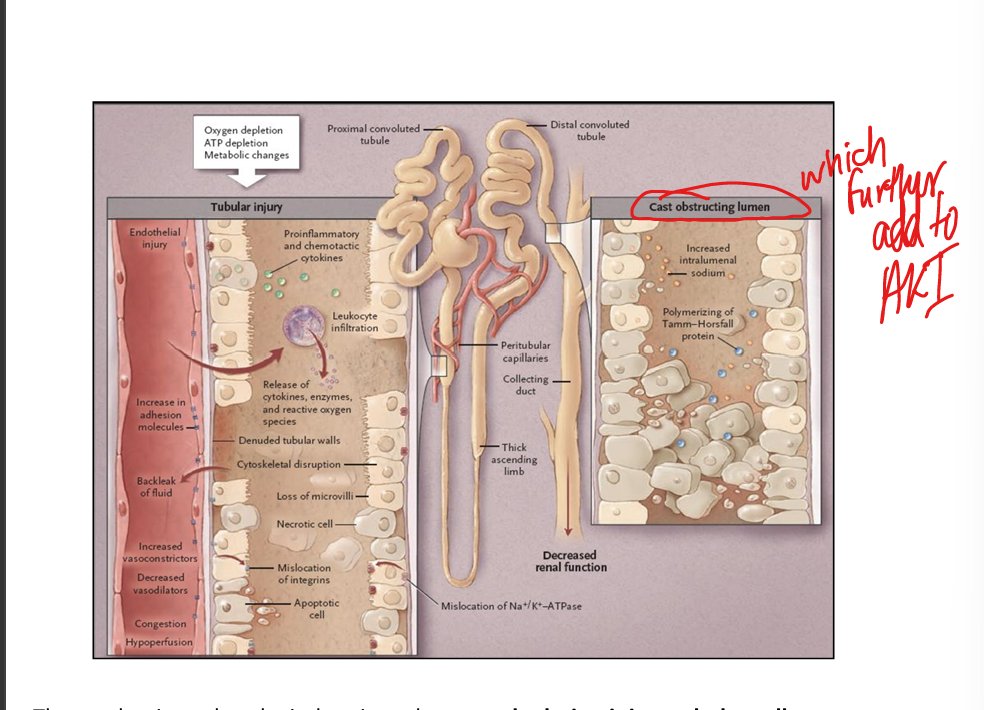
Intrinsic AKI pathophysiology

Direct injury to renal parenchyma (ATN, AIN, GN, vascular injury) → tubular necrosis, loss of polarity, back‑leak, casts, impaired concentrating ability.
knowt flashcard image


<p>Direct injury to renal parenchyma (ATN, AIN, GN, vascular injury) → tubular necrosis, loss of polarity, back‑leak, casts, impaired concentrating ability.</p><img src="https://assets.knowt.com/user-attachments/1ff021a1-c37b-41ef-a2b0-dfef76cd5efd.png" data-width="50%" data-align="center" alt="knowt flashcard image" style="display: block; width: 50%; margin-left: auto; margin-right: auto;"><p></p>
5
New cards

Postrenal AKI pathophysiology

Obstruction anywhere from renal pelvis to urethra → ↑ hydrostatic pressure proximal to obstruction → ↓ GFR

knowt flashcard imageknowt flashcard image


<p>Obstruction anywhere from renal pelvis to urethra → ↑ hydrostatic pressure proximal to obstruction → ↓ GFR</p><img src="https://assets.knowt.com/user-attachments/394470b0-7e39-40b8-83eb-ac5a49a8d85a.png" data-width="50%" data-align="center" alt="knowt flashcard image" style="display: block; width: 50%; margin-left: auto; margin-right: auto;"><img src="https://assets.knowt.com/user-attachments/34ed70cd-7a92-4468-806b-38924aab4dc6.png" data-width="50%" data-align="center" alt="knowt flashcard image" style="display: block; width: 50%; margin-left: auto; margin-right: auto;"><p></p>
6
New cards

Major causes of prerenal AKI

True volume depletion(DI, diarrhea, vomiting, blood loss), CHF/cirrhosis (low effective circulation), NSAIDs/ACEi/ARBs, renal artery stenosis, hypercalcemia, vasoconstrictive drugs.

knowt flashcard image


<p>True volume depletion(DI, diarrhea, vomiting, blood loss), CHF/cirrhosis (low effective circulation), NSAIDs/ACEi/ARBs, renal artery stenosis, hypercalcemia, vasoconstrictive drugs.</p><img src="https://assets.knowt.com/user-attachments/3328bad7-b227-4fd6-b894-7a8222e770f6.png" data-width="50%" data-align="center" alt="knowt flashcard image" style="display: block; width: 50%; margin-left: auto; margin-right: auto;"><p></p>
7
New cards

Major causes of intrinsic AKI

Acute Tubular Necrosis(ATN) (ischemic or toxic), Acute Interstitial Nephritis (AIN)(drug/infection/autoimmune), Glomerulonephritis (nephritic syndromes), vascular causes (TMA, atheroemboli).

knowt flashcard image


<p>Acute Tubular Necrosis(ATN) (ischemic or toxic), Acute Interstitial Nephritis (AIN)(drug/infection/autoimmune), Glomerulonephritis (nephritic syndromes), vascular causes (TMA, atheroemboli).</p><img src="https://assets.knowt.com/user-attachments/cd6705bc-8fff-4b29-8c1b-cc7a4f1e5ff1.png" data-width="50%" data-align="center" alt="knowt flashcard image" style="display: block; width: 50%; margin-left: auto; margin-right: auto;"><p></p>
8
New cards

Major causes of postrenal AKI

BPH, urethral stricture, stones, tumors, neurogenic bladder, papillary necrosis, retroperitoneal fibrosis.

knowt flashcard image


<p>BPH, urethral stricture, stones, tumors, neurogenic bladder, papillary necrosis, retroperitoneal fibrosis.</p><img src="https://assets.knowt.com/user-attachments/f3b2f770-ff8a-4fe1-820c-61219241d88b.png" data-width="50%" data-align="center" alt="knowt flashcard image" style="display: block; width: 50%; margin-left: auto; margin-right: auto;"><p></p>
9
New cards

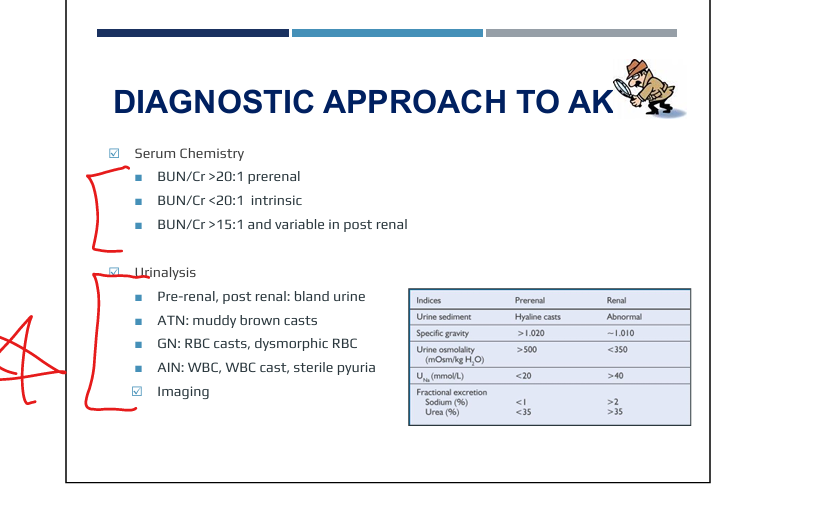
Diagnosis of prerenal AKI

BUN/Cr >20:1, FENa <1%, FEUrea <35% (if on diuretics), Una <20, Uosm >500, bland sediment.

knowt flashcard imageknowt flashcard image


<p><strong>BUN/Cr &gt;20:1</strong>, FENa &lt;1%, FEUrea &lt;35% (if on diuretics), <strong>Una &lt;20, Uosm &gt;500</strong>, bland sediment.</p><img src="https://assets.knowt.com/user-attachments/7c452de4-84d7-4fe3-a26f-1f9013c453c4.png" data-width="50%" data-align="center" alt="knowt flashcard image" style="display: block; width: 50%; margin-left: auto; margin-right: auto;"><img src="https://assets.knowt.com/user-attachments/c3d347e0-be81-4108-ab47-ff48f56a6465.png" data-width="50%" data-align="center" alt="knowt flashcard image" style="display: block; width: 50%; margin-left: auto; margin-right: auto;"><p></p>
10
New cards

Diagnosis of intrinsic AKI

BUN/Cr <20:1, FENa >2%, Una >40, Uosm <350, muddy brown casts (ATN), WBC casts (AIN), RBC casts (GN).

knowt flashcard image


<p><strong>BUN/Cr &lt;20:1,</strong> FENa &gt;2%, Una &gt;40, Uosm &lt;350, <strong>muddy brown casts (ATN)</strong>, WBC casts (AIN), RBC casts (GN).</p><img src="https://assets.knowt.com/user-attachments/faaaaf8c-f9b0-4d09-8dec-d3b6b14fc179.png" data-width="50%" data-align="center" alt="knowt flashcard image" style="display: block; width: 50%; margin-left: auto; margin-right: auto;"><p></p>
11
New cards

Diagnosis of postrenal AKI

BUN/Cr >15:1, FENa >2–4%, hematuria or crystals possible, imaging shows hydronephrosis or obstruction. TX: Relieve obstruction

knowt flashcard imageknowt flashcard image


<p>BUN/Cr &gt;15:1, FENa &gt;2–4%, hematuria or crystals possible, imaging shows hydronephrosis or obstruction. TX: Relieve obstruction</p><img src="https://assets.knowt.com/user-attachments/9a5f5f31-7b55-40ff-b712-59912cc13816.png" data-width="50%" data-align="center" alt="knowt flashcard image" style="display: block; width: 50%; margin-left: auto; margin-right: auto;"><img src="https://assets.knowt.com/user-attachments/d707df70-46eb-4188-9b3c-2c148b9d987d.png" data-width="50%" data-align="center" alt="knowt flashcard image" style="display: block; width: 50%; margin-left: auto; margin-right: auto;"><p></p>
12
New cards

Etiology of Acute Tubular Necrosis (ATN)

Ischemia (prolonged prerenal states, shock, surgery), endogenous toxins (myoglobin, hemoglobin, uric acid, light chains), exogenous toxins (contrast, aminoglycosides, amphotericin, heavy metals).

knowt flashcard imageknowt flashcard image


<p>Ischemia (prolonged prerenal states, shock, surgery), endogenous toxins (myoglobin, hemoglobin, uric acid, light chains), exogenous toxins (contrast, aminoglycosides, amphotericin, heavy metals).</p><img src="https://assets.knowt.com/user-attachments/d51b688c-a2ff-452a-acfb-7550a490901b.png" data-width="50%" data-align="center" alt="knowt flashcard image" style="display: block; width: 50%; margin-left: auto; margin-right: auto;"><img src="https://assets.knowt.com/user-attachments/a2f1de54-7fb0-488f-a596-52a1ac8c9022.png" data-width="50%" data-align="center" alt="knowt flashcard image" style="display: block; width: 50%; margin-left: auto; margin-right: auto;"><p></p>
13
New cards

What is AIN and Causes of Acute Interstitial Nephritis (AIN)

Inflammation and swelling of interstitial tissue where nephron sits→Causes: Allergic drug reaction (β‑lactams, sulfa, NSAIDs, PPIs), infections (pyelo, CMV, EBV), autoimmune (sarcoid, TINU).

knowt flashcard imageknowt flashcard image


<p>Inflammation and swelling of interstitial tissue where nephron sits→Causes: Allergic drug reaction (<strong>β‑lactams</strong>, sulfa,<strong> NSAIDs</strong>, PPIs), infections (pyelo, CMV, EBV), autoimmune (<strong>sarcoid</strong>, TINU).</p><img src="https://assets.knowt.com/user-attachments/102f6a25-9911-417b-aea9-627168f4049b.png" data-width="50%" data-align="center" alt="knowt flashcard image" style="display: block; width: 50%; margin-left: auto; margin-right: auto;"><img src="https://assets.knowt.com/user-attachments/2f1a4111-950c-4ce6-b54b-07b4ac6b068a.png" data-width="50%" data-align="center" alt="knowt flashcard image" style="display: block; width: 50%; margin-left: auto; margin-right: auto;"><p></p>
14
New cards

Treatment of prerenal AKI

Restore perfusion: isotonic fluids, blood products, pressors if needed

knowt flashcard image


<p>Restore perfusion: isotonic fluids, blood products, pressors if needed</p><img src="https://assets.knowt.com/user-attachments/f3f0034e-f7be-4030-a85f-3034f731dc8f.png" data-width="50%" data-align="center" alt="knowt flashcard image" style="display: block; width: 50%; margin-left: auto; margin-right: auto;"><p></p>
15
New cards

Treatment of intrinsic AKI

Supportive care: maintain SBP >100, correct electrolytes, treat acidosis, avoid nephrotoxins, adjust drug dosing, dialysis if needed.

knowt flashcard image


<p>Supportive care: maintain SBP &gt;100, correct electrolytes, treat acidosis, avoid nephrotoxins, adjust drug dosing, dialysis if needed.</p><img src="https://assets.knowt.com/user-attachments/348c9f3d-c3e6-4ead-8739-cb5e2c3a303d.png" data-width="50%" data-align="center" alt="knowt flashcard image" style="display: block; width: 50%; margin-left: auto; margin-right: auto;"><p></p>
16
New cards

Treatment of postrenal AKI

Relieve obstruction: Foley catheter, remove stones/clots, stents or nephrostomy for extrinsic compression.

knowt flashcard image


<p>Relieve obstruction: Foley catheter, remove stones/clots, stents or nephrostomy for extrinsic compression.</p><img src="https://assets.knowt.com/user-attachments/5b5dd2ff-8000-4011-9667-d61694c5573e.png" data-width="50%" data-align="center" alt="knowt flashcard image" style="display: block; width: 50%; margin-left: auto; margin-right: auto;"><p></p>
17
New cards

Indications for dialysis in AKI (AEIOU)

AEIOU: Acidosis (pH <7.2), Electrolytes (refractory hyperkalemia), Intoxications, Uremia (AMS/pericarditis), Overload (refractory).

knowt flashcard image


<p>AEIOU: Acidosis (pH &lt;7.2), Electrolytes (refractory hyperkalemia), Intoxications, Uremia (AMS/pericarditis), Overload (refractory).</p><img src="https://assets.knowt.com/user-attachments/a65233bb-5d6e-47fc-8624-38a1c0e03181.png" data-width="50%" data-align="center" alt="knowt flashcard image" style="display: block; width: 50%; margin-left: auto; margin-right: auto;"><p></p>
18
New cards

Acute Interstitial Nephritis (AIN) Clinical Triad

Rash, Fever, Eosinophilia

knowt flashcard image


<p>Rash, Fever, Eosinophilia</p><img src="https://assets.knowt.com/user-attachments/c464c458-82b2-47bc-b200-c0a9080190bc.png" data-width="50%" data-align="center" alt="knowt flashcard image" style="display: block; width: 50%; margin-left: auto; margin-right: auto;"><p></p>
19
New cards

Acute Interstitial Nephritis (AIN) Diagnosis + Tx

Increased white cells and white cell casts. Tx: Discontinue agent, corticosteroids

knowt flashcard imageknowt flashcard image


<p>Increased white cells and white cell casts. Tx: Discontinue agent, corticosteroids</p><img src="https://assets.knowt.com/user-attachments/19d3e6e3-2c63-43e2-82d1-5627143753b0.png" data-width="50%" data-align="center" alt="knowt flashcard image" style="display: block; width: 50%; margin-left: auto; margin-right: auto;"><img src="https://assets.knowt.com/user-attachments/2b473986-b89f-487e-9955-c1219803adab.png" data-width="50%" data-align="center" alt="knowt flashcard image" style="display: block; width: 50%; margin-left: auto; margin-right: auto;"><p></p>
20
New cards

Serum BUN/Cr >20:1 suggests AKI where

Prerenal AKI

knowt flashcard image


<p>Prerenal AKI</p><img src="https://assets.knowt.com/user-attachments/fd543af9-6c8f-4a39-aaf9-a8ef9924d362.png" data-width="50%" data-align="center" alt="knowt flashcard image" style="display: block; width: 50%; margin-left: auto; margin-right: auto;"><p></p>
21
New cards

Serum BUN/Cr <20:1 suggests AKI where

Intrinsic
knowt flashcard image


<p>Intrinsic</p><img src="https://assets.knowt.com/user-attachments/0587d99b-00b4-4f92-a363-47f6a4e8bfd1.png" data-width="50%" data-align="center" alt="knowt flashcard image" style="display: block; width: 50%; margin-left: auto; margin-right: auto;"><p></p>
22
New cards

Muddy Brown Casts think:

Acute Tubular Necrosis

knowt flashcard image


<p>Acute Tubular Necrosis<br></p><img src="https://assets.knowt.com/user-attachments/aff71cbc-4c47-444e-b0d4-c1f304a463c6.png" data-width="50%" data-align="center" alt="knowt flashcard image" style="display: block; width: 50%; margin-left: auto; margin-right: auto;"><p></p>
23
New cards

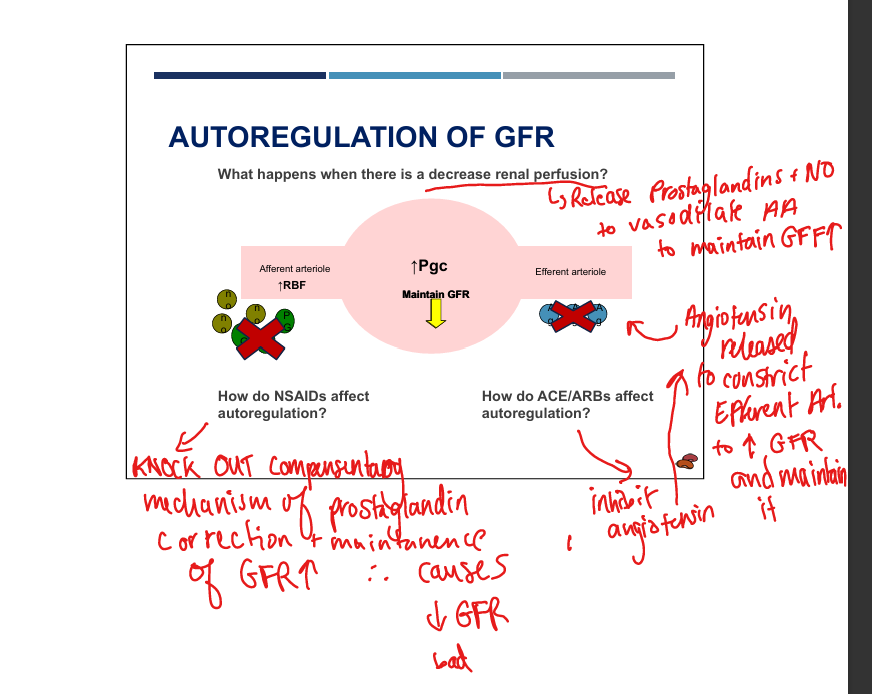
How do NSAIDs affect autoregulation of GFR with decreased renal perfusion?

They inhibit prostaglandins compensation/correction (normally vasodilating afferent arteriole and increasing GFR)→causes decreased GFR(worse kidney function)
knowt flashcard image


<p>They inhibit prostaglandins compensation/correction (normally vasodilating afferent arteriole and increasing GFR)→causes decreased GFR(worse kidney function)</p><img src="https://assets.knowt.com/user-attachments/95954c80-7ac7-43b5-8ea4-50b980dfd263.png" data-width="75%" data-align="center" alt="knowt flashcard image" style="display: block; width: 75%; margin-left: auto; margin-right: auto;"><p></p>
24
New cards

How do ACEi/ARB affect autoregulation of GFR when there is decreased renal perfusion?

Normally in decreased perfusion Angiotensin release will constrict efferent arteriole to increase GFR, BUT ACEi/ARBs inhibit this»cause efferent vasodilation and decreased GFR(worse kidney function in hypoperfusion)

knowt flashcard image


<p>Normally in decreased perfusion Angiotensin release will constrict efferent arteriole to increase GFR, BUT ACEi/ARBs inhibit this»cause efferent vasodilation and decreased GFR(worse kidney function in hypoperfusion)</p><img src="https://assets.knowt.com/user-attachments/89a2a4af-b281-4db7-bf8e-3aabcc42ed27.png" data-width="50%" data-align="center" alt="knowt flashcard image" style="display: block; width: 50%; margin-left: auto; margin-right: auto;"><p></p>
25
New cards

Acute Tubular Necrosis (ATN) Phases (pee related)

Initiation (peeing very little due to tubular damage and water retention)

Maintenance (pee a lot more as tubular epithelium regenerates)
Recovery (peeing normal and regenerated epithelium but cant reabsorb H20 and electrolytes)

knowt flashcard image


<p>Initiation (peeing very little due to tubular damage and water retention)</p><p>Maintenance (pee a lot more as tubular epithelium regenerates)<br>Recovery (peeing normal and regenerated epithelium but cant reabsorb H20 and electrolytes)</p><img src="https://assets.knowt.com/user-attachments/ceedfafd-bb56-4470-8b6c-3aa197bed7b8.png" data-width="50%" data-align="center" alt="knowt flashcard image" style="display: block; width: 50%; margin-left: auto; margin-right: auto;"><p></p>
26
New cards

Contrast Induced Nephropathy (cause, timing, tx)

Type of ATN caused by constrast induced renal artery constriction and direct tubular injury; AKI is apparent within first 24-48hrs after contrast

Tx: Prevention is key, use fluids before, during and after to volume expand

knowt flashcard imageknowt flashcard imageknowt flashcard image


<p>Type of ATN caused by constrast induced renal artery constriction and direct tubular injury; AKI is apparent within<strong> first 24-48hrs</strong> after contrast</p><p>Tx: Prevention is key, use fluids before, during and after to volume expand</p><img src="https://assets.knowt.com/user-attachments/3717a883-0dd3-45b0-942e-0c2be8f7e3e4.png" data-width="50%" data-align="center" alt="knowt flashcard image" style="display: block; width: 50%; margin-left: auto; margin-right: auto;"><img src="https://assets.knowt.com/user-attachments/883cd143-76de-4482-8a9a-628d1d234f56.png" data-width="50%" data-align="center" alt="knowt flashcard image" style="display: block; width: 50%; margin-left: auto; margin-right: auto;"><img src="https://assets.knowt.com/user-attachments/4e139069-3f2e-4cc3-a359-79bbc84128b9.png" data-width="50%" data-align="center" alt="knowt flashcard image" style="display: block; width: 50%; margin-left: auto; margin-right: auto;"><p></p>
27
New cards

Pigment Induced Acute Tubular Necrosis (cause, labs)

Caused by Rhabdomyolysis (seen with trauma or statins)→ muscle breakdown increases Cr, heme (+) in urine with NO RBCs, hyperkalemia/hyperphosphatemia/hyperuricemia

knowt flashcard image


<p>Caused by Rhabdomyolysis (seen with trauma or statins)→ muscle breakdown increases Cr, heme (+) in urine with NO RBCs, hyperkalemia/hyperphosphatemia/hyperuricemia</p><img src="https://assets.knowt.com/user-attachments/48223670-566e-45ad-89d4-39c32d5e53f1.png" data-width="50%" data-align="center" alt="knowt flashcard image" style="display: block; width: 50%; margin-left: auto; margin-right: auto;"><p></p>
28
New cards

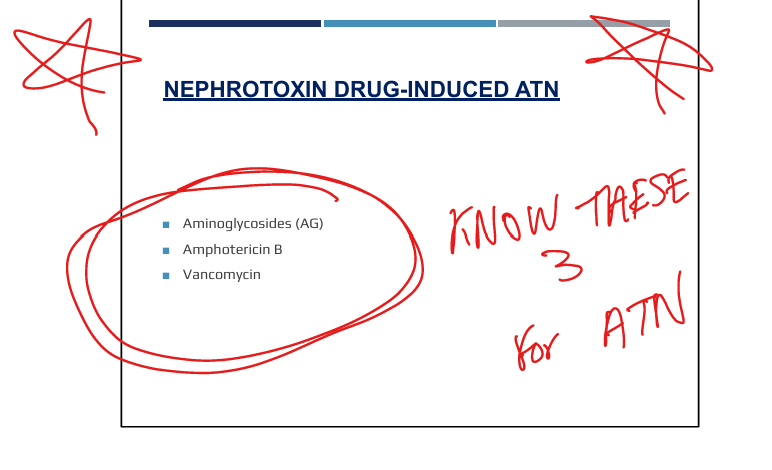
Nephrotoxin Drug Induced Acute Tubular Necrosis DRUGS (3)

Aminoglycosides, Amphotericin B, Vancomycin
knowt flashcard image


<p>Aminoglycosides, Amphotericin B, Vancomycin</p><img src="https://assets.knowt.com/user-attachments/fb22f196-4f51-4f8a-8dcd-3407e65dd325.png" data-width="50%" data-align="center" alt="knowt flashcard image" style="display: block; width: 50%; margin-left: auto; margin-right: auto;"><p></p>
29
New cards

Mechanism of Aminoglycosides causing ATN

Accumulates in lysosomes of nephrons and taken up in PTĀ» and interferes with normal cell function→cell death

knowt flashcard image


<p>Accumulates in lysosomes of nephrons and taken up in PTĀ» and interferes with normal cell function→cell death</p><img src="https://assets.knowt.com/user-attachments/2220d263-3808-44f0-9e00-100e20d31a87.png" data-width="50%" data-align="center" alt="knowt flashcard image" style="display: block; width: 50%; margin-left: auto; margin-right: auto;"><p></p>
30
New cards

Mechanism of Amphotericin B Drug Induced ATN

It directly binds to tubular epithelial cells and punches holes into the proximal tubule»causes Na, K, Mg wasting

knowt flashcard image


<p>It directly binds to tubular epithelial cells and punches holes into the proximal tubule»causes Na, K, Mg wasting </p><img src="https://assets.knowt.com/user-attachments/1ea6e14e-25cf-4411-8c85-0bb5c5a25be6.png" data-width="50%" data-align="center" alt="knowt flashcard image" style="display: block; width: 50%; margin-left: auto; margin-right: auto;"><p></p>



