Ontogeny of Cognition
 Call Kai
 Learn
 Practice Test
 Spaced Repetition
 Match
 Flashcards
 Knowt Play
1/21

There's no tags or description
Looks like no tags are added yet.
22 Terms
Ontogeny
Development of a living being from the time the egg is fertilized until death
Ontogeny of behaviour
How behaviour changes throughout an individual’s lifetime, from conception to death
Tinbergen’s Four Questions
Mechanism / Causation
How does this behaviour occur in an animal?
Ontogeny / Development
How does this behaviour arise in an animal?
Adaptive Value / Function
Why is this behaviour adaptive for the species?
Phylogeny / Evolution
How does this behaviour arise in the species?
Why is it important to study the ontogeny of behaviours?
Teaches us how an individual’s behaviour is shaped by genetic inheritance and the environment
Informs us of the underlying mechanism and its evolutionary origin
Give examples of behaviours that may not be fixed in an animal
E.g. bird singing
not hardwired
have some programming for a “subsong” and practices it as it hears conspecifics sing
after a certain time period, the song crystallizes and becomes permanent (cannot be changed)
learning happens through a sensory phase
practicing and refining of the song happens through a sensorimotor phase
E.g. tool use
E.g. migration route
Ontogeny of cognition
Development of an animal’s cognitive abilities throughout its life
We don’t know much about the ontogeny of cognition in animals (more studies have been done on humans)
Questions regarding the ontogeny of cognition that researchers are trying to answer. Answer them!
How does a specific cognitive ability change with age within an individual’s lifetime?
Maturation of the brain throughout the earlier periods of an animal’s life leads to altered behaviours and cognition
Allows for more complex decision-making
At what critical periods during development must certain experiences occur for a cognitive function to emerge or develop typically?
Is the development of different cognitive skills linked, or do they develop independently?
How do the developmental trajectories of cognitive abilities compare across different species, and what do these comparisons reveal about the evolution of cognition?
Fun facts about brain maturation
Leads to altered behaviours and cognition
Allows for more complex decision-making and an increase in cognitive control over behaviour
Early life is sensitive to social learning, mediated by brain mechanisms, orchestrated by hormones and biological rhythms
Enrichment of the environment affects dendrite proliferation and cognition in rats
What does tool use tell us about cognition?
By studying how tool use develops over an individual’s lifetime, we can separate innate instincts from true cognition
If it arises gradually through practice and social learning, it reveals cognitive mechanisms
E.g. woodpecker finches use cactus spines to get bugs without needing any social demonstration
innate behaviour, does not require any high cognitive function
mainly controlled by genetics
E.g. tufted capuchin monkeys use rocks to crack nuts
takes 2.5 years to learn (needs the brain to develop), make systematic errors and combine separate actions and need a lot of social input before they learn
Sensory feedback vs hardwired brain
Early cognition relies on immediate sensory-motor feedback and associate learning, such as classical and operant conditioning.
As executive brain networks (e.g. prefrontal cortex in mammals and nidopallium in birds) mature, organisms gain inhibitory control, working memory, and the capacity for abstract reasoning, future planning, and rule-switching.
Woodpecker finches bypass heavy executive processing because their tool-use is hardwired from the start, whereas capuchins take 2.5 years to crack nuts because their brains must mature enough to inhibit random object banging and plan a multi-step sequence.
How does social interaction drive cognitive development?
Cognitive growth is deeply embedded in social contexts.
Young individuals accelerate their learning by observing caregivers and peers through [ below ] rather than relying on individual trial-and-error
social referencing
imitation
shared attention
In chimpanzees, infants whose mothers spend more time ant-dipping learn the skill earlier and make fewer errors
Cognitive development of birds
Precocial birds
e.g. ducks, chickens, and shorebirds
hatch with advanced physical and neural maturity
rely on immediate sensory-motor feedback and associative learning for rapid spatial orientation, predator avoidance, and filial imprinting within hours of hatching
Altricial birds
e.g. songbirds, parrots, and corvids
hatch blind and dependent
undergo prolonged post-hatch brain development that support mature executive network capable of inhibitory control, tool use, future planning, and rule-switching
Discuss stork migration and how cognition is involved
Migration in itself is not a cognitive skill; in storks it is a mix of things
Birds have an innate hard-wired genetic program that provides general direction, timing, and distance for their first migration
use cues like the earth’s magnetic field, the sun, and stars
As they mature, they learn and refine their routes and destinations through experience, recognizing landmarks etc.
Older individuals stop exploring as much and instead move more efficiently
How much they learned while young determines the final route when older
Start migrating at a young age (8 weeks after hatching) and can afford to explore a lot in the first years of life before they start breeding at 3-4 years of age
no longer has the time/energy to explore
Pros of studying cognitive development in dogs
Allow us to look at the correlation between various phenotypic traits (brain size and composition) and variation in longevity without having to deal with phylogeny.
Describe the cognitive development in dogs (and humas)
Processes increase in early life
Peak in midlife
Decrease in late life

Is the ontogeny of cognition the same for dog breeds with different lifespan?
2 hypotheses
Truncation hypothesis
Large and small breeds follow the same cognitive aging trajectory
Larger breeds die before reaching the cognitive decline associated with old age
Compression hypothesis
Cognitive aging scales with lifespan
Larger shorter-lived dog breeds experience an accelerated rate of cognitive development and decline
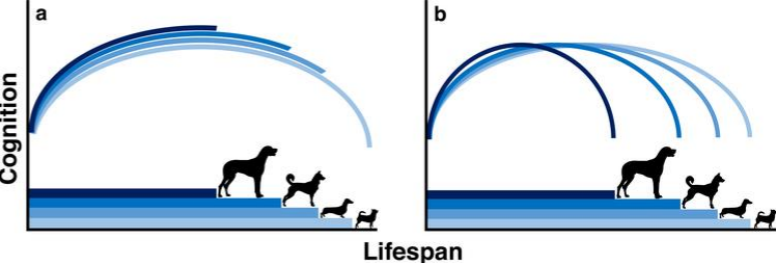
Can study this via cross-sectional research or longitudinal research
In a cross-section study they found that the truncation hypothesis model fit slightly better to the data collected
However, research has found that dementia across breeds is similar
Some researchers suggest large breeds physiologically deteriorate rapidly
Together, these results may suggest that the pathways which influence cognitive aging may be partially decoupled from those which affect the pace of physiological aging.
Examples of critical and sensitive periods regarding cognition
E.g. filial imprinting in geese (within first 24-48 hours)
E.g. songbirds, if they are deprived of the opportunity to hear a tutor song during this specific developmental state phase, it will not be able to develop a normal song later in life
E.g. visual systems in cats, kittens need visual input once they open their eyes in order for their visual cortex to develop normally
similar for chick lateralization (prenatal light exposure)
E.g. touch processing in mice, normal whisker stimulation is required within the first few days after birth for the healthy development of touch processing in the brain
E.g. social interactions in dogs (and humans) to wire social brain networks
Social cognition
Process of understanding and interpreting social information about other individual and social situations.
developed independently from physical cognition
suggests genetical independency
Physical cognition
Processes involved in understanding and interacting with the physical world, e.g. motor skills, sensory processing, spatial abilities
developed independently from social cognition
suggests genetical independency
How does brain plasticity vary with age?
Highest in childhood and adolescence
Gradually decreases over age, but is still possible throughout life (e.g. learning)
Research shows that exposure to young blood seems to counteract and reverse pre-existing effects of brain aging in mice (at molecular, structural, functional, and cognitive levels)
cognitive decline and loss of neural plasticity is not necessarily irreversible
Piaget’s Sensorimotor Stages: Humans vs Great Apes
Go through Piaget’s six sensorimotor stages in the same order, although at different speeds
Apes progress more slowly in the later stages, taking 5-8 years to finish the period compared to 2 years for human infants
Suggests a shared evolutionary past, where humans inherited fundamental cognitive abilities from a common ancestor
The differences indicate that human cognitive evolution involved a distinct trajectory
leading to uniquely human traits like language, complex social reasoning etc
Ontogeny of object permanence
Both jackdaws and humans master stage 6 object permanence at 11-15% of the way to sexual maturity
develop at the (relative) same time in their lifetimes despite not being related cognitionally
Complex cognitive abilities can evolve independently in species with different brain structures (e.g. birds don’t have a prefrontal cortex)
Similarities show that the Piagetian framework could be a valuable tool for cross-species comparisons
helps researchers understand how different evolutionary pathways can lead to parallel cognitive abilities