Bio Midterm 1
 Call Kai
 Learn
 Practice Test
 Spaced Repetition
 Match
 Flashcards
 Knowt Play
1/93

There's no tags or description
Looks like no tags are added yet.
94 Terms
Systems
the network of interactions required for life
Evolution
accounts for the unity and diversity of life
What is the correct order of biological organization from smallest to largest
organelles, organisms, populations, communities, biosphere
Your sister claims the shape of your nose resembles your great aunt’s nose. Which biological theme does this demonstrate?
Information Flow
Evolution
Diversity of life evolved over time by processes, like natural selection
Structure and Function
Basic units of structure define the functions of all living things
Information Flow, Exchange, and Storage
Growth and behavior of organisms are activated through the expression of genetic information
Energy and Matter
Biological systems grow and change via processes that are based on chemical transformation pathways that are governed by the laws of thermodynamics
Systems
Living systems are interconnected and interacting.
Chemistry of Life
study of the chemical building blocks, structures, and reactions that make and sustain living organisms
Cells
smallest, basic unit of life that can live on its own and makes up all living organisms and tissues
Metabolism
the sum of all chemical reactions in the cells of living organisms that convert food into energy and building blocks to sustain life
Cellular Respiration
process that cells use to break down food (like glucose) and oxygen to produce usable chemical energy in the form of ATP (adenosine triphosphate), releasing carbon dioxide and water as waste product
Photosynthesis
process by which plants, algae, and some bacteria use sunlight to make their own food
DNA structure and Replication
the molecule that holds the genetic instructions for all living things
Transcription and Translation
two main steps cells use to turn the instructions in DNA into working proteins
Regulating Gene Expression
cell uses to control when a gene is turned "on" or "off", how much of its product (RNA or protein) is made, and where inside the organism it happens
Mutation and DNA Repair
permanent change or "mistake" in the sequence of DNA (the genetic code) of a living organism
Cell Reproduction
biological process by which a single parent cell divides to create two or more new cells (daughter cells)
Genetics
branch of biology that studies genes, heredity, and how traits are passed down from parents to their children
Gene Technology and Genomics
the lab practice of directly changing, removing, or adding genes in an organism's DNA to change its traits
Neutral Oxygen has a total of 8 electrons and can form a maximum of_________ bonds with other elements.
2
Which of the following is likely to be a polar bond?
C-O
When electrons are shared in a bond, this is a(n)
covalent bond
Which of the following sets are LEAST likely to be attracted to each other?
two nonpolar molecules
Which of the following is NOT true about hydrogen bonding?
They are very strong true bonds that involve two or more metals
The subatomic particle most important for bonding is the
electron
Which of the following are properties of water that make it important for life?
It has a neutral pH, It is a good solvent, its polar
Many atoms are most stable when they have ___ electrons in their outermost shell.
8
Monomer contains the following components: a phosphate group, 5-carbon sugar, and a nitrogen containing base. Joining together multiple of these monomers into a polymer results in which of the following
a nucleic acid
which statement about carbon is/are correct
carbon can form 4 bonds, C-C bonds are nonpolar, C-H bonds are nonpolar bonds
which molecule or structure may be found in eukaryotic cells but not in bacteria
nucleus
what feature of carbon is important for producing a diverse of organic molecules
carbon can be formed from both polar and non polar covalent bonds with various elements
what is not one of the four stages that led to the orgin of the first living cell
formation of organelles
Which of the following best describes how amino acids are joined to form a polypeptide?
The monomers of proteins are amino acids, and these are linked by polar covalent bonds commonly referred to as peptide bonds.
cell theory states that
cells are the smallest unit of life, new cells come pre existing cells by cell division, all living things are composed of cells
what are lipid molecules that are important in living organisms
phospholipids, fats
a dehydration reaction
used to form polymers
Which of the elements below is most abundant in living organisms?
Hydrogen
Element
a pure substance that contains only
one kind of atom
Nitrogen (N) has 7 electrons, 5 in its outermost shell, and can form a maximum of_________ bonds with other elements.
3
Bond
form from sharing or transferring electrons
Molecule
two or more atoms held together by a chemical bond.
Compound
two or more different elements held together by chemical bonds, has different properties from elements alone
Ionic bonds involve ______________; covalent bonds involve _____________.
transferring electrons; sharing electrons
In a non polar covalent bond
Electrons are shared equally between two atoms.
Hydrogen “bonds”
hydrogen atom that is bound to a very electronegative atom (O, F, Cl, Br) and an electronegative atom on a different molecule
Water molecules are formed from ________ bonds, meaning the elements share electrons unequally.
polar covalent
Which of the following is not a macromolecule?
Monosaccharide
Which of the following is not a monomer?
Cellulose
Polymers formed
via dehydration synthesis reactions
Polymers disassemble
via hydrolysis reactions
Nucleic Acids
encode and transmit genetic information
Monomer is
a nucleotide
Polymer is
RNA or DNA
The element below that is part of all proteins and nucleic acids is
Nitrogen
Which of the following is the smallest unit
Cell
Origin of Life on Earth
1. Simple organic molecules formed
2. Polymers formed
3. Enclose polymers
4. Cellular functions arise
Prokaryotic Cells are
Bacteria and Archaea
Eukaryotic Cells
Animals, Plants, Fungi, Protists
Which of the following molecules or structures may be found in eukaryotic cells but not in bacteria?
Endoplasmic reticulum
Which of the following is present in a prokaryotic cell?
Ribosome
Fluid (semi) - lipids
can move laterally and flip-flop, are fatty acid length and
saturation and have amount of cholesterol
Mosaic - proteins
Integral (Transmembrane and Lipid-anchored) , Peripheral
Diffusion
molecules to spread out, move down concentration gradient (from high to low)
Osmosis
Movement of water from areas of high concentration (of water molecules) to low concentration (of water molecules)
Animal cells live
in isotonic solutions
Plant cells live
in hypotonic solutions
Simple diffusion (Passive transport)
Direct movement across membrane, Down concentration gradient
Facilitated diffusion (Passive transport)
Transport proteins required, Down concentration gradient, Used for hydrophilic molecules (polar, ions, etc
Active transport
Transport proteins required, Against concentration gradient, requires ATP
Bulk transport (exocytosis, endocytosis)
Packaging vesicles required Requires ATP Used for large molecules (proteins, polysaccharides)
Metabolism
all chemical reactions required to maintain life of an organism
Anabolic (type of metabolism)
building molecules, requires energy
Catabolic (type of metabolism)
breaking down molecules, produces energy
Cellular Respiration
(not question) cellular respiration
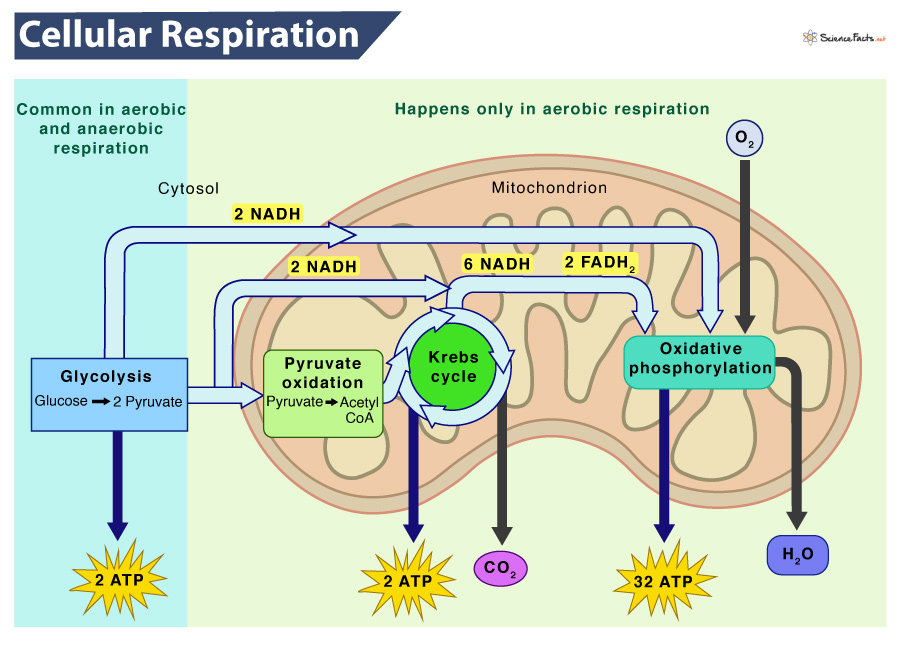
Cellular Respiration steps
Glycolysis—catabolize glucose to 2 pyruvate, Breakdown of Pyruvate—pyruvate to Acetyl CoA, Citric Acid Cycle—Acetyl CoA to CO2, Oxidative Phosphorylation—e- transport chain takes e- from shuttles (NADH & FADH2)
1 Glycolysis Steps
glucose is metabolized to two pyruvate molecules (with three carbons each), producing a net energy of two ATP molecules and two NADH molecules (eukaryotis happen in the cytosol)
2 Breakdown of pyruvate to release an acetyl group. Steps
in eukaryotes, the two pyruvate molecules enter the mitochondrial matrix. Each one is broken down to an acetyl group (with two carbons each) and one CO molecule by an enzyme complex called pyruvate dehydrogenase. For each pyruvate broken down via oxidation, two high-energy electrons are removed from pyruvate and transferred to NAD, together with H, to produce a molecule of NADH
Oxidation
systematic removal of electrons or loss of electrons
Reduction
addition of electrons (reduces overall charge)
Which of the following statements describes the results of this reaction?
C6H12O6 + 6O2 6CO2 + 6H2O + energy
C6H12O6 is oxidized and O2 is reduced
Where is glycolysis happening?
Cytosol
What are the net products of glycolysis?
2 ATP, 2 NADH, 2 pyruvate
When a molecule of NAD+ (nicotinamide adenine dinucleotide) gains a hydrogen atom (NADH) the molecule becomes
reduced
Overview of Cellular Respiration
1) Glycolysis—breakdown glucose to 2 pyruvate Form: NADH, ATP Location: Cytosol of the cell
2) Breakdown of pyruvate to acetyl CoA Form: NADH Location: Mitochondrial Matrix
3) Citric Acid Cycle—acetyl CoA to CO2 Form: NADH, ATP, FADH2 Location: Mitochondrial Matrix
4) Oxidative Phosphorylation—e- transport chain takes e- from shuttles (NADH & FADH2) Form: e- + H+ + O2 H2O, lots of ATP location: Inner membrane of mitochondria
What does the citric acid cycle mean?
Oxidative Phosphorylation
Electron transport chain, and Chemiosmosis,
The final electron acceptor of the electron transport chain that functions in aerobic oxidative phosphorylation is
O2
The immediate energy source that drives ATP synthesis by the ATP synthase during oxidative phosphorylation is the
H+ (proton) concentration gradient across the membrane where the ATP synthase is located
Photosynthesis
picture (photosynthesis)
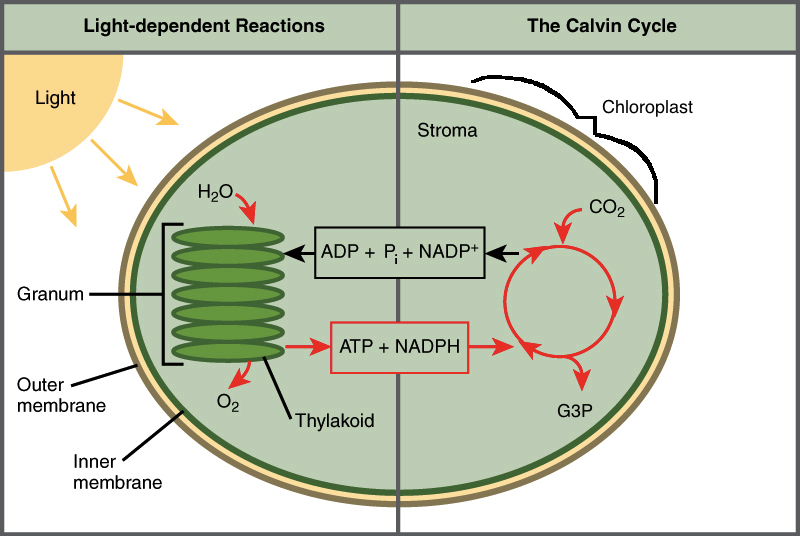
Which process is most directly driven by light energy in photosynthesis
Removal of electrons from chlorophyll molecules
Which structures in the thylakoid membrane absorb light energy
both photosystem I and photosystem II
Which of the following molecules are products of the light reactions of photosynthesis and are used in the catabolic reactions of the Calvin cycle?
ATP, NADPH