APGOV Unit p 1 test- Legislative Branch
 Call Kai
 Learn
 Practice Test
 Spaced Repetition
 Match
 Flashcards
 Knowt Play
1/46

There's no tags or description
Looks like no tags are added yet.
47 Terms
What was the structure of congress for the British gov?
Bicameral
Upper House- House of Lords
Lower House- House of Commons
What was the structure of congress under the AoC?
Unicameral
1 vote per state
Connecticut (Great) Compromise
compromise between NJ (small states) and VA (large states) plans
result: Bicameral legislature
- 1 house had reps based on pop
- 1 house had 2 reps per state
What is the structure of congress today?
Bicameral
- Upper house- Senate
- Lower house- House
each house can check the other
Original role of Senate
"saucer"
representing the educated and wealthy, more elite
less rules and regulations
less people, more civil
more significant powers
Original role of House
"teacup"
representing the common man, more direct
more rules and regulations
more people, more wild
less significant powers
Powers of the House
- impeach gov officials
- initiate taxes/revenue bills
- break electoral college tie (only happened in election of 1800)
Powers of the Senate
- advice and consent aka senatorial courtesy
- ratifies international treaties
- acts as jury for impeached officials
- selects VP if none wins in Electoral college (never happened)
Representation in the House
435 members
allotted based on pop (census)
each state guaranteed 1 rep
Members of the House
min age: 25
term length: 2 years
term limits: none
must live in district you represent
citizen for at least 7 years
every 2 years, every seat is up for election
gerrymandering
relates to House
exploiting shape of districts
used to be racial, now mostly just partisan
Representation in the Senate
100 members
2 reps per state
filibustering
occurs in Senate
*defense: Cloture Rule- requires 60/100 to shut them up
Members of the Senate
min age: 30
term length: 6 years
term limits: none
"continuous body"- every 2 years, 1/3 seats are up for election
3 models of leadership
delegate/representative
trustee/attitudinal
partisan/organizational
logrolling/reciprocity
exchanging votes/support for mutual benefit
How can reps/senators take the pulse of their constituents?
polls, town halls, letters/calls, protests, focus groups
pendulum of power for the House
strong members-----strong speaker
pendulum of power for the national gov in general
strong congress-----strong president
(often, congress is emboldened/stronger when the pres is the opposite party)
(often, pres is emboldened/stronger in crises or when congress is same party as them)
Powers of Congress in general
"power of the purse"
congressional oversight
foreign affairs and military
Power of the purse
Congress' power to control gov spending
-decide where to appropriate $
-regulate interstate commerce
-controls salary for gov officials
27th Amendment
limits the power of Congress to increase their own salaries
enacts pay raise for the next congress
2 types of gov spending
mandatory (social security, etc.)
discretionary (at congress' discretion)
powers of congress regarding foreign affairs and military
- declare war
- raise an army
- military funds
- appoint some military positions
leadership in the House

leadership in the Senate
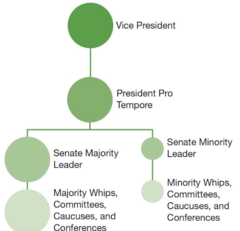
caucus (congressional)
organized around a race, special interest, etc.
some cross party lines, some go between houses
What is the purpose of congressional committees?
allow expertise, specialization, divide and conquer
congressional oversight- oversee exec branch
types of committees
standing
joint
select/special
conference
standing committee
permanent
focused on a particular subject
chaired by senior member of majority party
joint committee
permanent
includes members of House and Senate
select/special committee
temporary
particular subject- often investigating scandal
conference committee
temporary
particular bill- iron out differences between similar bills between houses
Who can write a bill?
anyone
Bills can be referred to multiple committees
multiple referral- simultaneous
sequential referral- one committee works on bill, then passes it to another
Riders and Christmas tree bills
riders are smaller add-ons to bills with little to no connection to the main bill
What committees are most desirable?
-ones with most power
-ones with most funding
-ones with a relevant topic
pork/earmarks
legislation that allows representatives to bring home money to their constituents, popular for reelection
Shaw v. Reno (1993) - Facts
North Carolina created a bizarrely shaped congressional district to increase Black representation after the 1990 Census. White voters claimed it was racial gerrymandering and violated the 14th Amendment Equal Protection Clause.
Shaw v. Reno (1993) - Issue
Can race be the predominant factor in drawing congressional districts?
Shaw v. Reno (1993) - Holding
Yes, the district was unconstitutional because it used race as the dominant factor without a compelling justification.
Shaw v. Reno (1993) - Significance
Established race cannot be the primary factor in redistricting. Important for understanding racial gerrymandering and how the Equal Protection Clause applies to district drawing.
Baker v. Carr (1962) - Facts
Tennessee had not redrawn its legislative districts since 1901, despite major population shifts. Urban areas were underrepresented, rural areas overrepresented. Citizens argued this violated the 14th Amendment Equal Protection Clause.
Baker v. Carr (1962) - Issue
Can federal courts rule on legislative apportionment?
Baker v. Carr (1962) - Holding
Yes, redistricting is justiciable, meaning courts can review it.
Baker v. Carr (1962) - Significance
Established the "one person, one vote" principle. Allowed federal courts to intervene in state apportionment cases. Paved the way for fairer representation in state legislatures.
Reapportionment vs Redistricting
Reapportionment = redistribution of seats in the House of Representatives based on population changes after the census. It's a federal responsibility.
Redistricting = drawing the new boundaries of congressional districts within a state after reapportionment. It's a state responsibility.