controlling microbial growth
 Call Kai
 Learn
 Practice Test
 Spaced Repetition
 Match
 Flashcards
 Knowt Play
1/46

There's no tags or description
Looks like no tags are added yet.
47 Terms
Terminology
Sterilization: Removal of all microbial life
Commercial Sterilization: Killing C. botulinum endospores
Aiming at killing C botulinum in our canned products
C botulinum makes botox, if it hits nerves wrongs gives paralysis, if it gets in guts food poising
Disinfection: Removal of pathogens
Removing infectious agent
Antisepsis: Removal of pathogens from living tissue
Taking out infection in living tissue
Degerming: Removal of microbes from a limited area
Removing things from a small area
Sanitization: Lower microbial counts on eating utensils
Biocide/Germicide: Kills microbes
Cidal = killing
Bacteriostasis: Inhibiting, not killing, microbes
stasis= only inhibiting not killing
What is the Removal of all microbial life
sterilization
What is Killing C. botulinum endospores
Aiming at killing C botulinum in our canned products
C botulinum makes botox, if it hits nerves wrongs gives paralysis, if it gets in guts food poising
Commercial Sterilization
What is the removal of pathogens
Removing infectious agent
disinfection
What is Removal of pathogens from living tissue
antisepsis
What is Removal of microbes from a limited area
dergerming
What is Lower microbial counts on eating utensils
sanitization
What kills microbes
Biocide/Germicide
cidal= killing
What is Inhibiting, not killing, microbes
Bacteriostasis
stasis= only inhibitiing not killing
Bacterial populations die at what rate of growth
constant logarithmic rate
Effecitveness of antimicrobial treatments depends on:
Number of micorbes
Environment (organic matter, temp, concnetration, biofilms)
Time of exposure
Microbial characteristics (e.g. glycocalyx, cell wall, resistance)
Physical methods of microbial control:
Heat: autoclaving
Moist heat denautres proteins
Autoclave: steam under pressure
15 min at 121o C at 15 psi
Moist heat does what
denatures proteins
What is steam under pressure?
autoclave
What temp is the autoclave set at and how long does it go for?
15 min at 121o C at 15 psi
15 psi (per square inch) raises up the temp by pressure
Pasteurization:
60oC for 30 minutes
72oC for 15 seconds
140oC for 4 seconds
Pasteurization reduces spoilage organisms and pathogensex: milk, beer
What does pasteurization do?
reduces spoilage organisms and pathogens
Physical methods of microbial control:
Dry heat sterlizartion by oxidation
Flaming
Incineration
Hot-air sterilzation
Equal treatments
Hot-air
170o C, 2 hr
Autoclave
121o C, 15 min
Physical methods of microbial control:
filtration, low temp, high pressure, dessication, osmotic pressure
Filtration removes microbes by trapping them in filter
Low temperature inhibits microbial growth
Refrigeration
Deep freezing (-20o c or -80o c)
Lypophilization
High pressure denatures proteins
Desiccation prevents metabolism
osmotic pressure causes plasmolysis (shrinkage of cytoplasm)
Physical methods of microbial control:
Filtration does what
removes microbes by trapping them in filter
Physical methods of microbial control:
Low temperature does what
inhibits microbial growth
Refrigeration
Deep freezing (-20o c or -80o c)
Lypophilization
Physical methods of microbial control:
High pressure does what
denatures proteins
Physical methods of microbial control:
Dessication does what
prevents metabolism
Physical methods of microbial control:
Osmotic pressure does what
causes plasmolysis (shrinkage of cytoplasm)
Physical methods of microbial control:
Radiation damages DNA
Ionizing radiation (x rays, gamma rays, electron beams)
Nonionizing radiation (UV)
Microvaes kill by heat; not especially antimicrobial)
Chemical methods of microbial control:
Principles of effective disinfection
Concentration of disinfectant
Organic matter
pH
Time
Chemical methods of microbial control:
Evaluating a disinfectant
Use-dilution test
Metal rings dipped in test bacteria are dried
Dried cultures placed in diluted disinfectant (according to manufacturers instructions) for min at 20 c
Rings transferred to culture media to determine whether bacteria survived treatment
Chemical methods of microbial control:
Evaluating a disinfectant
Disk-diffusion method
Particular species are evaluated in each test
Zone of inhibition must be at or beyond a certain diameter
Chemical methods of microbial control:
Phelolics:
disruption of the plasma membrane
lysol , amphyl
o-phenylphenol
Listerine
Thymol
Pinesol
Turpineol
dial soap
Chemical methods of microbial control:
Halogens
Tincture of iodine (I2)
Iodine denatures proteins by breaking disulfide bonds
Betadine
Povidone iodines (linked to organic molecule) as in Betadine; denatures proteins by breaking disulfide bonds
Sodium hypochlorite (NaOCl)
Is a strong oxidizing agent
Bromine tablets
Used in hot tubs, pools kills by oxidation
Chlorine gas
used in swim pools -oxidizing agent.
Bromine and chlorine products are strong oxidizers
Halogen:
What does iodine do?
denatures proteins by breaking disulfide bonds
Halogen:
What does betadine do?
Povidone iodines (linked to organic molecule) as in Betadine; denatures proteins by breaking disulfide bonds
Halogen:
What does sodium hypochlorite (NaOCl) do?
a strong oxidizing agent
Halogen:
What do bromine tablets do?
Used in hot tubs, pools kills by oxidation
Halogen:
What does chlorine gas do?
used in swim pools -oxidizing agent.
Halogen:
Bromine and chlorine products are strong..
oxidizers
Types of disinfectants: alcohol
Alcohols. Ethanol isopropanol
Denatures proteins, dissolves lipids
What does alcohol do to proteins and lipids
Denatures proteins, dissolves lipids
Heavy metals: denature proteuns by breaking disulfide bonds
Mercurachrome antiseptic: for wounds
Copper sulfate (CuSO4): algicide
Zinc chloride (ZnCl2): mouthwashes
Silver nitrate (AgNO3): antiseptic for eyes, wounds
Types of disinfectants: Surface active agents
Surface-active agents or surfactants (soaps and detergents)
Soap: acid-anionic detergents
Degerming: sanitizing
Quaternary ammonium compounds (quats):
Disruption of plasma membrane, denaturation of proteins
Benzalkonium chloride (aka Zephiran)
Roccal: lab disinfectant
cationic detergents
Cetylpyridinium chloride (Cepacol)
Types of disinfectants: aldehydes
Inactive proteins by cross-linkin with functional groups (–NH2, –OH, –COOH, —SH)
– Glutaraldehyde, formaldehydeDisinfection of hospital equipment, especially in respiratory therapy, for kidney dialysis machines, endoscopes
Alkali and acids
NaOH (sodium hydroxide) in some floor cleaners
NH4OH in ammonia, esp good at breaking down lipids
Benzoic acids in mouthwashes; benzoic acid, sobic acid, citric acid, and ascorbic acid, in food products
Gaseous sterilants:
Denature proteins
Ethylene oxide to sterilize hospital equipments, disposable lab plasticware
Other oxidizing agents:
O3 (swim pools),
H2O(skin),
Cl2 (swim pools)
peracetic acid(dialysis equipment),bleach (sodium hypochlorite),
bromine
– Steals electrons from biomolecules, causing breakdown
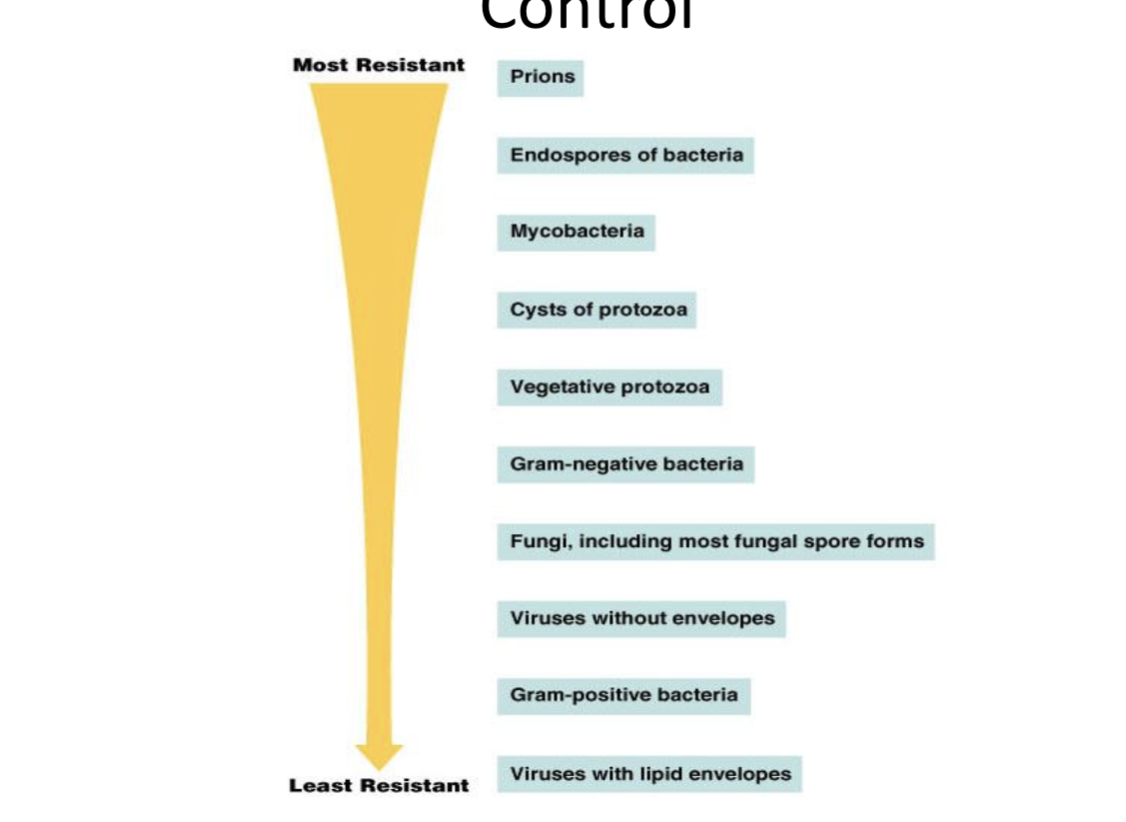
Microbial characteristics and microbial control, image
Microbial characteristics and microbial control, image
Microbial Characteristics and Microbial Control, chart of chemical agents and their effectiveness
Chemical agent | Effective against | Effective against |
endospores | mycobacteria | |
phenolics | poor | good |
quats | none | none |
chlorines | fair | fair |
Alcohols | Poor | good |
glutaraldehyde | fair | good |