Synapse, Neuronal connection, and muscle contraction
 Call Kai
 Learn
 Practice Test
 Spaced Repetition
 Match
 Flashcards
 Knowt Play
1/42

There's no tags or description
Looks like no tags are added yet.
43 Terms
The model that describes the contraction of the muscle is called the
Sliding filament model
In which of the following situations does a resting membrane potential exist?
A relaxed muscle fiber
A muscle fiber will respond to a stimulus when that stimulus reaches the________ level.
Threshold
Synaptic vesicles in the neuromuscular junction contain
Acetylcholine
The sites where a chemical substance is transmitted from the presynaptic terminal of an axon to the postsynaptic membrane of a muscle fiber are called
Neuromuscular junction
Acetylcholine is released from the presynaptic terminal by the process of
Exocytosis
The sarcoplasmic reticulum
Stores Ca2+
T tubules are invaginations of the
Sarcolemma
If Na+ cannot enter a muscle fiber in response to a stimulus,
Contraction can’t occur
In a contracted muscle, the A bands narrow because the length of the myosin myofilaments changes.
False
Which of the following individuals would have more mitochondria in her skeletal muscle?
22 year old soccer player
Due to the pattern of innervation of skeletal muscle, one would expect that
there are fewer motor neurons than skeletal muscle fibers.
Substance A is found to be a competitor with acetylcholine. Which step of muscle contraction physiology would be directly affected by this substance?
Generation of sarcolemma at action potential
A stimulus either causes an action potential or it doesn't. This is called
All or none response
During the absolute refractory period, the cell
Is insensitive to further stimulation
A series of local potentials causes the membrane potential to move to -80 mV. Predict the result.
The neuron is hyperpolarized
Saltatory conduction of an action potential means that
an action potential is conducted from one node of Ranvier to the next node.
Local hyperpolarization in a synapse is called a/an
Inhibitory postsynaptic terminal
Arrange the events of synaptic transmission in correct sequence.
Na+ diffuses into the cell and cause a local potential
Neurotransmitter binds with receptor on postsynaptic cell
Neurotransmitter diffuses across the synaptic cleft
Membrane permeability to Na+ on postsynaptic cell increases
Action potential causes release of neurotransmitter
5, 3, 2, 4, 1
Neurotransmitters are released from the
Presynaptic terminal
Neurotransmitters
cause the production of action potentials in the postsynaptic membrane.
Rapid removal or destruction of neurotransmitter in the synaptic cleft
may affect the ability of the postsynaptic membrane to generate action potentials.
List the following structures in order from smallest to largest.
Muscle fiber
Myofilament
Myofibril
Muscle fascicle
2, 3, 1, 4
Hypertrophy of skeletal muscles from weight lifting is caused by an increase in the
Size of muscle fibers
What type of muscle is under voluntary neural control
Skeletal muscle
What isn’t a function of skeletal muscle
Constriction of an organ
What is excitability
The ability to respond to a stimulus by nervous system
A fascicle is
Surrounded by perimysium
What connective tissue layer is outside all of the others
Epimysium
What is true about skeletal muscle
Every muscle fiber receives a branch of a axon from a motor neuron
Myosin is also known as
Thick myofilament
Muscle myofibrils
Contain myosin and actin filaments
The active sites to which cross-bridges attach are found on the
Actin myofilaments
Gap junctions are functionally
Electrical synapses

A
Depolarization - ligand-gated channels

B
Depolarization - voltage-gated channels (rapid Na influx)

C
Repolarization phase (K+ out)

D
Threshold

A
Actin
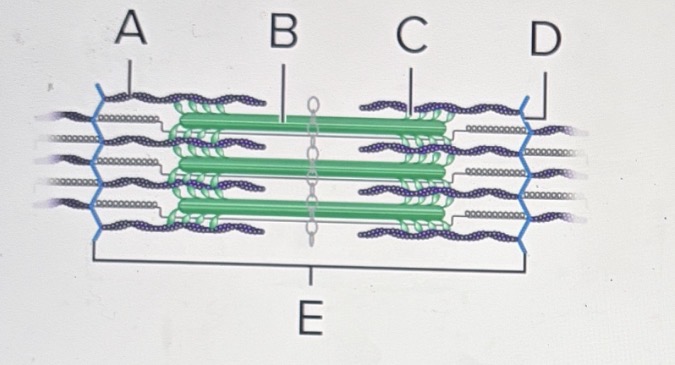
B
Myosin

D
Z disc

E
Sarcomere
At rest, the inside of the sarcolemma is _____ to the outside
Negatively charged