Exam 2 Learning Objectives
 Call Kai
 Learn
 Practice Test
 Spaced Repetition
 Match
 Flashcards
 Knowt Play
1/58

There's no tags or description
Looks like no tags are added yet.
59 Terms
What is the general function of epithelial tissue?
to create boundaries between different environments; secrete/filter/absorb things from outside environment
Where are most epithelial tissue located?
they COVER body SURFACES and LINE the hollow organs/body cavities. also form glands
What does epithelial tissue allow the body to do?
Allows body to interact with both internal and external environments
How are most epithelial tissue arranged?
Cells are arranged in sheets and very densely packed, and attach to basement membrane with many CELL JUNCTIONS present
Where are the two surfaces/characteristics of epithelial tissue?
Apical Surface (Free Side) and Basal Surface (Attached Side); Top vs Bottom
What is the apical surface exposed to and what are its characteristics?
exposed to surface or cavity, some have specialized fingerlike projections (microvilli)
What is the basal surface exposed to and what are its characteristics?
INWARD towards body, attaches to the basement membrane: adhesive sheet holding BASAL SURFACE of epithelial cells to underlying cells (holding it down)
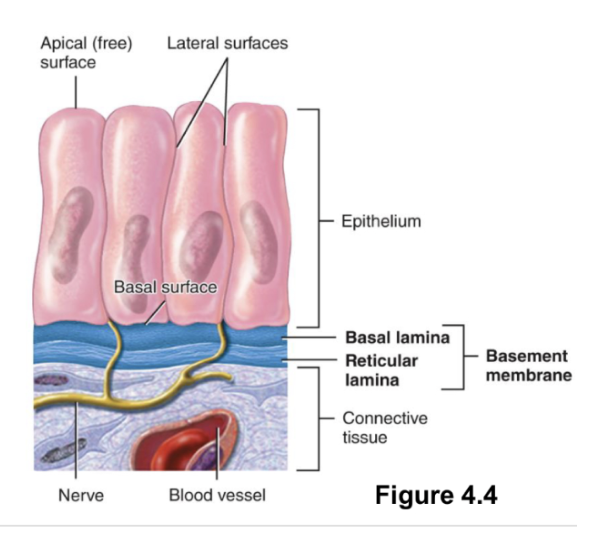
What is important about the basal surface?
It defines the epithelial boundary by anchoring cells to basement membrane
What are the five types of cell junctions?
Gap junctions, Tight junctions, Hemidesmosomes, Adherens AND Desmosomes
What is “Gap Junction” function and location?:
Function: Cell Communication
Location: Digestive Tract, Uterus, Heart Muscle
*think: GAP communicates through dancing with the heart
What is “Tight Junction” function and location?
Function: serve as IMPERMEABLE barrier
Location: Digestive Tract
*think: tight (serves as barrier)
What is “Hemidesmosomes” function and location?
Function: ANCHOR cells to the basement membrane
Location: epithelial tissue
*think hemi (hemming the anchor)
What is “Adherens” and “Desmosomes” function and location?
Function: helps cells resist SEPARATION during tension or movement
Location: digestive tract, heart, skin
How are Epithelial Tissues classified?
by shape, then layers. (ex: simple squamous)- SL (SEE LATER)
*note: transitional has no layers, and only columnar has pseudo-stratified
*note: glandular is an option, and is not classified by layers, just endocrine and exocrine
What are the types of cell layers for epithelial tissue?
simple, pseudostratified, stratified

How many layers is in simple and what is its function?
single layer, functions for diffusion and osmosis (outside surface); basically moving in and out
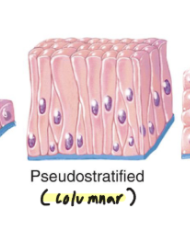
How many layers is in pseudostratified and what is its function?
single layer, functions similar as simple, but has cilia/goblet cells for mucus production

How many layers is in stratified and what is its function?
2+ layers, serves as protection, shape can vary across layers
What are the types of shapes for Epithelial Tissue classification?
squamous, cuboidal, columnar, transitional

What describes “Squamous” shape?
FLATTENED and scale-like

What describes “cuboidal” shape?
BOX like, cube, secretion and absorption

What describes “columnar” shape?
tall columns; functions for protection, secretion, absorption
What describes “transitional” shape?
changes shape from cuboidal to squamous and back (allowing for stretch), no layers at all, usually in urinary system because changes shape when full/empty
What is a gland?
SINGLE cell or MASS of epithelial cells adapted for SECRETION
What are the two types of Glandular epithelial tissues?
Endocrine and Exocrine
What is endocrine gland?
DUCTLESS (pituitary); secretions (hormones) enter interstitial fluid and diffuse into blood (which regulates metabolic and physiological activities to maintain homeostasis)
*think: endocrine = homeostasis
What is exocrine gland?
HAS DUCTS (sweat), secretions enter ducts emptying onto surface of covering/lining epithelium (skin, so sweating onto skin).
What are the two types of exocrine glands?
Unicellular Exocrine Glands and Multicellular Exocrine Glands
What are Unicellular Exocrine Glands?
includes MUCOUS cells and GOBLET cells
Function: to produce mucin (sugar protein to dissolve in water to form mucus) as PROTECTIVE coating to LUBRICATE
Location: found in epithelial linings of intestinal and respiratory tracts
What are Multicellular Exocrine Glands?
composed of DUCT and SECRETORY UNIT; has cells that form DISTINCT microscopic structure/macroscopic organ
What are the two types of structural classification for multicellular gland?
Tubular vs Alveolar/Acinar AND Simple vs Compound

What are tubular glands?
glands that have tubular secretory parts, shaped more like a tube (more vertical, a little longer)

What are alveolar glands?
glands that have ROUNDED secretory portion (rounder, a liittle bigger)

What does “Simple” mean in terms of glands?
no branches, just one straight from the top

What does “Compound” mean in terms of glands?
lots of branches, splitting from the one at the top
What are the three functional classifications of multicellular gland?
merocrine, apocrine, holocrine
What is merocrine?
fluid product released through exocytosis (ex: SWEAT)
What is apocrine?
ACCUMULATE products within but ONLY apex RUPTURES (ex: mammary)
What is holocrine?
ENTIRE cell REPTURES releasing secretions (ex: sebaceous oil gland)

Classify this epithelial tissue
simple squamous (one layer, very thin, flat cells with flattened nuclei)

Classify this epithelial tissue
simple columnar (distinctly two different layers)

Classify this epithelial tissue
pseudostratified columnar (not actually two layers, just them going back and forth columnar on each other

Classify this epithelial tissue
stratified squamous

Classify this epithelial tissue
simple cuboidal

Classify this epithelial tissue
transitional (puffy)
What are the major functions of connective tissue?
BINDING and SUPPORT, protecting, insulating, storing fuel, transporting blood substances (has varying degree of vascularity with nerve supply)
What does connective tissue consist of?
Consists of cells that are suspended/embedded in extracellular matrix (ECM), but composition and arrangement of elements vary in different types of connective tissue
What are the general features of connective tissue?
extracellular matrix, fibers, cells
What does aging do to the tissue repair process?
SLOWS it down due to decreased blood supply and slower metabolic rate
What happens to epithelial tissues from aging?
they become THINNER and MORE FRAGILE, disorders are specific to organs (skin cancer)
What happens to connective tissues from aging?
they become STIFFER with less elasticity (more stiff in the body); disorders are AUTOIMMUNE (immune system gets confused and attacks healthy body)
What happens to muscle tissues from aging?
muscle MASS and STRENGTH decrease (weaker)
What happens to nervous tissues from aging?
decrease in FUNCTION and SENSITIVITY (nerves aren’t as functional and are less sensitive to things like pain)
What is the purpose of tissue repair?
To replace worn out/damaged/dead cells
How do epithelial cells go through tissue repair?
replaced through division of stem cells or undifferentiated cells
How do connective tissue cells go through tissue repair?
Don’t all have ability to repair
How do muscle cells go through tissue repair?
They perform limited repair