PHP Exam #2 Midterm (copy)
 Call Kai
 Learn
 Practice Test
 Spaced Repetition
 Match
 Flashcards
 Knowt Play
1/195

There's no tags or description
Looks like no tags are added yet.
196 Terms
What is it meant by the delivery system? What is it meant by delivery? what is it meant by system?
Delivery System
Delivery: anything and everything related to the delivery of any type of medical care or service
Hospitals
Doctors
Nurses of all kinds
All other health professionals (e.g.,) pharmacists, chiropractors, physical therapists, home health aids, etc.)
Complementary and alternative medicine (CAM) providers
Many other things
System: as you know well by know, there is no system-ness, nothing system-like, about health care delivery in the US
What are some trends about the numbers of hospitals both in general and then in focus of rural areas?
the total number of hospitals is falling
the reduction is due to closures of rural hospitals
what is the total trend of inpatient hospital utilization admissions? inpatient hospital utilization days? emergency departments?
number of admissions went down
inpatient days dropped increasingly
number of emergency departments is goign down but now going back up
what is the trend of outpatient visits?
there are a lot of care outside of hospitals so increase in outpatient visits
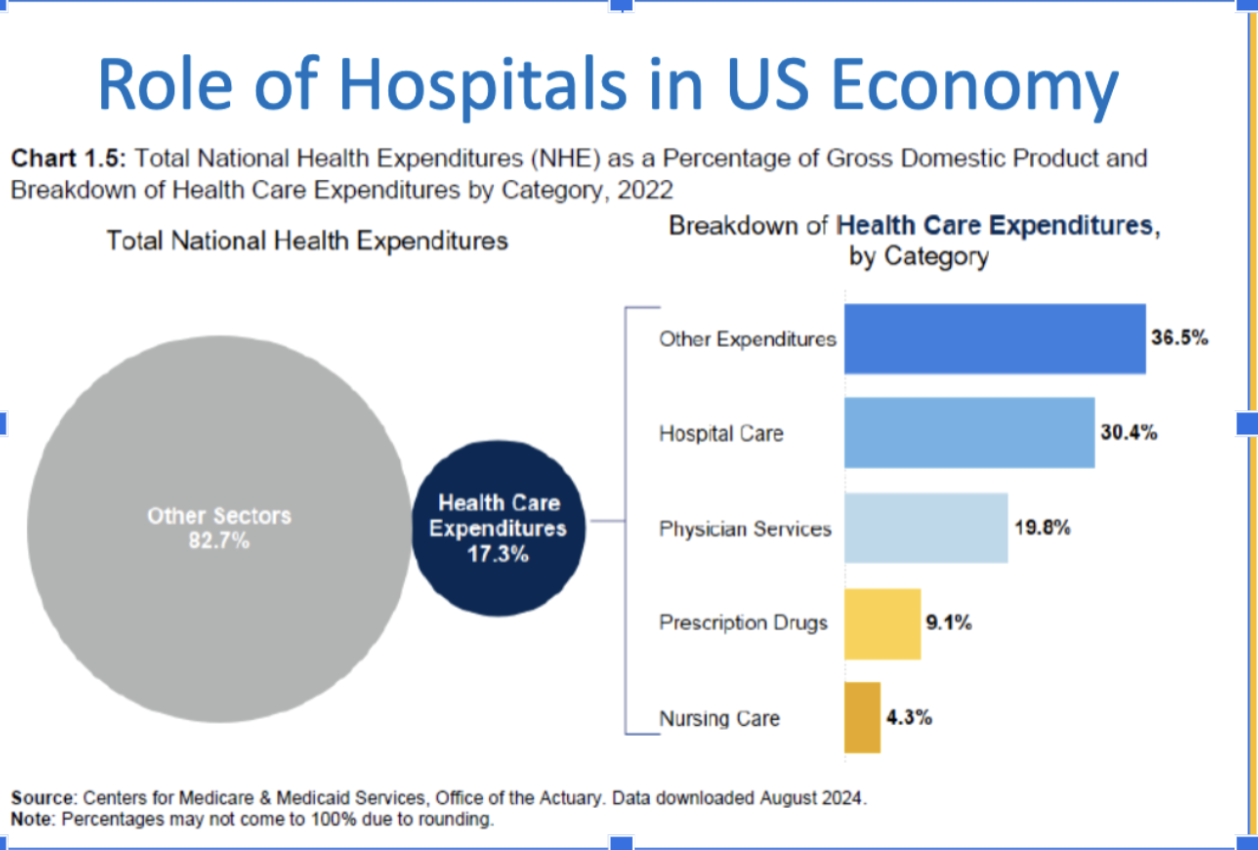
Around how many percentages of healthcare expenditures is part of our total GDP? What is the breakdown of the health care expenditures usage?
~17.3 —> 17-18 percent of healthcare expenditures is part of our total GDP
What are some overall trends when looking at hospital numbers, inpatient utilization, redeployment, economies, medicaid expansions?
Take Home Messages
Inpatient utilization is falling, and in response, hospital outpatient utilization is rising
Redeployment: hospitals are shifting outpatient care
Something called a facility fee which increase their reimbursement when they really aren’t doing additional work within the facility
Hospitals are very important to local economies and the US economy (and, not surprisingly, they have a very strong lobby)
Medicaid expansions helps struggling hospital (urban and rural)
More later: Hospital mergers and consolidation, impact trend
what is the physician gender ratio?
physician workforce gender is 60:40 male : female
however, female is increasing
International Medical Graduates (IMGs) make up what percentage of practicing physicians in the US?
24%
What are the take home messages for physicians? Think back to distributions of MDs by states and urban/rural groups. Think about the workforce? what are the trends? What about challenges? What percentage of IMGs make up the MD workforce?
Take Home Messages
Supply/demand mismatch; likely shortages, especially in primary care
Uneven geographic distribution of MDs
By state
Also (data not shown), by urban/rural (rural shortages)
MD workforce is aging (men especially)
Serious workforce diversity challenges, that are worsening
~24% of MD workforce are international medical graduates (IMGs)
What is the training hierarchy for LPN, RNs and Advanced Practice Nurse?
LPN: Licensed Practical Nurse (1 year training)
RN: Registered Nurse (2 years training)
Advanced Practice Nurse (usually MA degree)
What are some take home points for other providers other than doctors? think PA, NP, APRNs
there are many important types of providers other than MDs
NPs, PAs, and others such as pharmacists will play an increasingly important role in the future
APRNS and PAs make good salaries
As always, there is state to state in nursing salaries
Primary care focuses on …
primary care focuses on complex individuals in the context in which they live and function
What is the definition of primary care?
The Definition
1996 Institute of Medicine (IOM) Report
Primary care is the provision of integrated, accessible health care services by clinicians who are accountable for addressing a large majority of personal health care needs, developing a sustained partnership with patients, and practicing in the context of family and community
Definition is in terms of the functions that primary provides, not who performs those functions
Primary care is the provision of integrated, accessible health care services by clinicians who are accountable for addressing a large majority of personal health care needs, developing a sustained partnership with patients, and practicing in the context of family and community
What is the dilemma of primary care? what is one of the main reasons? how does it compare to other nations?
The Dilemma
We have a high cost, and often low quality, health care system
The “value” of the health care we get is, relative to other developed nations, low (lecture 1)
Assertion: part of the reason we have this dilemma is that health care in the US is specialty dominated, and specialty driven; not primary care driven
Today’s goal: understand the reason for this assertion
what are the the three C’s and what do they mean in terms of integrated care?
Comprehensive: any health problem at any stage of the life cycle
Coordinated: the combination of services that meets patient’s needs, and the connection between and rational ordering of those services
Continuous: care over time by an individual or team, and timely communication of health information (e.g., events, risks, advice, patient preferences)
what are healthcare services? where can they be held ? physicians and the systems they work in are responsible to patients, families, and communities for the delivery of?
The full array of services performed to promote, maintain and restore health
Those services should be provided where the patient is
Office
Skilled nursing facilities
Nursing home
Hospitals
Schools and homes
Physicians and the systems they work in are responsible to patients, families and communities for the delivery of
Qualify care
Patient satisfaction
Efficient use of resources
Ethical behavior
an essential characteristic of primary care is that…?
Primary Care Physicians (PCPs) receive all the problems patients bring
Have the skills to manage most of them
Know when to appropriately involve specialist
personal health care needs often include
physical, mental, emotional, and social concerns related to individual functioning
what is the sustained partnership between the provider and patient?
Patient-centered care
Shared decision making
Providers (generally) have more knowledge about medicine
But patients/families are the only ones who can provide information about values, goals, priorities, preferences
We can make grave mistakes when we assume we know what a patient or family might want, and do not ask (and listen)
Patients’ values should (almost) always trump providers’ values
within the context of family and community, primary care understands…? community is defined as? our population is increasingly …
living conditions
family dynamics
cultural background
Community is broadly defined and can mean a physical community like a neighborhood, or people who share values, experiences, language, etc. (e.g., gay community, Hispanic community, breast cancer community)
In the context of our poor “value” health care system, arguable this is the kind of care that is needed, particularly given that our population is increasingly
Older
Chronically ill
Obese
Diverse: racially, ethnically, religiously, culturally, linguistically
what is the secondary care? tertiary care? and quaternary care?
Primary care
Secondary care: short term, can be outpatient, may have technological focus
Tertiary care: complex, institution based, highly specialized
Quaternary care (not in the book): pediatric heart surgery or pediatric bone marrow transplantation (e.g., for a leukemia)
what is the relationship between physician connected patients and practice connected patients in context of prevention?
Physician vs. practice connectedness
Large MA study of primary care (n=92,315)
Physician connected patients more likely than practice connected patients to get: mammography, cervical cancer screening, colorectal cancer screening, recommended diabetes care, and recommended coronary disease care
having more primary care providers is associated with? having more specialty providers is associated with ? think quality and costs
Counter intuitive findings
Having more primary care providers is associated with higher quality and lower costs
Having more specialty providers is associated with lower quality and higher costs
primary care is associated with … (positive impacts)
Primary care associated with
Greater use of preventive services
Less use of Emergency Departments
Higher care quality using Medicare data
Lower care costs using Medicare data
Other data show equal quality of care for diabetes, hypertension, and back pain
Higher overall satisfaction with care
Population-level mortality
what does the simon paper cover?
evidence about attributes of high value primary care
definition of high value: low cost AND high quality
data: claims data from commercial insurance
blinded interviews of high and average value practices
what are attributes seen in higher value practices?
Decision support for evidence-based medicine → usually integrated into your medical record, is the ability to get quickly get access to definitions of high quality evidence based care
Risk-stratified care management → map the intensity of the various types of care to different patients and problems
Careful selection of specialists
Coordinated care
Standing orders and protocols → you might not have to see a doctor and can instead see a nurse, being more efficient and ensuring timely care ← example
Balanced compensation → do people actually want to work as a team and do work as a team
what are simon paper’s three themes?
risk stratified care management
careful selection of specialists
coordination of care
teamwork is essential for high value care
primary care: ideally positioned to provide essential leadership
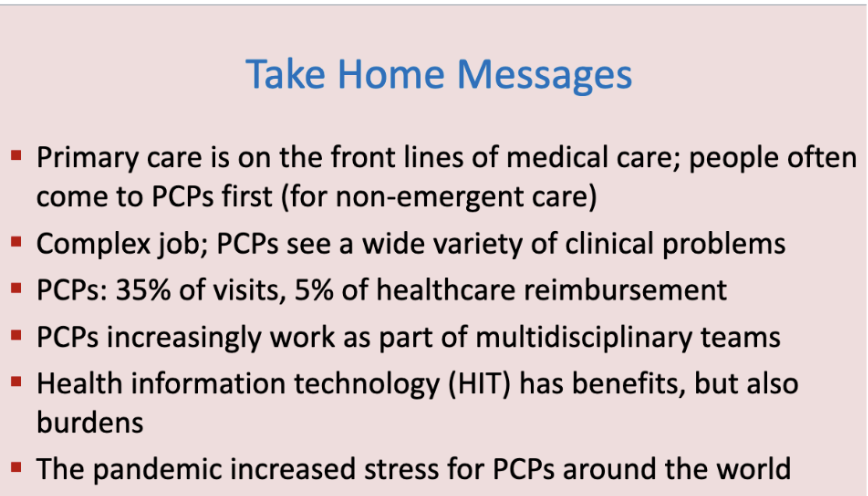
primary care only receives around X % of funding but receives X % of health care patient visits
primary care only receives 5% of primary care funding but helps and receives 35% of health care patient visits
what is desktop medicine?
consists of activities such as communicating with patients through a secure patient portal, responding to patients’ online requests for prescription refills or medical advice, ordering tests, sending staff messages, and reviewing test results
what are some take home messages about primary care? think how often people see them, funding received, who they work with, what the pandemic did, what their job entails?
over past three years, gender pay gap has widened among doctors by how much for PCP gap and specialist gap?
PCP gap: 39k (15%)
Specialist gap: $108k (32%)
what is the RUC? who is it sponsored by? who is on the RUC? what is the discrepancy between the RUC members and primary care?
Resource-Based Relative Value Scale (RBRVS) Update Committee (RUC)
An association of doctors that is in charge of how much doctors get paid
Sponsored and run by American Medical Association
Recommends RVUs for each of >7000 medical services
Who is on the RUC?
32 voting members, most appointed by specialty societies
Primary care
35% of visits
Only 1 guaranteed seat for primary care
RVU stands for Relative Value Units. They are a metric used in healthcare to measure the complexity, time, and resources required to provide medical services.
How does the RUC determine RVUs? think relationship to CMS and the percentage of recommendations CMS has implemented from RUC. what is the trend in compensation gap?
Proceedings are private and proprietary, with secret ballots
In a zero-sum redistribution game, decisions are political
The RUC is the primary advisor to CMS for RVUs
CMS has implemented 95% of the RUC’s recommendations
No surprise when you understand the RUC process: growing compensation gap between cognitive and proceduralist specialties
what is the take home messages for primary care physicians in terms of pay, policies in terms of prices, and then reimbursement differences?
primary care physicians get paid significantly less than specialists
payment policies are complex, and the process of setting prices is dominated by specialists
these reimbursement differences between generalists and specialists are hard to change and have important implications
what is the summary from the 2025 scorecard report —> thinking financing, workforce/access, training, and research?
Summary
Financing: Declining investment and fee-for-service payment are hindering primary care clinicians’ ability to meet growing patient needs
Workforce/Access: Insufficient funding is diminishing the primary care workforce and access to care
Training: Misdirected graduate medical education funding is not producing enough new primary care physicians, exacerbating access issues for patients
Research: The lack of research dollars to study the practice of primary care is limiting evidence-based improvements in care
what are some general take home messages about primary care workforce in terms of the workforce make up of it? what are some reasons?
Primary care workforce not growing fast enough
Too few trainees enter and stay on primary care paths
The government underinvests in primary care
Technology has become a burden
Research on novel solutions is lacking
which providers are PCPs?
Primary care practitioners are usually
Family physicians
General internists
Geriatricians
General pediatricians
Nurse practitioners
Physician assistants
Sometimes included: nurses, pharmacists, health educations, medical assistants
what are hospitals and hospital healthcare practices doing to primary care practices?
hospitals and hospital healthcare practices are buying primary care practices and bringing them into their systems
what is the distinction between primary care physians and primary care providers?
A primary care physician (PCP) is a medical doctor (\(MD\) or \(DO\)) who provides comprehensive primary care, while a primary care provider is a broader term that includes physicians as well as other qualified healthcare professionals like nurse practitioners and physician assistants. All primary care physicians are providers, but not all primary care providers are physicians.
how many million americans live in primary care health professional shortage areas? `
101 M americans
what role do IMGs play in primary care?
IMGs play an important role in providing access to primary care
64% of foreign trained physicians were practicing in medically underserved areas or health professional shortage areas with almost 46% of these physicians practicing in rural areas
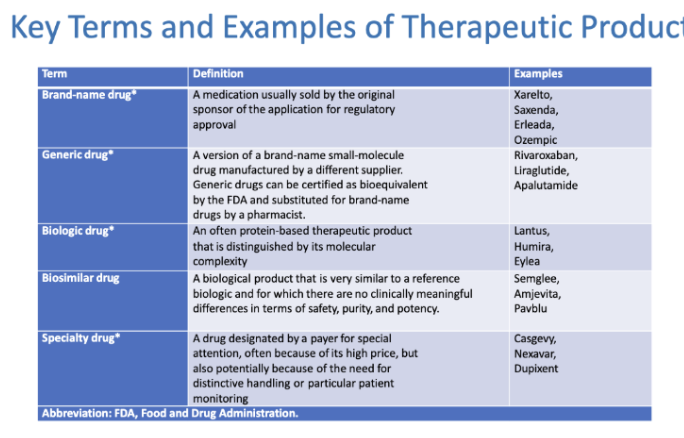
what are the definitions of brand name drug, generic drug, biologic drug, biosimilar drug, and a specialty drug? what are examples of them ?
what are some trends with how much the US pays for pharmaceuticals?
the us pays significantly more on pharmaceuticals compared to other countries
in the 90s US spending on pharmaceuticals increases
what was the average annual costs of widely used prescription drugs? for generic? for brand name? for specialty drugs?
The average annual cost of therapy for widely used generic drug products was $679 in 2020
The average annual cost of therapy for widely used brand name drug products was $6,604 in 2020
The average annual cost of therapy for wiley used specialty drug products was $84,442 in 2020
TRUE or FALSE: specialty drug growth outpaces traditional drugs
TRUE
what are some take home messages about prescription drug costs? think about US vs worldwide, for patients and the impact, and the cost of various types of drugs?
Take Away Messages
Prescription drug costs are increasing worldwide but much faster in the US
Out of pocket costs impact patients’ ability to take their drugs as prescribed by their physicians
The cost of specialty drugs are the most expensive category of prescription drugs and continues to increase in sales
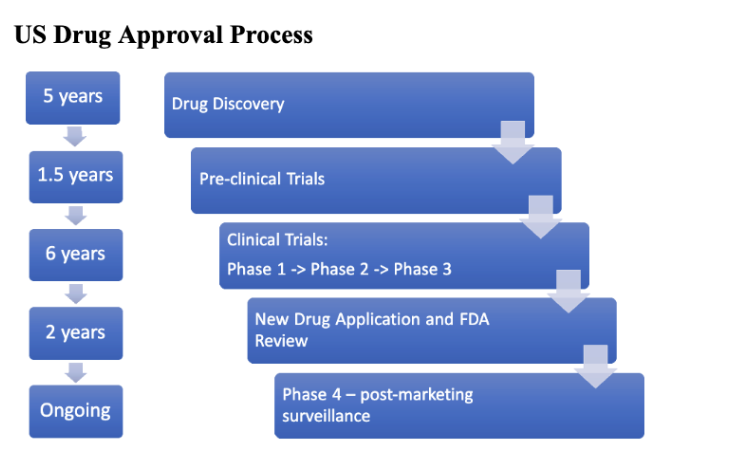
what is the US drug approval process? how long does it take for each step? what does each step entail?
FDA Phases
Discovery and Development
Find a selection of potential compounds through results from separate studies, extensive testing, or new scientific or technological knowledge
Narrow down the field by examining the chemical and biological properties of the compounds to find one that may interact favorably with a given condition
Pre-Clinical Trials
Both in vitro (i.e. in a petri dish) and in vivo (i.e. animal studies) to determine any major effects of the drug, specifically efficacy, toxicity, and dosing
If results are promising, submit an investigational new drug proposal to the FDA outlining preclinical results and plans for clinical trials
FDA Phases: Clinical Trials
Phase 1
20-100 healthy participants (except for cancer, in which case testing done on cancer patients)
Testing for metabolism, dosing, efficacy and side effects
Several months
~70% move to Stage 2
Phase 2
Several hundred participants with the target condition
Testing for safety and efficacy
Several months ~2 years
~ 33% move to Stage 3
Phase 3
300-3000 participants with the target condition
Testing for efficacy and larger range of side effects (due to large sample)
1-4 years
Once filed
~92% approved
Phase 4
Post-marketing surveillance
Several thousand participants with the target condition
Continued safety and efficacy testing – look at long-term side effects
Phase 5
Drugs that have been approved by the FDA and available to be prescribed by physicians
May involve thousands of people
Typically the safest type of trial as it has been studied in detail and many instances for a long time
May gather data on long-term side effects, recurrence or survival
Outcomes may include quality of life or cost-effectiveness
what is the federal drug administration : new drug approval? what is the to be licensed portion entail ? what does it mean?
To be licensed: “safe and effect under conditions of intended use” (statutory standard)
Risks are considered acceptable for the potential benefits for a given indication
what is the costs of development for the DiMasi study?
Sample of 106 drugs from 10 firms
Financial and development information submitted by the companies via a surgery - no way to publicly verify information
These 10 firms are from the top 50 pharmaceutical companies, so no perspectives from smaller firms
Similar cost calculations as Wouters
Time costs (different between out-of-pocket and capitalized costs) make up about 45% of total cost
$1.163 billion of the $2.6 billion figure are due to this calculation of opportunity costs into the model
what was the wouters study about? what did it result and produce?
Sample of 63 FDA approved pharmaceuticals between 2009-2018 (the amount of approved drugs with publicly available R&D)
Found mean development cost of $1.336 billion and median of $985 million (calculated costs for Dupixent were a large outlier)
The study accounted for direct and indirect yearly R&D spending, average numbers of failed trials, and the cost of capital rate (10.5%) – basically the opportunity cost of developing the drug
What are some take home messages about costs of developing medicines, phases, the probability of starting phases, and the R&D pipeline?
Take Home Messages
The cost to develop a new medicine is significant
There are multiple phases for evaluating the safety and efficacy of a new product
The probability of a product starting phase 1 and progressing to FDA approval is low
The R&D drug pipeline is crowded with likely high-cost specialty drugs
what is the history of PBMs/ pharmacy benefit managers?
During the 1970s and 1980s, PBMs evolved the system of discounted mail-delivered pharmaceuticals and networks of bricks and mortar pharmacies
Starting in 1987, PBMs introduced real-time electronic processing of drug claims, moving the management of insurance based pharmaceutical therapy to a completely paperless system
Predominantly serving the private sector during the 1970s and 1980s
PBMs expanded services to Medicaid programs in the 1990s
PBMs are hired by health plans/employers/ Unions/ government to…
Design formularies
Negotiate rebates
Set up pharmacy networks
Process claims
what are PBMs or pharmacy benefit managers?
PBMs, or Pharmacy Benefit Managers, are third-party companies that act as intermediaries in the prescription drug supply chain, managing drug benefits for health insurers, large employers, and other payers. Their main functions include negotiating drug prices and rebates with manufacturers, creating drug formularies, processing claims, and managing pharmacy networks. PBMs were created to help control prescription drug spending but have become complex entities that generate revenue through various means, including fees and the spread between what they charge insurers and what they pay pharmacies.
PBMs reduce drug costs by…
Offering home delivery of medications and created select networks of more affordable pharmacies;
Encouraging the use of genetics and more affordable brand medications;
Negotiating rebates from drug manufacturers and discounts from drugstores;
Managing high cost specialty medications
Reducing waste and improving adherence
what is a prescription drug formulary? what is it also called?
A list of prescription drugs covered by a prescription drug plan or another insurance plan offering prescription drug benefits. Also called a drug list
what is the formulary development process?
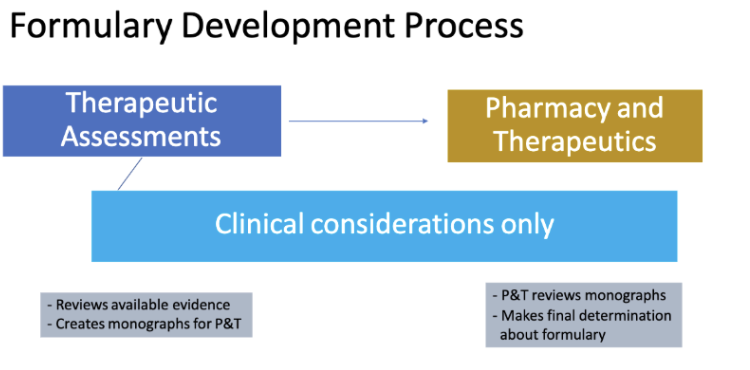
what is the pharmacy and therapeutics committee (P&T)? who is on it? who do they do?
P&T Committee consists of non-employee physician members and pharmacists from active community and academic based practices and represents a broad range of medical specialties
P&T Recommendations
Must add/Include
May add / Optional
Must not add / Exclude
what are three different formulary types?
Open - the plan sponsor pays a portion of the cost for all drugs, regardless of formulary status. Although, a plan sponsor may choose to exclude certain products, such as “lifestyle” drugs, from coverage
Restricted- the plan sponsor will only cover drugs listed on the formulary. Non formulary drugs are not covered unless approved through a formulary override process
Tiered - plan sponsored offer different copays or other financial incentives to encourage participants to use preferred formulary drugs but will still pay a portion of the cost of the non-preferred design, it may cover non-preferred, nonformulary products on its third tier with a higher copay
the more covered lives (insured customers) represented by a PBM…
the more likely that manufacturers will offer rebates in return for formulary placement
what are PBMs rebates? why do manufacturers pay for rebates? rebates can only occur in a competitive drug class?
Rebates are retroactive discounts negotiated with manufacturers by PBMs and health plans for brand name drugs
Manufacturers pay rebates in exchange for improved access, preferred formulary position or exclusive status or to lock out the competition
Rebates can only occur in competitive drug classes
what is PBM scrutiny?
In the past few years PBMs have gotten greater visibility and public attention
Increases in consolidation (with the three leadings PBMs – CVS Caremark, Cigna–Express Scripts, and UHS OptumRX – controlling 80 percent of the market), power, and secrecy have swung the needle in the opposite direction
As the PBMs have consolidated, prices have risen. Manufactures that wish to have their dugs covered on PBM formularies pay significant rebates and fees to PBMs, often paid for by raising the price tag
what is the inflation reduction act and the impact it had on prescription drug provisions?
Require the federal government to negotiate prices for some drugs covered under Medicare Part B and Part D with the highest total spending, beginning in 2026
Require drug companies to pay rebates to medicare if prices rise faster than inflation for dugs used by Medicare beneficiaries, beginning in 2023
Cap-out-of-pocket spending for Medicare Part D enrollees and make other Part D benefit design changes, beginning in 2024
Limit monthly cost sharing for insulin to $35 for people with MEdicare, beginning in 2023
Eliminate cost sharing for adult vaccines covered under Medicare Part D and improve access to adult vaccines in Medicaid and CHIP, beginning in 2023
Expand eligibility for full benefits under the Medicare Part D Low Income Subsidy Program, beginning in 2024
Further delay implementation of the Trump Administration's drug rebate rule, beginning in 2027
What are some certain categories of drugs that are excluded from the negotiation process?
Drugs that have a generic or biosimilar available
Drugs that are less than 9 years (for small-molecule drugs) or 13 years (for biological products) from their FDA approval or licensure date
“Small biotech drugs“ (until 2029), defined as those which account for 1% or less of Part D or Part B spending and account for 80% or more of spending under each part on that manufacturer’s drugs
Drugs with Medicare spending of less than $200 million in 2021 (increased by the CPI-U for subsequent years)
Drugs with an orphan designation as their only FDA approved indication
All plasma-derived products
what is the IRA estimated impact? on medicare D enrollees? on medicare? on out of pocket costs?
IRA Estimated Impact
Medicare Part D enrollees expected to save $1.5 billion from the 2026 negotiations
Price negotiations finalized on August 1, 2024
If the negotiated prices for the 10 2026 drugs had been implemented in 2024, Medicare would have saved $6 billion, or about 22%
Insulin caps and free vaccines alleged saved $400 million in out-of-pocket costs
what are some drugs qualified for negotiations for 2027?
15 drugs include the popular diabetes and obesity drugs Ozempic and Wegovy
Other drugs used to treat asthma and chronic obstructive pulmonary disease, type 2 diabetes, prostate and breast cancer, and other conditions
Total spending on these 15 drugs between November 2023 and October 22024 was $40.7 billion, with 5.3 Medicare beneficiaries using these medications during that time
what is the cost of the IRA for medicare part D drug benefits?
The dressing of the Medicare Part D drug benefit will cost $10 billion to $20 billion more next year than the Congressional Budget Office initially projected
what is inpatient care?
at least one overnight stay
what is ambulatory care?
“ambul“ : walking
ambulatory care is a medical treatment provided in an outpatient setting, meaning patients do not stay overnight
what are three interrelated trends? think within the context of inpatient care, hospital based out patient care, and non hospital based outpatient care
3 interrelated trends
Because inpatient care is so expensive, payers won’t pay for an overnight stay if it isn’t medically necessary
Hospital-based outpatient care is more expensive that non hospital-based outpatient care
Busy people demand convenient care
what is the trend of why hospitals must maintain all the expensive services and technology?
Hospitals must maintain all the expensive services and technology in order to:
Be properly accredited and licensed
Attract various insurers, patients AND good physicians
This high overhead puts them at a competitive cost disadvantage relative to free-standing, single focus ambulatory facilities, including even surgical centers or imaging centers
what are ambulatory care setting examples?
Hospital emergency departments (EDs)
Hospital-based outpatient departments (OPDs)
Outpatient offices; physician private practices
Community Health Centers
Free-standing specialty care settings
Ambulatory surgery centers (ASCs)
Imaging centers
Urgent Care Centers
Retail clinics
Concierge medicine
Complimentary and Alternative Medicine
what did the chau et al conclude in context of acute care?
Chau et al., Conclusions
Large decline in acute care visits to primary care offices
No corresponding, balancing increase in acute visits to EDs
The rapid rise of alternative acute care sites such as retail clinics, urgent care centers, and telemedicine likely also plays a part in the reduction in rates of acute primary care visits
what are the take home messages for visits for PCPS, specialists, and visits to NPs and PAs?
Take Home Messages
Visits to primary care physicians for acute care and care more generally are decreasing
Visits to specialist are mostly flat
Visits to NPs and PAs in medicare are increasing (and probably in non-Medicare settings also)
what is EMTALA (1986)? what does it require of hospitals? it functions as a safety net? it was a response to ?
Emergency Medical Treatment and Labor Act (S&S, page 316)
Requires hospitals and ambulances to provide emergency care to anyone needing it regardless of ability to pay, citizenship, and legal status
Functional “safety net”
Provides no money to accomplish this; classic “unfunded mandate”
Counteract “dumping” of uninsured or unprofitable patients
everyone wishes that EDs weren’t ? EDs are essential for?
Place of EDs in US system of Care
Everyone wishes ED weren’t so important
Essential for “real emergencies”
A complex, inefficient and expensive way to provide non-emergent care
Article is an ED-centric view, arguing that given that EDs do so much that they need to be better paid
Article referring to RAND - strategies for sustaining emergency care in the United States
What is the general take home message for ED care? think EMTALA — what does EMTALA cover / what doesn’t it cover? think about trends of ED utilization. think about acute care trends in context of primary care doctor’s officers.
Know what EMTALA is (and isn’t)
You may get a bill for being seen
They wont pay for medicines, follow up care, if you get diagnosed with heart disease or cancer → they won’t provide follow up care, they just need to stabilize you
Pre-pandemic, ED utilization appeared to be decreasing slightly; post-panemic visits are trending up again
There are pretty dramatic decreases in the amount of acute care that is done in primary care doctor’s offices
Use of EDs is a difficult habit to break, but will continue to receive attention because it is an expensive and efficient palace to provide nonemergency care
what are urgent care centers? how does it differ than a primary care practice? compared to an emergency room — what is the difference in cost, wait times? what is the caveat for children though? how do urgent care centers operate in terms of patients coming in? what are the hours like?
Treat patients who have illness/injury that requires immediate care but do not require ED level care
Should be treated within 24 hours
Unscheduled, walk in abscess
Extended hours
Fills in the gap after private offices are closed
More services than primary care practice
X-ray defibrillator, oxygen, lab capabilities
Can be free standing or within hospitals
Compared to emergency room
Less expensive source of care (3-4 x cheaper)
Often shorter wait times
Often lower copay for insurance than ER
Perhaps inappropriate for children under 2 if not pediatric expertise
But, access to regular physicians?
what is the percentage of growth in urgent care centers from 2016-2024?
~67% growth over 8 years
what are the take home messages for urgent care centers? what do they try to fill? their growth is a testament that? what is the trend of the utilization of urgent care centers?
Urgent Care Centers attempt to fill the need for acute care that falls in the gap between office-based outpatient care and ED care
Their growth is a testament to the need for a place for these services to be conveniently provided
According to the industry and academic data, utilization of urgent care centers continues
what are retail clinics? what are examples of them? how are they convenient? they are usually staffed by ? how are their hours?
Clinics located in retail stores
Grocery stores
Drugstores
“Big box” stores such as wal-mart
Convenient, walk-in for minor problems like colds and prevention (e.g., flu shots)
Usually staffed by non-physicians
Nighttime and weekend hours
what are some take home messages about urgent care centers?
urgent care centers and retail clinics both attempt to meet clear need for more timely, more convenient primary care
retail clinics continue to grow through pandemic
they clearly fill a market niche for convenient care
impact remains to be seen: will they increase quality and decrease costs?
what is concierge medicine? how does it work? what are other names for it? what does it include within services? what are some benefits of it? you still need to have what?
Other names: boutique medicine, retainer-based medicine, and innovative medical practice design
Pay a retainer of $1000-10,000
Also called “direct care” because patients pay their PCPs directly, rather than charging patients’ insurance
For that, you get increased access to your PCP
The extra revenue allows PCP to have fewer patients
600 patients rather than the usual 2,000 to 4,000 for someone in full time practice
Get a variety of additional services such as
Cell phone access to MD 24/7
Same day visits
Longer visits
PCP accompanies you to specialty visits
You still need to have health insurance
The retainer only covers outpatient care through that practice
For lab testing, specialty visits, and hospitalizations, you still need insurance
Generally, those who use concierge services have both employer based insurance AND also pay a retainer for concierge services
a retainer is an advance payment for services, typically made to a professional like a lawyer or a service provider
it secures the provider’s time and expertise, and the fee is often held in a trust account and deducted as work is completed
What is the concierge medicine controversy? what are the pros? what are the cons? how many are in the country?
Concierge Controversy
PROS
Why not allow people to pay more to get more?
Physicians argue that it allows them to practice the kind of medicine that they think is right
CONS
2 tier medicine; very costly
Better care for the wealth
Takes physicians away from those who need them
Probably only 1000 or so in the country; probably don’t have a huge impact (yet)
what is direct primary care?
Direct Primary Care
Direct = no insurance between provider and patient
concierge care for the rest of us
Concept: pay a monthly retainer (say $50/m), and get all the office-based primary care you need
Couple with high deductible plan
MD perspective: don’t have the hassle of reimbursement; focus on patient care
PT perspective: better, easier access
what does the annals of internal medicine - position paper claim about concierge and direct patient contracting practices?
draws attention to the difficulties in routine practice related to the hassles of payment systems that is driving physicians to enter DPCPs
notes that this trend may exacerbate racial, ethnic, and other socioeconomic disparities
what are some take home messages with concierge medicine and direct primary care? what are they symptoms of? what is the trend of ambulatory care? free market context creates?
Take Home Messages
Concierge medicine and direct primary care are symptoms of a poorly functioning “system”
Patients not getting what they need
Physicians constrained in how they can meet these needs
Free market context creates opportunities, niches to be filled
Ambulatory care is evolving rapidly
what is the difference between complementary versus alternative medicine?
if a non mainstream approach is used together with conventional medicine, it’s considered “complimentary“
if a non mainstream approach is used in place of conventional medicine, it’s alternative
what are some take home messages for complementary health approaches? what is the trend?
Take Home Messages
Americans use a lot of complementary health approaches
And spend a lot of money out of pocket doing so
what percentage or fraction os healthcare expenditures in the US go to hospital based care?
1/3 !
what is the evolution of hospitals?
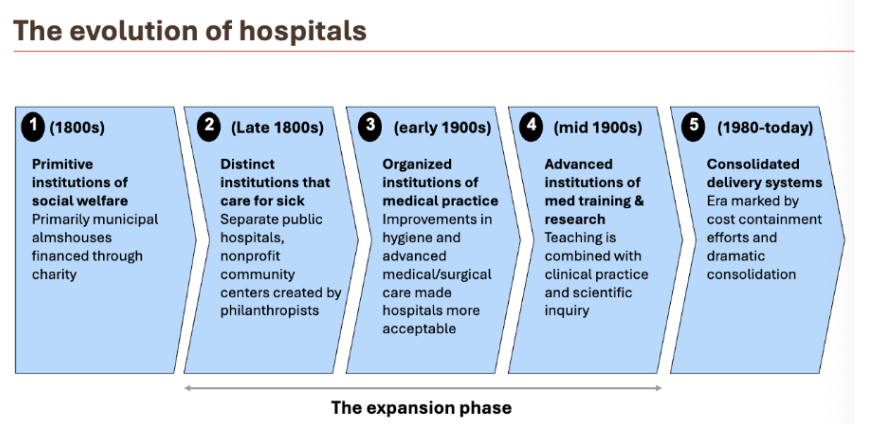
what was the expansion phase for the late 1800s to mid 1980s? what was the trend for US hospitals? what was roemer’s law?
rapid increase in the number of US hospitals
Roemer’s Law (1961) : a built bed is a filled bed
what contributed to this massive growth in the expansion of hospitals?
advances in medical science
medicine moved from a field that was dominated by “snake oil salesmen“ to a respected profession
physician societies, like the AMA, began to be established in the mid 1800s
surgical advances made complex procedures safer
development of specialized technology
germ theory revolutionizes the practice of medicine, leading to an explosion of medical research and scientific discovery
specialized tools like X rays and EKGs begin to be developed that make medicine safer and more effective
hospital accreditation and inspection developed more robust standards for hospital equipment and wards (American College of Surgeons in 1918 and Joint Commision in 1951)
Advances in medical education
advances in biomedical knowledge made it necessary to train physicians in hospital settings, which in turn make doctor’s training more rigorous
internships and residencies were established as part of the training
clinical research associated with hospitals flourished
development of professional nursing
florence nightingale transforms nursing into a recognized profession with the founding of the nightingale school of nursing in england in 1860
the US followed suit as the benefits of having trained nurses in hospitals became apparent, increasing treatment efficacy and patient care standards
the presence of trained nurses improved the image of hospitals
growth of health insurance
the development of private health insurance in the 1930s allowed people to more easily pay for and access hospital services
it also improved the financial stability of hospitals
the advent of public insurance plans in 1965 significantly expanded the pool of peple who could access hospital based care
role of government
arguable the most important role in hospital expansion in the 20th century came from government funding for hospital construction
the US emerged from WWII flush with cash and with a new generation in need of medical care
the great depression and WWII consecutively had led to a downturn in construction and a hospital bed shortage
enter: the hospital survey and construction act of 1946, more commonly called the Hill Burton Act
what is the hill burton act (1946)?
Bipartisan law named for a Northern Republican (se. Harold Burton of OH) and a Southern Democrat (Sen. Lister Hill of AL)
Original wording called for “separate but equal” hospitals with “equitable distribution of hospital beds for each population group”
Overturned in Simkins v. Moses H. Cone Memorial Hospital (1963) – challenged federal government's use of public funds to maintain segregated hospital care Civil Rights Act of 1964 banned segregation at hospitals
However, most Southern hospitals were forced to desegregate primarily due to the loss of access to Medicare and Medicaid funding, which began to represent a significant portion of the market
why did 1980 see a hug contraction in hospitals and beds? as well as occupancy?
change in care patterns
outpatient care is preferred
changes in reimbursement
prospective payment system and the advent of DRGs
impact of managed care
hospital closures
what is the tax equity and fiscal responsibility act (TEFRA) of 1982? what is a DRG payment? what are the incentives for this system?
the Tax Equity and Fiscal Responsibility Act (TEFRA) of 1982, established the hospital prospective payment system (PPS) for Medicare reimbursement
Under a PPS, hospitals are paid a fixed amount per admission according to the patient’s primary diagnosis
flat rate payment tied to a diagnosis related group (DRG)
DRG payment is consistent regardless of time in the hospital, resources used, or adverse events that occur
the prospective payment system provides a predetermined rate, creating incentives for efficiency
do non profit hospitals actually deliver on their promise?
non profit hospitals actually DO make a profit, they are just restricted from distributing that profit to any individuals (e.g., no shareholders looking for return on investment)
to achieve tax exempt status, must provide some defined public good or community benefit
in 1983, this language was standardized to include a 24 hr ED, policy guidelines for treating the uninsured and health promotion in the community
what are the four new community benefit requirements?
written financial assistance and emergency care policies
limit charges for individuals eligible for financial assistance policy
limit billing and collection actions against those who quality for financial assistance
conduction a community health needs assessment and an implementation strategy at least every 3 years
what are the various ways hospitals are classified? most people classify hospitals however based on ?
General Hospitals vs Specialty Hospitals
Short Stay vs Long-Term Care Hospitals
Urban vs Rural vs Critical Access
Teaching vs Non-Teaching
Physician-Owned Hospitals
Psychiatric Hospitals
State Mental Health Institutions
Rehabilitation Hospitals
Children's Hospitals
most people think of hospitals by ownership type
48% private non profit
21% private for profit
16% state and local government
3% federal
10% psychiatric (non federal)
other 2%
what are key takeaways for hospital classifications? how non profit hospitals operate vs for profit hospitals?
there are various ways to classify hospitals, but most people primarily consider ownership type
non profit hospitals often behave very similarly to “for profit” hospitals
understand how the concept of community benefit relates to not - for profit tax status