Molgen 5607 Exam 2 The Electric Boogaloo
 Call Kai
 Learn
Learn Practice Test
 Spaced Repetition
 Match
Match Flashcards
 Knowt Play
1/99

There's no tags or description
Looks like no tags are added yet.
Name | Mastery | Learn | Test | Matching | Spaced | Call with Kai | Chat |
|---|
No analytics yet
Send a link to your students to track their progress
100 Terms
What are the main two methods of cell signaling? (broadly)
1. Extracellular receptor-signaling
2. Intracellular signaling

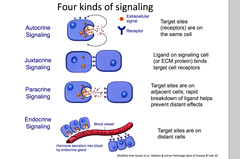
Briefly explain the four types of signaling? (Closest to Farthest)
1. Membrane bound signaling
2. Paracrine signaling
3. Synaptic membrane signaling
4. Endocrine signaling
What are a few different types of cell receptors?
1. Ion-channel ligand receptor
2. G-protein coupled protein receptors
3. Enzyme coupled receptors
T/F: Signaling pathways are the same for all types of cells?
False: Different cell types may elicit different reactions for the signal molecule

What are signal transduction pathways?
A sequence of modulation factors that that cascade throughout the cell, in response to a signal.

What are the two types of binary molecular switches?
1. Signaling through phosphorylation
-P-groups are added by kinases
-P-groups are removed by phosphatase
2. Signaling through GTPase
-GEF and GAP activity
T/F: Inhibitory signals can promote signaling cascades.
True: Inhibitory signals can inhibit the function of inhibitory proteins, thus promoting the signals (two negatives makes a positive).
What are the function of scaffolding proteins?
Scaffolding proteins help to upkeep the structure of kinase complexes. They can build upon receiving the initial signal molecule.

Where is a common place to find these kinase complexes?
Signal proteins can be found on the cytosolic side of the membrane, attached via phosphoinositide docking sites.

T/F: The relationship between different signaling molecules are independent of one another.
False: There is a relationship between different signaling pathways.
Name one way signaling pathways can be interconnected.
Integration - Kinase activity may have two phosphorylation sites, and such need different signaling pathways to activate it.

Signal A and signal B molecule reach their respective target receptors. However, signal A pathway is three times faster then B, explain why?
Signal A's pathway has less complex intracellular signaling pathways than that of B.
How is persistence of a signal impacted by the presence of phosphatase?
- The longer a signaling protein is phosphorylated, the longer the signal lasts (signal persistence).
-Phosphatase thus removes this phosphate group and turns of the signal, so the more phosphatase present, the lower the persistence of the signal.
T/F: Signaling process that require more effectors (proteins that carry the response), give a gradual response?
False: The more effectors required in the cell signaling response, the more all-or-nothing response it will exhibit.
This is because if a cell signaling process needs one effector, any small amount of change in that concentration will give a gradual response
If a cell signaling process needs twenty effectors, the change in concentration will seem arbitrary until boom something happens (they all work together).
What would a signal be if there were no feedback loops?
It would be a short, abrupt signal

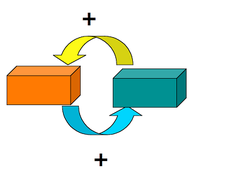
What is a positive feedback loop? Give an example.
It is feedback loop that amplifies and promotes the initial signal.
Example: MyoD - The initial production of MyoD targets muscle specific genes and thus produces itself.
What are negative feedback loops? Give an example.
Negative feedback loops is an inhibitory response to the initial signal, dampening the signal.
Example: Target Cell Adaption

Do signaling molecules work binary or in a spectrum?
Binary - there is no half on, we learned this with advanced single-cell measurements.
What are intracellular receptors?
Receptors inside the cell, where signaling molecules have to diffuse/cross the membrane.
What are nuclear receptors?
1. Nuclear receptors are ligand receptors inside the cell and are bound by hsp proteins
2. The ligand enters the cell and conformationally changes the nuclear receptors, freeing them from the hsp proteins
3. The newly activated nuclear receptors enter into the nucleus and become transcriptional activators (requiting cotranscriptional activators)
-Picture does not include the hsp proteins

What are GPCRs (G-protein coupled receptors)?
GCPRs are seven-transmembrane protein(s) that are responsible for mediating cell signaling.
What are trimeric G proteins?
intracellular proteins that mediate G protein-linked signaling (alpha, beta, and gamma subunits).
How does ligand binding start the GCPR and Trimeric G-protein cascade?
The ligand or signal molecule binds to the GCPR, thus leading to a conformational change. The GCPR-ligand conformational change becomes the Guanine Exchange Factor (GEF) for the Trimeric G-Protein.
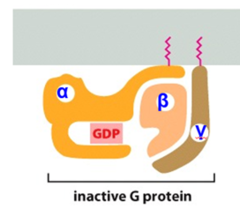
Which of the trimeric G-protein is anchored to the cell membrane?
The alpha complex and the gamma complex are attached via lipid-anchors. The beta is not anchored but is associated with the gamma complex.
What are the domains of the G-alpha complex?
Ras domain: The domain associated with the GCPR.
AH Domain: The protein domain responsible for binding to GDP and GTP.
What does the GTP-bound to the AH domain entail (talk about the complex and the following cascade)
1. The trimeric G-protein disassociates into the G-alpha complex and the G-beta/gamma complex. (Both still anchored)
2. The alpha subunit of the stimulatory G-protein laterally diffuses through the membrane and recruits adenylyl cyclase.
3. Adenylyl cyclase binds to the alpha subunit and becomes active, converting ATP into cAMP.
How is adenylyl cyclase deactivated?
Adenylyl cyclase is a GTPase activating protein (GAP) and increases the intrinsic GTPase activity within the alpha complex.
Thus, this hydrolyzes the GTP into GDP, resulting to an inactive form of the G-alpha complex.
What is cAMP?
cyclic AMP - a secondary messenger molecule

What is the primary effector of cAMP?
Protein Kinase A (PKA) is the primary effector of cAMP. cAMP molecules bind to regulatory subunits --> Freeing PKA --> Allowing it to phosphorylate targets.

How does PKA influence gene expression?
After being freed from the subunits via cAMP signaling molecules, PKA phosphorylates an inactivated CREB (a transcription factor) --> promoting transcription of a targeted gene (w/ the addition of a CREB-binding protein and the cyclic-AMP element sequence acting as an enhancer).
T/F: Phosphorylation is an irreversible process.
False: Phosphorylation is reversible with phosphatase

What is signal amplification?
- One GCPR-ligand complex can activate many stimulatory G-proteins,
- Each G alpha complex can activate multiple adenylyl cyclase
- Each adenylyl cyclase will convert multiple ATP molecules into cAMP.
- Each cAMP can then activate protein kinases which activate several molecules of target enzyme.

What are ATP-binding pockets? What are gatekeepers?
In PKs, there are ATP-binding pockets for ATP to fit right in. On the sides of these binding pockets are large amino acid residues- this is to ensure inhibitors are BLOCKED.
What would entail if you were to change this gatekeeper residue to a smaller side group?
The enzyme would be "holed," where this new mutated kinase would be able to fit inhibitors as opposed to the WT kinases with the bulky residues. (Selective inhibition)
What are the two different types of G-proteins?
G(s) and G(q), where Gs refers to cAMP and Gq is the Ca2+ pathway.
What is the start of the Gq pathway?
A ligand binds to the GCPR and creates a conformational change. This acts as the GEF for Gq protein, where the Gqa subunit releases GDP and uptakes GTP. This leads to the disassociation of the Gqa and Gqb/y subunits.
What does the activated Gq protein activate?
The activated Gq protein leads to the activation of the membrane-bound Phospholipase-C Beta protein (PLC-B).
What is the function of PLC-Beta and what are the resulting products?
PLC-Beta is responsible for cleaving PIP2 into two products: IP3 and diacylglycerol (DAG).
What are the functions of IP3 and DAG?
-IP3 is responsible for mediating IP3-gated Ca2+ channels in the ER --> Increasing cytosolic Ca2+ concentration.
-DAG is responsible to binding to one of the domains required to activate PKC (Protein Kinase C).
How does IP3 open the Ca2+ channel?
IP3 is a water soluble signaling molecule. This means it is polar in the cytoplasm and directs itself to the IP3-ligand gated Calcium channel.
T/F: PKC only needs DAG to activate?
False: PKC requires an integration of Ca2+ and DAG to activate, hence why IP3 is important in the process.
How is Ca2+ regulated in the cytoplasm? What could happen if unregulated?
1. Ca2+ can be pumped outside of the cell membrane via Na+/Ca2+ cotransporters.
2. Ca2+ can be pumped inside of organelles like the ER or Mitochondria.
- Lack of regulation can lead to activation of Ca2+ dependent kinases or CaM activation.
What is calmodulin and what does it do?
A highly conserved Ca2+ binding protein in the cytoplasm. Once the Ca2+ binds to CaM, the Ca-CaM complex can bind to target proteins, including kinases.

What is special about CaM kinase II (CaMKII).
It is a ring-like structured protein that exhibits molecular memory due to specific autophosphorylation reaction. Thus, it can still be activated after CaM disassociation.

What is target cell adaptation?
An inhibitory response after prolonged exposure to a stimulus.
How are GCPRs deactivated?
1. After prolonged activation, GPKs phosphorylate the activated GCPR on many regions.
2. The phosphorylated residues leads to leads to the binding of arrestin proteins.
3. This downregulates the signal, prevents interaction with the G-protein, and can even recruit clathrin-coated pits
What are enzyme-coupled receptors?
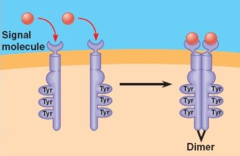
- The signal molecule dimerizes the inactive tyrosine proteins by bringing the kinase domains together to activate them

Explain RTK dimerization and the phosphorylation cascade that happens within the kinase domain?
RTKs or Receptor Tyrosine Kinases dimerize as a result of a signal molecule bringing them together.
- After the kinase domains dimerize, they in-trans autophosphorylation (bidirectionally), thus creating auto phosphorylated tyrosines.
What is the difference between in-trans or in-cis autophosphorylation? Why don't in-cis autophosphorylation happen in RTKs?
- In-trans autophosphorylation is when a kinase phosphorylates its neighbor chain (the other RTK)
- In-cis autophosphorylation is when a kinase phosphorylates its own chain.
- Due to the structural homology of the protein, in-cis autophosphorylation does occur.

Why are phosphorylated tyrosines important for signaling?
Proteins with the SH2 domain specifically bind to phosphotyrosines. Only SH2 proteins can bind to the RTKs.
How is there specificity between the SH2 proteins and the RTKs?
SH2 domains have two binding pockets:
1.) One of the binding pockets is specifically for phosphotyrosines
2.) The other binding pocket is for unique amino acid chains.
- This second pocket makes sure SH2 proteins have specificity when binding to the RTK.

If a GAP protein binds to Tyr-771, how is the binding affinity impacted if Tyr-771 changes to Phe-771?
Would that change the affinity of PLC-y at Tyr-1009?
1.) Changing Tyr-771 to Phe-771 would mean the SH2 domain of the GAP protein would not bind correctly. Thus not activating this protein.
2.) No, the binding of Tyr-1009 to PLC-y is independently recruited from Tyr-771. The SH2 domain would connect to Tyr-1009 and thus bind as normal.
What is the "Ras" protein and what does it do?
The Ras protein is a monomeric GTP binding protein that is lipid-anchored to the membrane. It is important to intracellular signaling.
Explain the activation process of Ras?
1.) With an activated RTK, the Grb2 adaptor protein binds with its SH2 domain.
2.) The adaptor protein recruits SH3, another protein (not related to SH2).
3.) This Grb2-SH3 complex recruits Ras-GEF --> bringing it closer to the membrane where Ras is located.
4.) The Ras-GEF is the key to releasing Ras-GDP and thus activating to Ras-GTP.

If Ras-GEF protein contained the lipid, myristic acid, attached to its N-terminus. Indicate what would likely happen to the Ras signaling pathway if this protein was expressed in wild-type cells?
The Ras-GEF would be anchored to the cell membrane, which would automatically decrease the distance from Ras, thus leading to Ras-GDP to disassociate.
T/F: The adaptor protein complex (Grb2) does not change the activity of Ras-GEF.
True: Ras-GEF functionality exists regardless of the adaptor protein, its vicinity is just changed to be closer.
What pathway(s) is Ras responsible for?
Ras is responsible for a variety of different pathways, but one important one is the MAP kinase pathway (kinase kinase kinase --> kinase kinase --> kinase).
How is Ras deactivated?
Ras has its own intrinsic GTPase activity (slow).
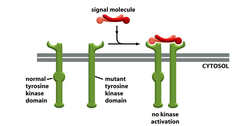
What are two ways an RTK is dysfunctional (think the receptor and kinase).
- A mutated receptor is worse because ligand-binding will be impaired and thus lead to no RTK dimerization.
-A heterodimer MUT-WT will not stimulate the kinase of the WT, as it takes dimerization of two tyrosine kinases to stimulate phosphorylation. This means the kinases will not phosphorylate each other.
What is the importance of PI3 kinase activity?
The PI3 kinase attaches to the phosphorylated tyrosine domain of the RTK and phosphorylates PIP2 molecules (the same as in the Gq pathway) into PIP3.
This is crucial for PI-based docking for proteins with PI3 specificity.

What is Akt and why is it important?
Akt is a protein responsible for cell growth and survival.
How is Akt activated?
- PIP3 recruitment is required first to have it docked.
- Next, the Akt protein has two phosphorylation sites, one from PDK1 phosphorylation and the other from mTORC2 phosphorylation
Which two important cell survival proteins have PIP3 docking?
Akt and PDK1

What is the function of Akt?
To understand Akt's function, it is impotant to define Bad and Bcl:
Bcl - apoptosis inhibitor protein
Bad - a protein that inhibits Bcl
Activated Akt phosphorylates the Bad protein, which then frees Bcl to inhibit apoptosis. This inhibition of apoptosis leads to cell survival.

What is the difference between mTORC1 and mTORC2?
mTORC2 - Inhibition of apoptosis
mTORC1 - Stimulation of cell growth
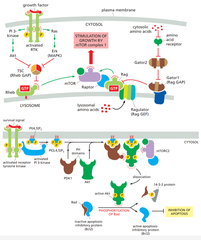
T/F: Cell signaling works in isolation
False, cell signaling works in complicated ways
What is apoptosis?
The process and organization of programmed cell death.

What is necrosis?
Cell death from extreme stressors
How is apoptosis utilized for development?
It helps to remove unwanted cells during development (i.e. webbing)

T/F: Apoptotic pathways are irreversible
True, for the most part, apoptosis is an irreversible
What are mutations that impact apoptosis called?
ced mutations

How is phosphatidylserine important for apoptotic process?
Phosphatidylserine is a specific phospholipid that helps to send out the "eat me signal"
What are the two different pathways for apoptosis
Extrinsic - caspases
Intrinsic - mitochondrial signal
What are caspases?
The main family proteases that carry out apoptosis. They have cysteine and cleave aspartic residues.

What is the first major step of the apoptosis extrinsic pathway? (Involving initiator caspases)
1.) There exists an apoptotic signal that comes in and activates an assembled adaptor protein complex.
2.) This assembled adaptor protein dimerizes a pair of inactive initiator caspase monomers.
3.) After dimerizing, cross-cleavage occurs of the pro-domains and subunit rearrangement happen --> creates a mature, active initiator caspase.

How does the active initiator caspase work?
The active initiator caspase proteolyzes the prodomains off of a pre-existing inactive dimer of executer caspases.
The executer caspases then go under subunit rearrangement to become mature, active executer caspases
(Executioner caspases are already dimers)

How does executioner caspase target scramblase and flipase?
1.) Cell membrane flippases are responsible for keeping phosphatidylserine inside of the cell, as it is a signal for apoptosis. Caspase will deactivate the flippase thorugh caspase-mediated cleavage.
2.) Cell membrane scramblase are usually turned off by default. With caspase turning on scramblase, phosphatidylserine lipids will be to homogenize on both sides of the leaflet, creating that signal.

How are apoptotic cells biochemically recognizable?
CAD is a protein responsible for cutting DNA, but usually is inhibited by iCAD. Executioner caspases cleave these iCAD inhibitors, and thus CAD can begin to fragment DNA --> leaving a biochemical signature.

What family of proteins are responsible for the intrinsic pathway?
The Bcl-2 family, contains both pro and anti apoptotic genes.
What is the intrinsic signal of apoptosis? How does it occur?
- Apoptotic signals come into the cell to mitochondrial membrane regulatory proteins
- They create a MOMP (Mitochondrial Outer Membrane Permeabilization)
- The Mitochondria releases Cytochrome C from the intermembrane space into the cytoplasm.
(Matrix proteins cannot escape because of the inner membrane)

What is the final form of the intrinsic apoptosis pathway?
Apoptosome - a scaffolding complex that brings caspases together (Don't remember any specifics).

T/F: lack of regulation of apoptosis can lead to cancer?
True
Cancers are follow _____ evolution. Explain your answer.
Monoclonal - tumor progression involves successive rounds of inherited mutations via natural selection
Why does cancer occur?
Cells lose the ability to control cell growth and do not respond to regulating signals

What is stem cell propagation in cancer?
That certain stem cancer cells (not real stem cells) are the roots of tumor formation.

What are overactivity mutations?
They relate to a gain of function mutation (dominant) and creates an oncogene.
What are different ways oncogenes can occur?
Point mutations, Regulatory mutation, Chromosomal rearrangement

A majority of oncogenes has mutations in what protein?
Ras
What are proto-oncogenes and oncogenes?
Proto-oncogenes are WT genes that can become oncogenes when mutated, which lead to cancer.
What is CML and Gleevec?
CML is a type of leukemia caused by chromosomal translocation. Gleevec is a targeted drug that binds to hyperactive oncogenic kinase.

What is an underactivity mutation?
Genes that are a loss of function (recessive). This is usually loss of tumor suppression genes.
Example: Retinoblastoma

How do tumor-suppression mutations happen?
Point mutations, deletions, epigenetic silencing
What is Rb responsible for in cell growth?
Rb is responsible for cell cycle entry.

Explain the Rb pathway
1.) Ras-GTP phosphorylates the MAP kinase pathway which activates Myc (transcription regulator protein)
2.) Myc will activate the G1-Cdk protein
3.) The activation of G1-Cdk indicates that the cell is ready to enter S-phase. So it goes phosphorylates Rb.
4.) Rb is an regulatory protein for E2F, so it being phosphorylated makes it lose affinity to the E2F protein.
5.) E2F goes to the nucleus and stimulates S-phase gene transcription

What is p53?
Tumor suppressor gene responsible for DNA damage tolerance and cell survival
What is the first step of the p53 DNA damage pathway?
1.) p53 exists in a complex of MDM2-p53. DNA damage alerts kinase proteins that phosphorylates p53, removing MDM2.
What is the first step of the p53 alternative pathway?
1.) Excessive mitogens lead to excessive myc production. This excessive myc production leads to the transcription and translation of Arf. Arf binds to MDM2, thus activating p53.
What does p53 do after being activated?
1.) p53 is activated and is a transcription factor for the p21 gene
2.) Transcription and translation of p21 creates the p21 protein or the Cdk inhibitor protein
What does p21 protein do?
The p21 protein binds to G1-Cdk and S-Cdk, leading to cell cycle arrest

Some cancer-associated mutations in p53 genes are dominant, with most of them being recessive. How?
- Dominant-negative inhibition by mutant RTK.
- MUT:WT RTK will out-titrate the WT RTKs