HEENT
 Call Kai
 Learn
Learn Practice Test
 Spaced Repetition
 Match
Match Flashcards
 Knowt Play
1/41

There's no tags or description
Looks like no tags are added yet.
Name | Mastery | Learn | Test | Matching | Spaced | Call with Kai | Chat |
|---|
No analytics yet
Send a link to your students to track their progress
42 Terms
What is Ménière’s disease? What is common patient presentation of Ménière’s disease?
disorder caused by fluid build up in the inner ear; sensorineural hearing loss
Vertigo, tinnitus, ear pressure, nystagmus and nausea
What is our biggest concern when providing care for a patient with Mèniere‘s disease? what does treatment look like?
Permanent hearing loss
no cure, but medications, diet changes and therapy can diminish symptoms
A new graduate nurse practitioner has a patient present with a hearing complaint. The patient states that they have had decreased hearing on the right side for the last month that is continuing to worsen. The nurse practitioner completes both the Rinne and the Weber test. If the patient has Ménière’s disease, what would be the expected finding on the Weber test?
The sound will lateralize to the left ear
What is a primary concern when dealing with a patient who has bells palsy?
Maintaining eye lubrication to prevent corneal abrasions
Conductive hearing loss vs sensorineural hearing loss
With conductive hearing loss, you can visualize the issue ( cerumen impaction). Will cause lateralization of sound to BAD ear during Weber test
With sensorineural hearing loss, you cannot physically visualize the issue, example such as meningitis or mumps.
Will cause lateralization of sound to the GOOD ear

Rinne Test
Place tuning fork on the mastoid bone.
A normal finding yields that air conduction is two times longer than bone conduction; an abnormal finding yields that bone conduction is two times longer than air conduction
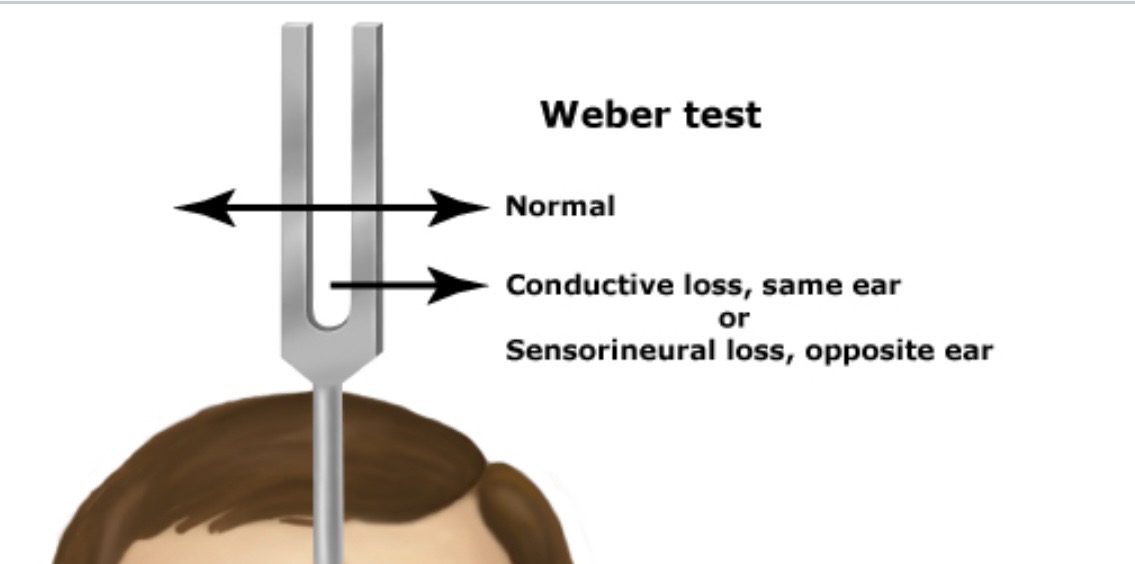
Webber Test
Place tuning fork on midline of skull.
A normal finding yields that the sound will be heard equally by both ears, meaning NO lateralization to either ear
What is the number 1 priority when a patient presents with an eye complaint?
Assessment of visual acuity
What is amblyopia?
Lazy eye
At what vision level is a patient considered legally blind?
20/100
What is the test for color blindness
Ishihara
What does a normal fundoscopic exam yield?
retinal arteries are thinner and lighter in color than veins
No hemorrhages or bulges
No cotton wool spots
No swelling of the optic disc (papilledema; needs referral)
Optic disc should have sharp margins
Positive red reflex
How can hypertension affect the appearance of the eye seen on fundoscopic exam?
copper wire arteries
arteriovenous nicking
flame hemorrhages
What is arteriovenous nicking?
Artery crosses a nerve causing a bulge
How can diabetes affect the appearance of the eye seen on fundoscopic exam!
cotton wool spots
neovascularization
microaneurysms

A patient presents to the office with an ocular presentation as seen below. They endorse sudden severe eye pain, blurred vision, and states that their eye feels firm to the touch. What diagnostics are we using? What is likely the diagnosis and how is it treated?
Tenometry
Acute angle closure glaucoma; increased intraoccular pressure
Refer to ED immediately
A patient states they they feel like “a curtain is being pulled over their eye”, are experiencing floaters, blurred vision, and flashes of lights. What is this patient experiencing? What do we do?
Retinal detachment; refer to the ED immediately
Central vision loss may suggest…
Macular Degeneration
What is the only curative treatment for cataracts?
removal and replacement of the occluded crystalline lens

What is this and what causes it? How are we treating this?
Arcus senilis is a common, harmless white, gray, or bluish ring or arc that forms around the edge of the cornea.
It is caused by fatty deposits (lipids and cholesterol) building up in the outer part of the cornea
We want to possibly increase statin doses and encourage lifestyle modifications

What is this and what causes it? How are we treating it?
xanthelasma
elevated cholesterol; want to possibly increase statin dose and encourage lifestyle modifications

What is this? What will we advise the patient?
Pterygium; which is a benign, noncancerous overgrowth of the conjunctiva that crosses over the cornea
Related to chronic sun exposure
vision may be impacted
Patient should wear UV sunglasses and discuss possibility of surgery
What are the 3 types of conjunctivitis? How do we differentiate them?
Bacterial; presents unilaterally and can spread to become bilateral; purulent drainage
Viral; presents unilaterally and can spread to become bilateral; serous drainage
Allergic; presents bilaterally; serous drainage that is often stringy/ropey
What is adenoviral conjunctivitis?
Pink eye
A patient presents with complaints of bilateral vision changes, difficulty driving at night, difficulty seeing things from a distance, and foggy/cloudy vision. A fundoscopic exam reveals an absent red reflex. What is likely the diagnosis?
Cataracts
What is presbyopia?
a normal, age-related eye condition where the lens inside the eye becomes less flexible, making it hard to focus on close-up objects like books or phones
How do corneal abrasions present? How do we diagnose a corneal abrasion
patient may state they feel as if something is stuck in their eye/sand sensation on the surface of their eye
fluorescein stain
What does tenometry measure?
Intraoccular fluid pressure
What is iritis? What might a patient complain of with this condition?
Inflammation of the iris
Patients will complain of eye pain, light sensitivity, decreased visual acuity, and a reddened scelera with visible swelling iris
Patient will need referral to opthlamology due to concern for blindness
treatment = steroid eyedrops
What can occur if a patient with Bell’s palsy does not properly lubricate their eyes.
Corneal abrasion
What is presbycusis? How is it diagnosed and what is the first line treatment?
Gradual, progressive, symmetrical hearing loss in older adults (60+)
Patients may also experience tinnitus and mild dizzinesss
Diagnosed using audiogram testing
First line treatment is hearing aids
What is otomycosis?
Fungal infection of the external ear
What is presbyopia?
Progressive visual impairment that causes farsightedness
Describe oral candidiasis. What are common risk factors? What is the treatment?
Oral thrush; will present as white plaques that appear in a patients mouth, commonly the tongue. Will often be able to scrape off the plaque using a tongue depressor
Patients may also report changes to taste, mouth pain and some difficulty swallowing
Risk factors include immunosuppression, use of inhaled steroids, and diabetes
Treatment can be use of topical antifungals
What is the first line pharmacological treatment for allergic rhinitis? How does it normally present?
Fluticasone (Flonase)
Presents as pale, boggy mucosa and patient will report rhinorrhea, sneezing, obstruction, mucosal swelling and pharyngeal itching

What is this? What will we advise the patient?
a harmless, non-cancerous yellowish bump or patch that forms on the conjunctiva but does NOT cross into the cornea
results from chronic sun exposure
vision is typically not affected
advise patient to wear UV sunglasses
hordeolum vs chalazion
hordeolum = style; typically caused by an infection; presents with pain, tearing, sensitivity to light and purulent drainage; patient may need abx
chalazion = blockage of duct/oil gland that results in painless swelling; presents as a small, red, beadlike nodule on the eyelid; treatment is a warm compress
what is herpes keratitis? how i it diagnosed and treated?
HSV infection of the cornea
Patients report “fern-like” lines on the cornea
diagnosed using a black lamp exam to visualize the cornea
treatment is antivirals
what is otosclerosis? how is it treated and how does it present?
is bone growth inside the middle ear that causes remolding
presents with hearing loss, vertigo and dizziness
treatment = hearing aid for mild cases; surgery in severe cases
what is cholesteatoma? how does it present and how is it treated?
abnormal, white, cauliflower looking skin growth in the middle ear (behind ear drum)
presents as recurrent ear infections with a foul smell
treatment = surgery; as it can damage CN7 if not removed
what is leukocoria? what do we need to advise the patient
white reflect seen during eye examination
patients should be referred to opthamology for evaluation of potential lens surgery; could indicate cataracts if seen bilaterally
Inhaled corticosteroids carry a risk of oral thrush when patients do not rinse their mouths properly after use. What do we do in this case?
Prescribe oral nystatin mouthwash and educate patients to rinse their mouths thoroughly after use of inhaled corticosteroids