Organisms exchange surfaces
 Call Kai
 Learn
Learn Practice Test
 Spaced Repetition
 Match
Match Flashcards
 Knowt Play
1/112

There's no tags or description
Looks like no tags are added yet.
Name | Mastery | Learn | Test | Matching | Spaced | Call with Kai | Chat |
|---|
No analytics yet
Send a link to your students to track their progress
113 Terms
What is the relationship between SA:V ratio and the size of an organism
The larger an organism, the smaller the SA:V ratio
How do small organisms e.g. unicellular transport substances
they have a smaller SA:V ratio so they can simply exchange by diffusion due to their short diffusion pathway
What effect does SA:V have on metabolism
smaller organisms lose heat faster so they have a higher rate of metabolism and respiration
What is different in exchange in larger organisms
they have larger SA:V ratio
This means they require special adaptations such as alveoli due to their demand of a higher metabolic rate and efficient waste transport
How does gas exchange happen in unicellular organism
they have a short diffusion pathway from the centre of the cell from the cell membrane
They have a large SA:V ratio
Photosynthesis and respiration ensure a concentration gradient
What do insects have for gas exchange
They have a tracheal system with spiracles, trachea and tracheoles
How does oxygen move into cells in an insect via diffusion
air with oxygen diffuses down spiracles, down trachea then tracheoles to the cells
This is driven by the concentration gradient provided when the cells respire
CO2 leaves via spiracles
How does gases move into insect by mass transport
The insect contracts and relaxes abdominal muscles to move gases on mass
Describe abdominal pumping
The rhythmic relaxing and contracting of abdominal muscle which increases or decreases the volume and pressure of the abdomen so O2 or CO2 moves in or out down the pressure gradient
How does gases move into insects while flying
the muscle cells respire anaerobically which produces lactate
This lowers water potential of cells, causing water to move out of tracheoles into cells
This decreases the volume of trachea so air is driven in
What are the adaptations of the tracheal system (4)
tracheoles have thin walls so short diffusion pathway
Highly branched so large SA
Diffusion of gases through air is very fast
Larger insects have abdominal pumping which maintains concentration gradient
How are insects adapted to prevent water loss
waterproof coating
Spiracles have valves which open and shut which prevent excessive water loss
Reduces SA:V ratio where water evaporates
What is a fish’s gas exchange system
They have four layers of gils made up of gill filaments covered in lamellae
They have a counter current flow to maintain concentration gradient
Describe the counter current flow
blood flows in opposite direction of water
So, blood is always next to water with high oxygen concentration so oxygen rapidly diffuses in
The countercurrent flow ensures that an equilibrium isn’t reached and there is a concentration gradient
It maintains this concentration gradient along whole lamellae
What are the adaptations of the gills (4)
many lamellae to provide large surface area
Thin epithelium + capillary network in each lamellae for short diffusion pathway
Ventilation of gills provides high oxygen water to maintain concentration gradient
Replacement of deoxygenated blood with oxygenated blood via circulatory system maintains concentration gradient
How does gas exchange occur in plants
palisade calls use CO2 for photosynthesis which creates a diffusion gradient
The cO2 diffuses into stomata then air spaces then into these cells
The CO2 can also diffuse in from adjacent mitochondria
What are the adaptations plants have for gas exchange (4)
Many stomata for large SA
Air spaces allow large SA
Large SA:V ratio for higher rate of diffusion
Thin leaves for short diffusion distance
What are xerophytes
plants found in areas of little water
What are the adaptations of xerophytes (4)
thicker waxy cuticle = prevent uncontrolled evaporation
Small leaf SA = reduces area for evaporation
Low stomatal density = smaller SA for diffusion
Sunken stomata and hair = reduces water potential gradient
How to measure surface area of leaf
Draw around leaf on graph paper
Count the number of squares inside the drawing
Multiply the answer by two to get the surface area of both the top and bottom sides
What is the path air takes to the alveoli
Mouth → trachea → bronchi → bronchioles → alveoli
Describe gas exchange in mammals
there is a high concentration of oxygen in alveoli
Oxygen diffuses down concentration gradient across alveoli epithelium and capillary endothelium
Oxygen associates with haemoglobin to make oxyhaemoglobin for transport
What are the adaptations of gas exchange of mammals
squamous, one cell thick cells so short diffusion pathway
Lots of folded alveoli for large surface area
Good circulation and ventilation for maintaining concentration gradient
How does inspiration work
external intercostal muscles contract and internal relax which lifts ribcage up and out
Diaphragm contracts and flattens
This increases volume of thoracic cavity and lowers pressure below atmospheric pressure
Air moves in down pressure gradient
How does expiration work
external intercostal muscles relax and external contract which moves ribcage down and in
This relaxes diaphragm and it becomes dome shaped
This decreases volume of thoracic cavity and increases pressure above atmospheric pressure
Air moves out down pressure gradient
What is tidal volume
Volume of air per breath
What is breathing rate
Number of breaths per minute
What is pulmonary ventilation
Volume of air that enters lungs per minute
How to calculate pulmonary ventilation
Pulmonary ventilation = tidal volume x breathing rate (dm³)
What is the purpose of digestive enzymes
They break down large insoluble substrate to soluble products which can be absorbed into the bloodstream and assimilate into bloodstream
What are the stages of breaking down carbohydrates
Starch to maltose to glucose
How is starch broken down
Starch → maltose via amylase
Where is amylase found
salivary glands
Pancreas
How is maltose broken down
Maltose → glucose via maltase
Where is maltase found
membrane bound disaccharidase found on cell membrane of epithelial cells in small intestine
What is the first stage of breaking down proteins
Endopeptidase hydrolyse peptide bonds within protein which makes smaller chains and increase surface area
What is the second stage of breaking down proteins
Exopeptidase hydrolyse peptide bonds at ends of proteins
What is the third stage of breaking down proteins
Dipeptidase (exopeptidase) hydrolysis dipeptides into amino acids
Where are exopeptidase and endopeptidase found
stomach
Small intestine
Where are dipeptidase found
Membrane bound dipeptidase found in the cell membrane of epithelial cells in small intestine
How are aminos acids absorbed into small intestine
cotransport
Na+ ions actively transported from cell into capillary using ATP, creating concentration gradient
Cotransport protein binds Na+ with amino acids and they diffuse in via facilitated diffusion
Amino acids go back into capillary via facilitated diffusion
What is the process of lipid breaking down
Tryglyceride → monoglyceride + 2 fatty acids via lipase
What are bile salts used for
They emulsify large lipid molecules to smaller droplets to increase surface area
What happens to the smaller lipid droplets
Lipase digest these into smaller drops called micelles
How are micelles absorbed
micelles move towards cell membrane of epithelial cells as they are soluble
Fatty acids and monoglycerides are lipid soluble so they move across membranes
They then reform into tryglycerides in smooth endoplastic reticulum or Golgi
What is mass transport
The bulk transport of molecules around the body
Describe the structure of haemoglobin
4 polypeptide chains so quaternary structure
Has a haem group (Fe2+) which binds with oxygen
When does oxygen associate with haemoglobin
in a high partial pressure of oxygen as it has a high affinity
The lungs
Where does oxygen dissociate with haemoglobin
where there is a low partial pressure as it has a low affinity
What does high affinity mean
Combines with oxygen more readily
What does low affinity mean
Releases oxygen more readily
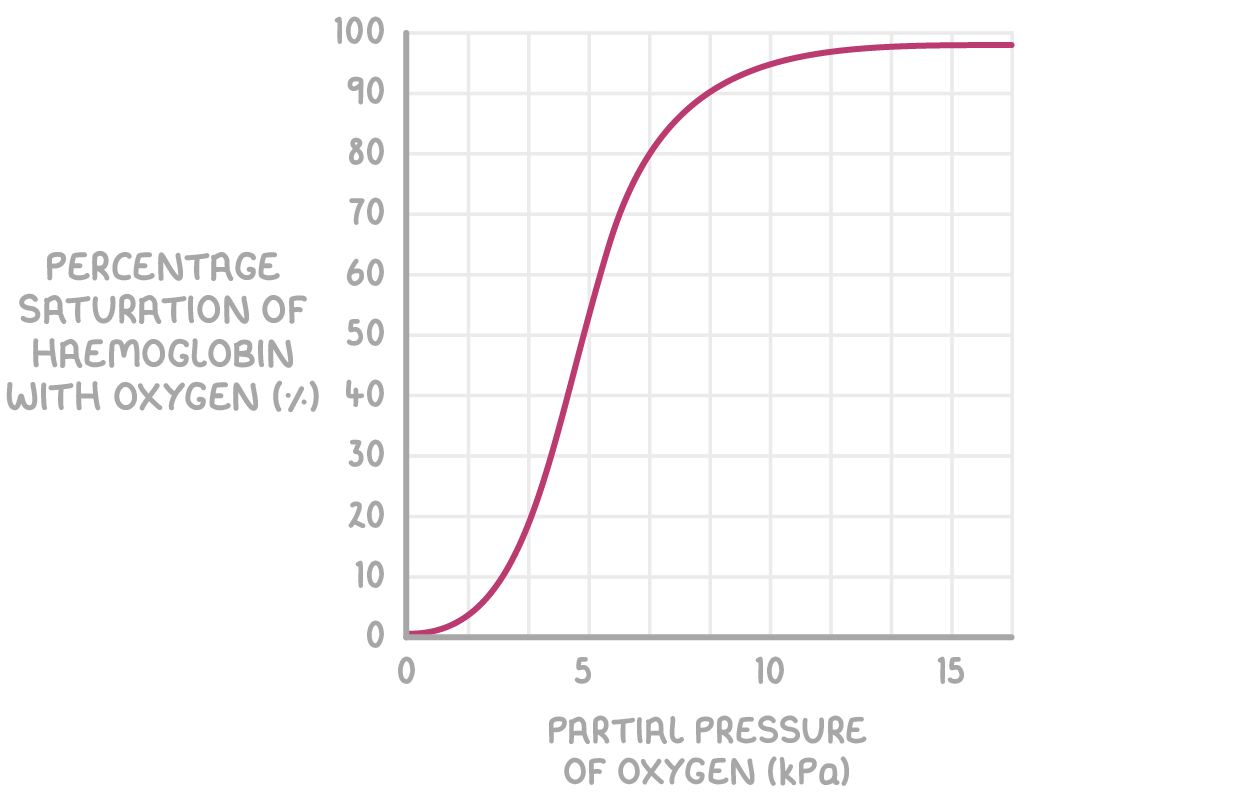
Why is the oxygen dissociation curve this shape
Cooperative binding which means it difficult for the first oxygen to bind but once it does, the tertiary structure of the haemoglobin changes which uncovers another binding site which makes it easier for a second oxygen to bind
Where does haemoglobin have high affinity
At the lungs
Where does haemoglobin have low affinity
At the respiring cells
What is the Bohr effect
The oxygen dissociation curve shifts to the right, lowering affinity, allowing for more oxygen to be dissociated for more respiration for more ATP
Why does the Bohr effect happen
when respiring, CO2 produced which lowers the pH of the blood which changes the tertiary structure of proteins and enzymes as it breaks hydrogen bonds
Where else is the curve shifted to the right
In Animals with a higher metabolic rate so higher rate of respiration
In what cases does the curve shifted to the left
Animals who live in areas with low oxygen leads to the curve shifting to the left
Why is the curve shifting to the left beneficial to animals who live in areas with low oxygen
haemoglobin has a higher affinity for oxygen
Oxygen more readily associates
Enough oxygen for more respiration
What is the cardiac muscle
The thick muscular walls of the heart which are myogenic and doesn’t fatigue with oxygen
What is the coronary artery
Supplies the heart with oxygen and it branches off the aorta
What are the atria
They have thinner muscular walls with weaker contractions as it only pumps blood to the ventricles
What are the ventricles
They have thicker muscles for bigger contractions as they withstand higher pressure as blood flows to the lungs and body
Why is the right ventricle thicker than the left
left = thicker muscles for larger contractions due to higher pressure as it pumps blood to whole body
Right = bit thinner as it prevents damage to capillaries and for slower flow to allow gas exchange
What is the vena cava
Carries deoxygenated blood from the body to the heart
What is the pulmonary vein
Carries oxygenated blood from the lungs to left atrium
What is the pulmonary artery
carries deoxygenated blood from right atrium to lungs
What is the aorta
Carries oxygenated blood from left ventricle to the rest of the body
Describe the cardiac cycle (5)
blood flows from the vena cava and pulmonary vein into the atria which increases its pressure moving blood passively into ventricle
The atria contract and blood moves down pressure gradient to ventricles so the AV valves open as pressure is higher in the atria
The atria relax but now the pressure in ventricles is now higher than atria so AV valves shut
The ventricle contracts and there is now a higher pressure in the ventricles than the arteries so semi lunar valves open and blood passes into the aorta and pulmonary artery
Ventricles relax and pressure in arteries are higher and semi lunar valves shut
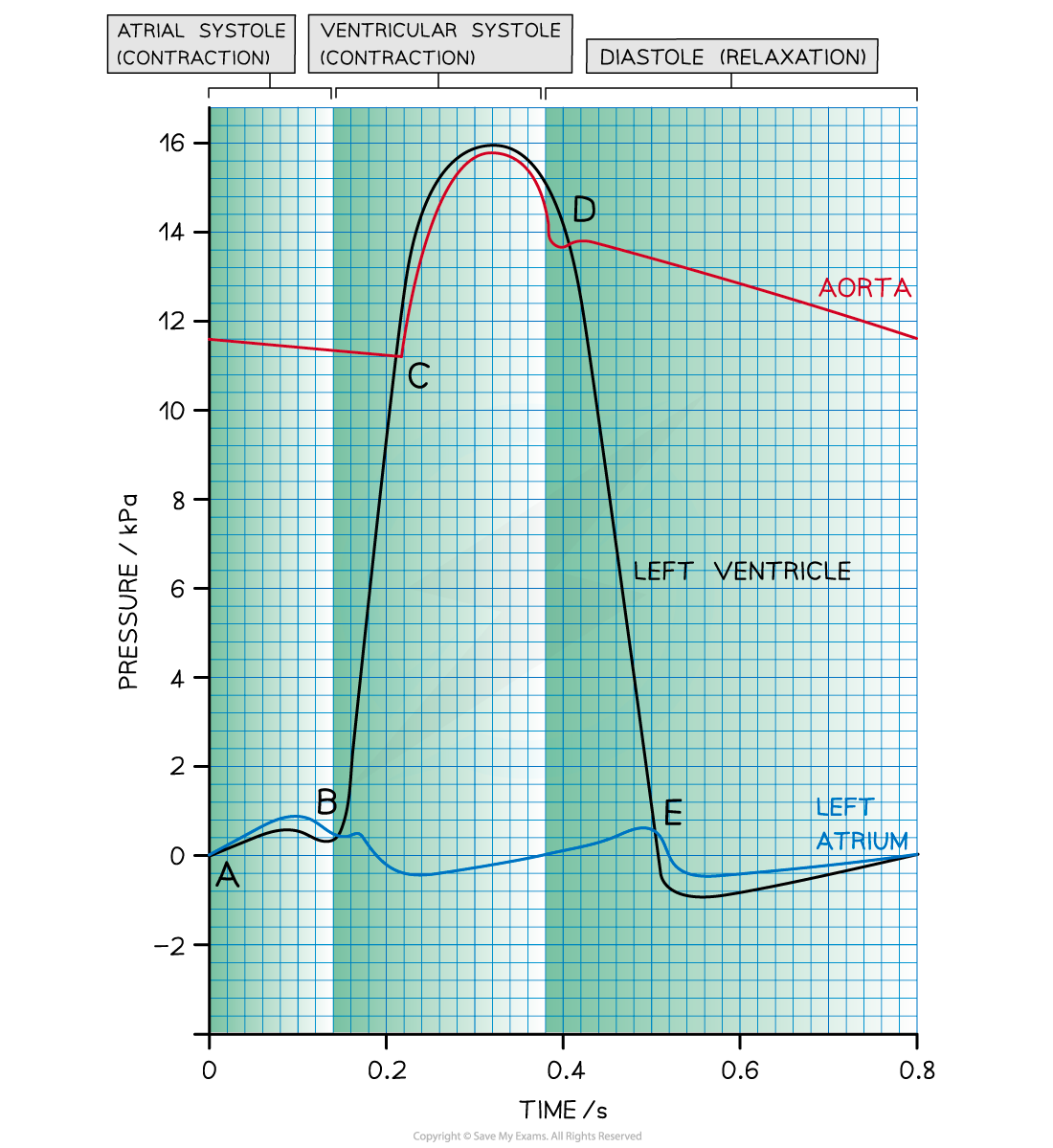
Describe the graph
B = closing AV valves
C = opening semi lunar valves
D = closing semi lunar valves
There is a small increase before the dip due to the elastic recoil of the artery which helps maintain blood pressure
E = opening semi lunar valves
How to calculate cardiac output
Cardiac output = heart rate x stroke volume
cardiac output = volume of blood leaving ventricle in one minute
Heart rate = how long it takes for the heart rate to return to original
Stroke volume = the range of the values
Why do mammals require a double circulatory system
increase pressure and the rate of flow of bood
To allow more O2 for more respiration
What are arteries
carry blood away from heart
Highest pressure as it carries blood from ventricles
What are arterioles
They join arteries to capillaries
What are capillaries
Blood vessels that allow the transport of substances
What are veins
They carry blood to the heart
low pressure due to friction from blood flow and further away from ventricle
What are venules
They join veins with capillaries
Features of arteries
thick muscular layer to prevent bursting under high pressure
Thick elastic layer to maintain high pressure as it stretches when high and recoil when low
Endothelium reduces friction
Features of arterioles
Thick muscular later to control flow as it contracts reducing blood flow by narrowing lumen which prevents damage to capillary
Features of capillaries
one cell thick endothelial = short diffusion pathway
Highly branched for large SA
Narrow lumen to slow blood for more time for diffusion
Pores between endothelial cells for tissue fluid
Features of veins
thin elastic and muscle layer due to lower pressure
Larger lumen
Valves to prevent backflow of blood
What is tissue fluid
Fluid containing glucose, amino acids, fatty acids, ions and oxygen which bathes tissues
How is tissue fluid formed
capillaries have small gaps so liquid and small molecules forced out
As blood enters capillaries via arterioles, the smaller diameter causes a higher hydrostatic pressure sp small molecules such as glucose and water forced out
Ultrafiltration
What happens to the larger molecules in tissue fluid
They remain in the fluid
Red blood cells, platelets, large proteins
How is tissue fluid reabsorbed
large molecules lower the water potential
At venule end, there is a lower hydrostatic pressure due to loss of liquid as well as a low water potential
Water renters capillaries by osmosis down water potential gradient alongside waste products such as CO2
Why wont all liquid be reabsorbed by osmosis
Since an equilibrium will be reached
What happens to the rest of tissue fluid
They are absorbed by lymphatic system and they eventually drain back into bloodstream near heart
What is the role of the heart in tissue fluid production
contraction of ventricles cause a high hydrostatic pressure
This means that smaller molecules like water are forced out of capillary by ultrafiltration
What is transpiration
The loss of water by evaporation via stomata
What is transpiration affected by
light intensity
Temperature
Humidity
Wind
Wh does light intensity affect transpiration
the higher it is, the more open stomata so there is a larger surface area for evaporation
Why deos temperature affect transpiration
The more heat, the more kinetic energy so there are faster molecules so there is more transpiration
Why does humidity affect transpiration
The more water vapour, the lower the water potential gradient so there is less evaporation
Why does wind affect transpiration
The higher the wind, the more water vapour blown away which maintains the concentration gradient so more evaporation
What are the adaptations of xylem
hollow tubes with no living components for easier non restricted water flow
No end walls to create a continuous column of water
The side walls are strengthened with rings of lignin
Pores allow movement between lignin
What is the effect of adhesion
It causes capillarity as when water molecules adhere to the xylem walls, it makes it narrower and capillarity forces water up the column
What is root pressure
When water moves into the roots by osmosis, there is now a higher pressure in the roots than the xylem so water moves into the xylem down a pressure gradient which aids the continuous column
Explain the water cohesion theory
water lost from lead because of the evaporation of water from the mesophyll cells
This lowers the water potential of mesophyll cells and pressure
The water is pulled up xylem, creating tension and is pulled up via transpiration pull and negative pressure
The water molecules stick together via cohesion via hydrogen bonds, forming a continuous column of water
The water molecules adhere to the walls of xylem
What is the purpose of the potometer practical
Measures the rate of uptake of water in a time period which is proportional to transpiration
it introduces one air bubbles and its distance is measured
Why is the sample cut underwater
To prevent air entering xylem and breaking the column