Plant Morph 2
 Call Kai
 Learn
 Practice Test
 Spaced Repetition
 Match
 Flashcards
 Knowt Play
1/59

There's no tags or description
Looks like no tags are added yet.
60 Terms
Haplontic Cycle
Dominant Stage: Multicellular haploid (n) adult.
Haploid adult produces gametes (n) by mitosis. Gametes fuse (fertilization) to form a diploid zygote (2n). The zygote is the only diploid stage and immediately undergoes meiosis to produce haploid spores (n), which grow into new adults.
Examples: Chlamydomonas, Spirogyra, Charophytes.
Diplontic Cycle
Dominant Stage: Multicellular diploid (2n) adult.
Process: Diploid adult undergoes meiosis to produce unicellular haploid gametes (n). Gametes fuse (fertilization) to form a diploid zygote (2n), which develops into a multicellular adult.
Examples: Fucus (rockweed), Diatoms (Bacillariophyceae), Saprolegnia (Oomycete), animals.
AG cycle
Dominant Stage: Involves both a multicellular haploid stage (gametophyte) and a multicellular diploid stage (sporophyte)
Isomorphic AG
Gametophyte and sporophyte are morphologically identical in appearance (e.g., Ulva / sea lettuce).
Heteromorphic AG
Gametophyte and sporophyte are morphologically distinct/different in size, shape, and structure (e.g., Laminaria, Bryophytes, Lycophytes).
Antheridium (n)
Male gametangium; produces flagellated sperm
Archegonium (n)
Female gametangium; produces and retains a single egg.
Sporophyte (2n)
Diploid multicellular generation. Arises from the zygote (2n) and produces haploid spores (n) via meiosis inside sporangia.
Evolutionary Trend in Dominance
Non-Vascular Plants (Bryophytes): Dominant, independent gametophyte (n); sporophyte (2n) is permanently attached and nutritionally dependent on the gametophyte.
Seedless Vascular Plants (Lycophytes/Monilophytes): Dominant, independent sporophyte (2n); gametophyte (n) is reduced, short-lived, but free-living
Homospory
Sporophyte produces one type of spore that gives rise to a bisexual/monoecious gametophyte bearing both antheridia and archegonia. (Found in mosses, liverworts, clubmosses like Lycopodium).
Heterospory
Sporophyte produces two distinct types of spores in different sporangia:
Significance: Promotes endosporic development (gametophyte develops inside the spore wall) and represents a key evolutionary step toward the seed. (Found in Selaginella/spikemosses)
Microsporangium (2n)
Produces microspores (n), which develop into male gametophytes (produce sperm).
Megasporangium (2n)
Produces megaspores (n) (usually 4), which develop into female gametophytes (produce eggs).
Euglenoids
Phylum Euglenozoa
Unicellular
Photosynthetic, mixotrophic, or heterotrophic; chloroplasts from secondary endosymbiosis (3 membranes)
Dinoflagellates
Phylum Miozoa
Unicellular
Autotrophic, mixotrophic, or heterotrophic; secondary/tertiary endosymbiosis.
Diatoms
Phylum Ochrophyta
Class Bacillariophyceae
Unicellular/colonial
Photosynthetic; pigments: Chl a, c, fucoxanthin (brown color)
The most numerous of the phytoplankton
Golden Algae
Phylum Ochrophyta
Class Synurophyceae
Unicellular or colonial; bi-flagellated.
Photosynthetic or mixotrophic; pigments: Chl a, c, fucoxanthin
many produce a distinctive ‘stinky pond’ odor
Brown Algae
Phylum Ochrophyta
Class Phaeophyceae
Multicellular macroalgae
Photosynthetic; pigments: Chl a, c, fucoxanthin.
air bladder
Water Molds (Saprolegnia, Phytophthora, Plasmopara)
Phylum Oomycota
Filamentous hyphae-like growth, coenocytic; flagellated zoospores
Heterotrophic decomposers or severe plant/animal pathogens (parasitic)
Red Algae
Phylum Rhodophyta
Multicellular macroalgae; completely lack flagella at all stages; contain cell wall galactans
Photosynthetic; pigments: Chl a, c, phycobilins
Green Algae (Chlorophytes)
Class Chlorophyceae & Ulvophyceae
Unicellular to multicellular; flagellated cells; Volvox shows volvocine line to multicellularity; Ulva is sheet-like thallus.
Photosynthetic; pigments: Chl a, b, carotenoids; store starch in plastids; cellulose cell walls
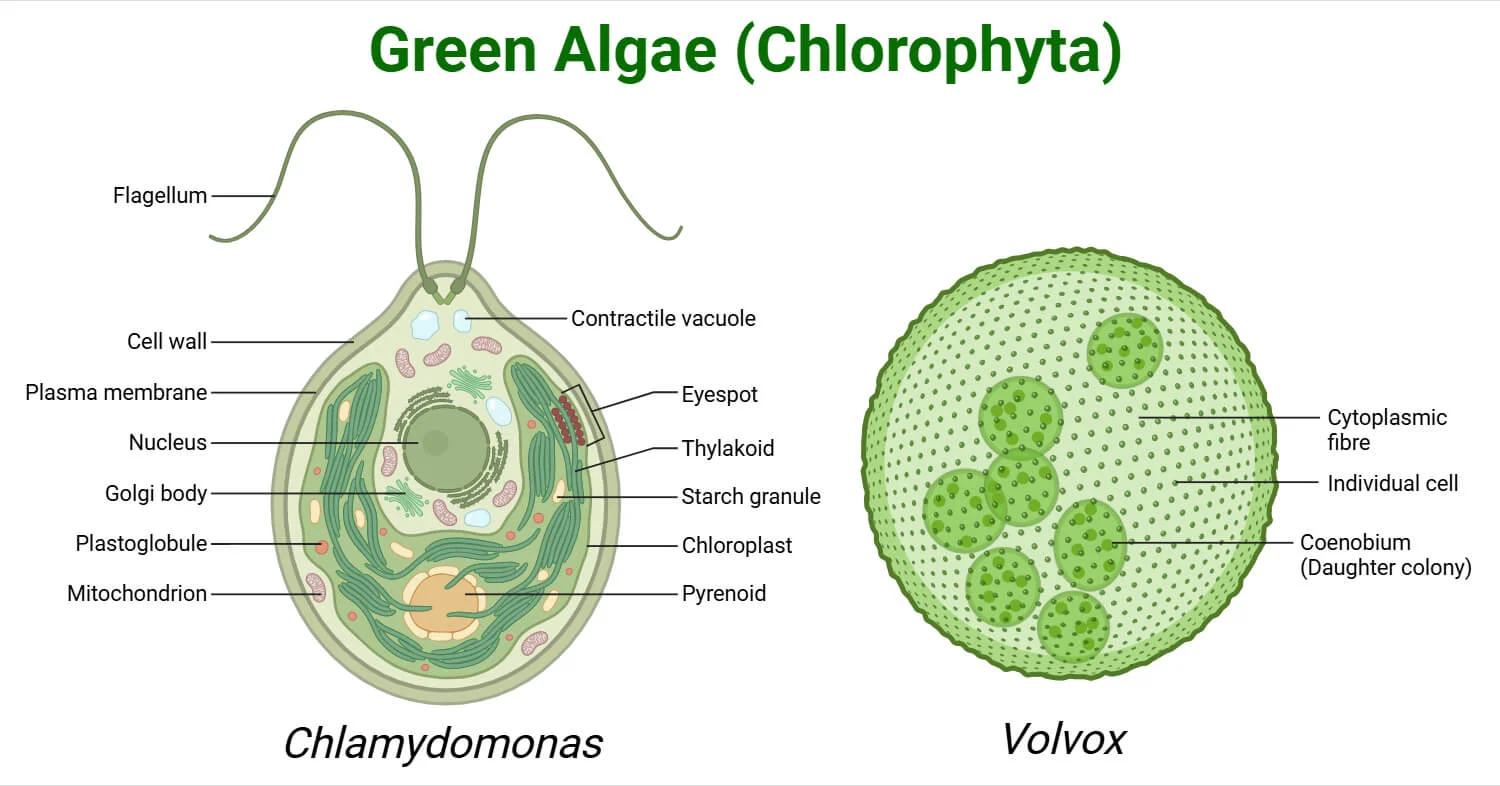
Green Algae (Charophytes)
Class Charophyceae (Zygnematales, Coleochaetales, Charales)
Filamentous (Spirogyra), discoid thallus (Coleochaete), or node-internode branching whorls (Chara). All have haplontic life cycle
Photosynthetic; Chl a, b, carotenoids.
Air Bladders
Structure: Gas-filled vesicles (pneumatocysts) located on the thallus/lamina of brown algae (e.g., Fucus, Macrocystis).
Environmental Function: Ocean water is dense, but light attenuates quickly with depth. Air bladders provide buoyancy, lifting photosynthetic blades toward the surface where sunlight intensity is highest for maximum photosynthesis.
Why Diatoms and Dinoflagellates Deserve Gratitude
Global Oxygen Production: Diatoms alone generate at least 20% of the atmospheric oxygen on Earth through photosynthesis.
Base of Aquatic Food Webs: Dinoflagellates ("grass of the ocean") and diatoms are the primary producers driving marine and aquatic ecosystems.
Coral Reef Ecology: Dinoflagellates (Zooxanthellae) live endosymbiotically inside corals, providing nutrients/sugars that allow coral reef ecosystems to thrive.
Embryophyta
Monophyletic group comprising all land plants (liverworts, hornworts, mosses, lycophytes, ferns, gymnosperms, angiosperms).
Why the Name is Used: Refers to matrotrophy—a defining synapomorphy where a multicellular diploid embryo is retained and nourished within the female gametangium (archegonium) of the parent gametophyte.
Matrotrophy In Charophytes (Coleochaete)
The female gametophyte retains and nourishes the single zygote; parental cells grow around it for protection and transfer nutrients.
Matrotrophy In Embryophytes
This trait evolved into full-fledged embryo retention, protection, and nourishment within the archegonium across all land plant life cycles.
Desiccation Prevention: Adaptations to Life on Land
Waxy Cuticle: Hydrophobic layer secreted over the epidermis to prevent water loss.
Stomata: Reg Regulatable pores with guard cells allowing gas exchange (CO2 in, O2/H2O out) while minimizing water evaporation.
Gravity & Structural Support:Adaptations to Life on Land
Lignin: Rigid, waterproof hydrocarbon polymer deposited in secondary cell walls of vascular plants, strengthening cell walls to allow tall vertical growth.
Protection from UV Radiation:Adaptations to Life on Land
Accumulation of protective pigments (carotenoids, flavonoids).
Dispersal & Gamete Protection:Adaptations to Life on Land
Multicellular Gametangia: Antheridia and archegonia enclosed by protective sterile cell layers.
Sporopollenin: Extremely resistant biopolymer forming the outer wall (exine) of spores, protecting them from desiccation and UV damage during wind dispersal.
Phylum Marchantiophyta (Liverworts)
First land plants (~475 mya). Developed cuticle, multicellular gametangia, and embryo retention. Lacks stomata (has simple open pores).
Gametophyte: Dominant; thalloid (e.g., Marchantia, complex/simple thallus with air chambers and pores) or leafy (Class Jungermanniiopsida).
Structures:
Antheridiophore: Stalked umbrella-like structure holding antheridia on top.
Archegoniophore: Stalked finger/wheel-like structure holding archegonia on the underside.
Gemma Cups / Gemmae (n): Asexual haploid tissue packets dispersed by splash drops.
Reproduction & Dispersal: Water required for swimming flagellated sperm. Sporophyte (2n) (foot, seta, capsule) develops under the archegoniophore. Spores (n) dispersed via wind assisted by elaters (hygroscopic single cells with helical thickenings that twist as humidity changes).
Phylum Anthocerotophyta (Hornworts)
Evolved true stomata on photosynthetic sporophytes
Gametophyte: Flat thallus; often forms symbiotic relationships with nitrogen-fixing Nostoc cyanobacteria.
PPTX
Sporophyte: Elongated, horn-like cylindrical sporangium that grows continuously from a basal meristem, photosynthesizes, and possesses stomata. Splits open vertically at maturity to release spores.

Phylum Bryophyta (Mosses)
Evolved specialized conducting cells (hydroids for water, leptoids for nutrients).
Protonema (n): Filamentous thread-like stage germinating from a spore, forming buds that become leafy gametophytes.
Enations: Leaf-like structures lacking true vascular veins.
Splash Cups: Specialized enation clusters at shoot tips of male gametophytes that catch raindrops to splash sperm.
Sporophyte Structure: Foot (anchor/nutrition transfer), Seta (stalk), Capsule (sporangium), protected by Calyptra (gametophyte tissue cap) and Operculum (capsule lid).
Peristome Teeth: Rings of hygroscopic teeth around capsule mouth that open under dry conditions to disperse spores into the wind.

Phylum Tracheophyta - Class Lycopodiopsida (Lycophytes - Clubmosses & Spikemosses)
Evolved true vascular tissue (xylem with lignified secondary cell walls & phloem), independent branched sporophyte, true roots, and microphylls.
Seedless Vascular Plants (Class Lycopodiopsida)
General Vascular Innovations: Lignified xylem, phloem, dominant/independent branched sporophyte, true roots/shoots, true leaves
Order Lycopodiales (Club Mosses)
horizontal stem (rhizome); covered in microphylls (leaves with a single, unbranched vascular vein).
Structures:
Strobilus (plural: strobili): Cone-like structure of densely packed sporophylls (modified microphylls bearing sporangia) at shoot tips.
Gametophyte: Monoecious, subterranean/non-photosynthetic, reliant on mycorrhizal fungal partners.
Order Selaginellales (Spike Mosses)
Structures:
Heterosporous Strobilus: Contains microsporangia (producing microspores → male gametophytes inside spore wall) and megasporangia (producing 4 megaspores → female gametophytes inside spore wall with archegonia).
PPTX
Endosporic Development: Gametophytes develop entirely within the spore walls.
Dermal Tissue
Outer protective covering (epidermis, cuticle, guard cells/stomata).
Ground Tissue
Bulk of plant body (parenchyma, mesophyll) used for photosynthesis, storage, and support.
Vascular Tissue
Conducting system running continuously throughout root and shoot.
Meristem Tissue
Regions of unspecialized, actively dividing cells (mitosis) driving growth (e.g., apical meristems at tips; vascular cambium for lateral expansion)
Xylem
Function: Transports water and inorganic minerals upwards (one-way) from roots to stems and leaves.
Structure: Cells have thick, lignified secondary cell walls and are dead at functional maturity.
Phloem
Function: Transports sugars, amino acids, and nutrients bi-directionally throughout the plant body.
Structure: Sieve elements with sieve plates; cells are living at functional maturity and lack lignin
Microphylls
Leaves with a single unbranched vascular vein. Evolved as epidermal outgrowths (enations) that later acquired a vascular trace. (Characteristic of Lycophytes).
Megaphylls
Leaves with branched vascular systems. Evolved from overtopping, planation (flattening), and webbing of side branch systems. Can undergo abscission. (Characteristic of Monilophytes and Seed Plants).
Lignin
A complex organic polymer deposited in the cell walls of many plants, making them rigid and woody.
Location: Deposited exclusively within the secondary cell wall of specialized cells (e.g., tracheids, vessel elements in xylem, sclerenchyma).
Significance & Features Enabled:
Structural Integrity & Height:
High-Pressure Hydrodynamics: Waterproofs xylem conduits, allowing water to be pulled upward under negative pressure without cell collapse.
Evolutionary Impact: First appeared ~400 mya in early Devonian tracheophytes, laying the foundation for Carboniferous coal swamp forests dominated by giant arboreal lycopods (Lepidodendron).
Gemma Cup / Gemma
Upper surface of thallus
Haploid (n)
Asexual reproduction via rain splash dispersal
New clone gametophyte
Antheridium
Gametophyte shoot tips / antheridiophores / male gametophytes
Haploid (n)
Male gametophyte
Archegonium
Gametophyte shoot tips / archegoniophores / female gametophytes
Haploid (n)
Female gametangium; site of fertilization & matrotrophy
Single egg (n
Antheridiophore / Archegoniophore
Liverworts
Stalks extending upward from thallus
Haploid (n)
Capsule (Sporangium)
Bryophytes (Mosses, Liverworts, Hornworts)
Top of sporophyte seta
Diploid (2n)
Site of meiosis and spore production
Elaters
that coil/uncoil in response to moisture, aiding in spore dispersal
Peristome Teeth
Rim of capsule under operculum
Controls spore release
Protonema
the filamentous, early gametophyte stage in mosses and some liverworts
Hydroids / Leptoids
Stem core of moss gametophyte
Primitive water conducting cells & food conduction cells
Microphyll
Along stems of club/spikemosses
Photosynthesis (single vascular vein)

Rhizome
horizontal underground stems in vascular plants (e.g., ferns, grasses, ginger) used for nutrient storage and vegetative reproduction.
Strobilus
A strobilus is a specialized reproductive structure found in certain non-flowering plants, characterized by a compact, often cone-like arrangement.
top of vertical sporophyte branches
Aggregation of sporophylls for spore production
Microsporangium / Megasporangium
in spike moss
Axils of micro/megasporophylls in strobilus
Specialized sporangia for heterospory
produce: Microspores (n) / Megaspores (n)