Anatomy and physiology of speech and hearing sciences: unit two
 Call Kai
 Learn
Learn Practice Test
 Spaced Repetition
 Match
Match Flashcards
 Knowt Play
1/24

Earn XP
Name | Mastery | Learn | Test | Matching | Spaced | Call with Kai | Chat |
|---|
No analytics yet
Send a link to your students to track their progress
25 Terms
The cranial nerve responsible for the movement of the muscles within the larynx is the:
Vagus
Hypoglossal
Glossopharyngeal
Trigeminal
Vagus
The hypoglossal nerve has both efferent and afferent functions:
True
or
False
False
The trigeminal nerve has both efferent and afferent functions:
True
or
False
True
The cranial nerve responsible for hearing is:
Optic
Vestibulocochlear
Trigeminal
Facial
Vestibulocochlear
The cranial nerve that provides innervation for muscles you use to smile is the:
Trochlear
Facial
Trigeminal
Glossopharyngeal
Facial
The cranial nerve responsible for sensation of taste from the posterior portion of the tongue is the:
Hypoglossal
Glossopharyngeal
Trigeminal
Facial
Glossopharyngeal nerve
The nerve responsible for muscles that allow you to turn your head side to side is:
Spinal accessory
Vagus
Vestibulocochlear
Glossopharyngeal
Spinal Accessory
The nerve responsible for sensation near your vocal folds, which can lead to coughing when food or liquid tries to enter your airway, is:
Facial
Spinal accessory
Vagus
Glossopharyngeal
Vagus
The cranial nerves most important to speech-language pathologists and audiologists include:
Hypoglossal
Abducens
Glossopharyngeal
Spinal accessory
Facial
Trigeminal
Olfactory
Optic
Trochlear
Vestibulocochlear
Vagus
Oculomotor
Hypoglossal, Trigeminal, Facial, Glossopharyngeal, Vagus, Vestibulocochlear, and Spinal accessory
the cranial nerve responsible for movement of the tongue is:
Glossopharyngeal
Vagus
Facial
Hypoglossal
hypoglossal
The cranial nerve responsible for sensation of taste from the anterior tongue is the:
Glossopharyngeal
Trigeminal
Facial
Hypoglossal
facial
The cranial nerve that controls muscles for chewing is:
Masticator
Glossopharyngeal
Trigeminal
Facial
trigeminal
The facial nerve is cranial nerve:
VI (6)
VIII (8)
VII (7)
V (5)
VII (7)
The nerve responsible for the sensation of balance, sending information from your inner ear, is:
Group of answer choices
Vestibulocochlear
Hypoglossal
Vagus
Spinal accessory
vestibulocochlear
Describe the movement of potassium ions during the falling phase (rectifying response) portion of an action potential.
Potassium remains inside the cell
Potassium moves from outside to inside of the cell
Potassium remains outside the cell
Potassium moves from inside to outside of the cell
Next QuestionNext
Potassium moves from inside to outside of the cell
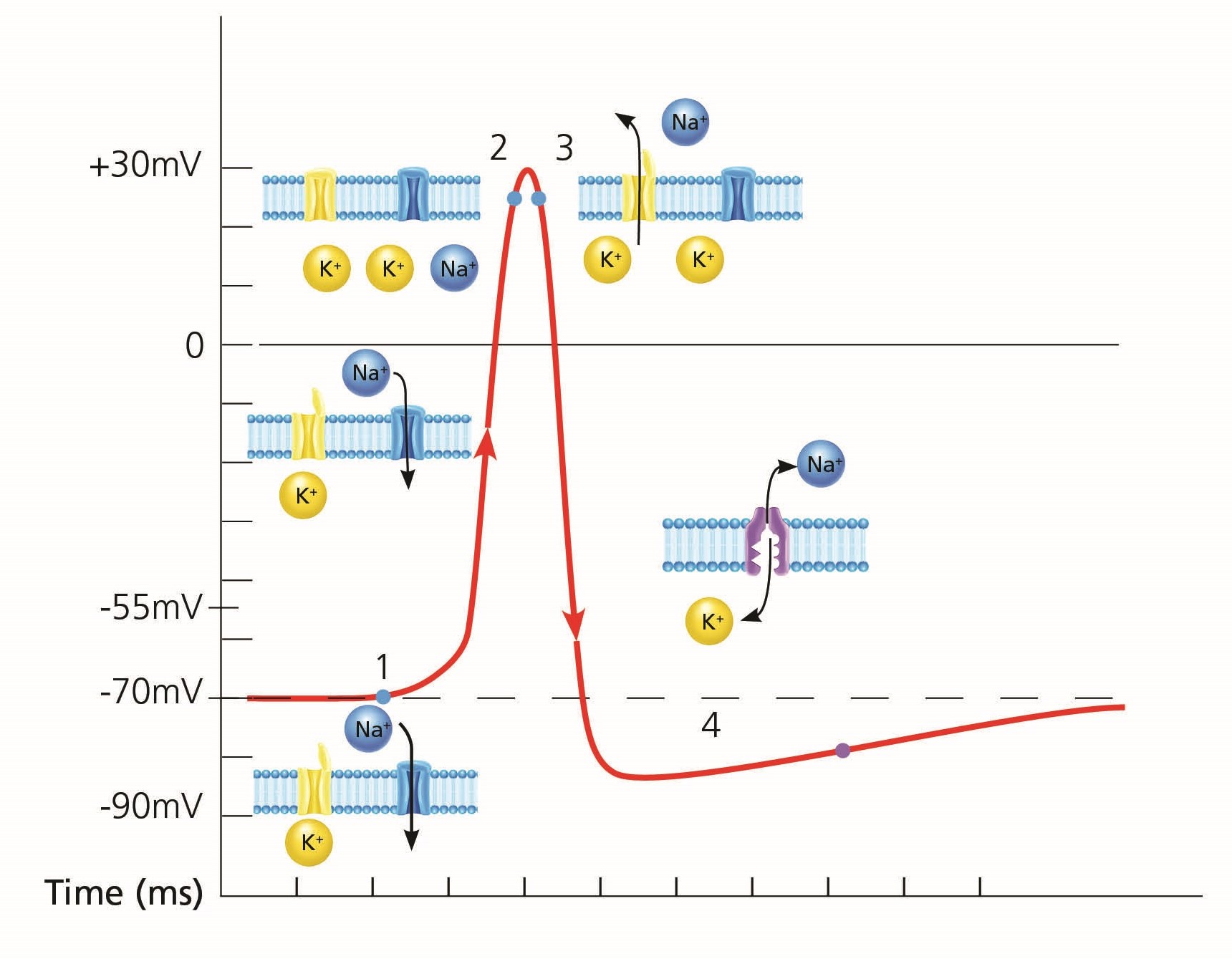
What process begins at step 3 in the image below?
Na moves into the cell
Threshold
Repolarization (rectifying response)
Depolarization
Repolarization(rectifying response)
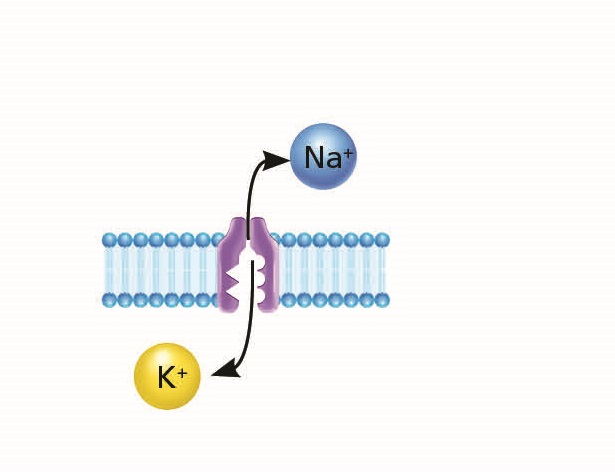
What best describes the function of the sodium-potassium ion pump?
The Na-K ion pump uses active transport (i.e., energy is expended in the form of ATP) to move Na ions in and K ions out, in order to restore resting membrane potential
The Na-K ion pump uses active transport (i.e., energy is expended in the form of ATP) to move Na ions out and K ions in, in order to restore resting membrane potential
The Na-Ka ion pump uses passive transport (i.e., energy in the form of ATP is spent to move ions), in order to restore resting membrane potential
The Na-K ion pump relies on passive transport (i.e., ions diffuse in and out along the concentration gradient), in order to restore resting membrane potential
The Na-K ion pump uses active transport (i.e., energy is expended in the form of ATP) to move Na ions out and K ions in, in order to restore resting membrane potential
This chemical stimulus carries information from one neuron to another...
Neurotransmitter
Potassium
Ion
Synapse
Neurotransmitter
Which refractory period does this statement best describe: During this period, a new action potential cannot be initiated, no matter how strong the charge of a stimulus signal.
Relative refractory period
Light refractory period
Sound refractory period
Absolute refractory period
Absolute refractory period
Identify the correct distribution and concentration of ions during resting membrane potential (RMP).
Equal balance of sodium within the intra- and extracellular space
More sodium in the extracellular space and more potassium in the intracellular space
More sodium in the intracellular space and more potassium in the extracellular space
Equal balance of potassium within the intra- and extracellular space
More sodium in the extracellular space and more potassium in the intracellular space
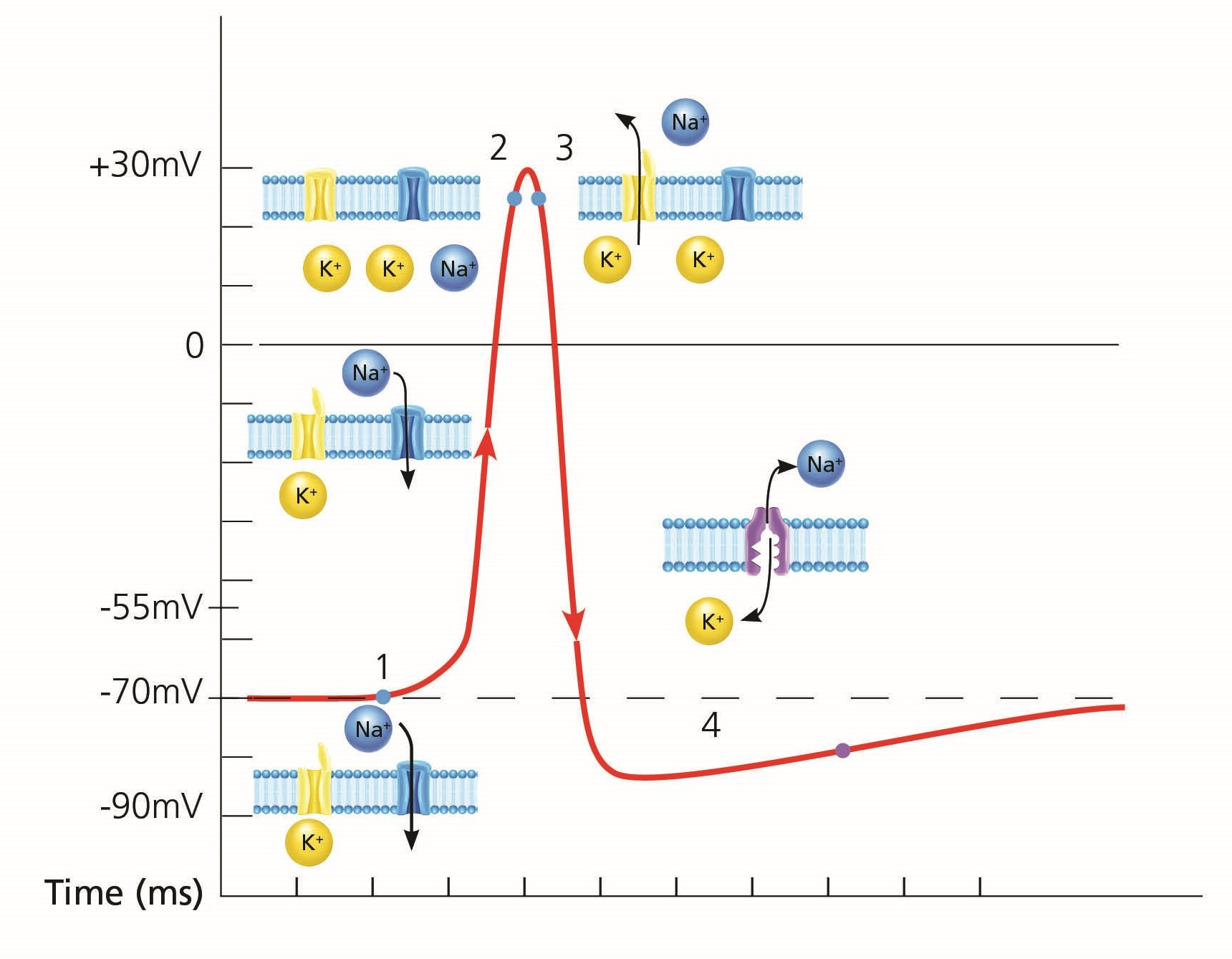
What is it called when depolarization peaks (aka, there is > 50% of Na in the cell)?
Overshoot
Oh shoot!
Undershoot
Under where?
Overshoot
This refractory period occurs when the neuron's membrane status has returned to at least 51% restored to resting membrane potential (i.e., between 51-99% restored to RMP).
Sound refractory period
Relative refractory period
Absolute refractory period
Light refractory period
Relative refractory period
What statement best describes hyperpolarization?
There is > 50% of Na in the cell and < 50% of Na outside of the cell
There is > 50% of K in the cell and < 50% of K outside of the cell
There is < 50% of K in the cell and > 50% of K outside of the cell
There is < 50% of Na in the cell and > 50% of Na outside of the cell
There is > 50% of Na in the cell and < 50% of Na outside of the cell
This type of pathway carries motor information from the brain to the body.
Afferent pathway
Apparent pathway
Efferent pathway
Electronic pathway
Efferent pathway
The space (or gap) between two neurons is called...
Neurotransmitter
Ion
Exocytosis
Synaptic cleft
Next QuestionNext