Chapter 9: Sound Beams
 Call Kai
 Learn
 Practice Test
 Spaced Repetition
 Match
 Flashcards
 Knowt Play
1/35

There's no tags or description
Looks like no tags are added yet.
36 Terms
What shape is diagnostic ultrasound imaging active element NOT and how does it NOT operate
disc shaped, does not operate in continuous wave mode
How does understanding disc-shaped unfocused PZT crystal operating in continuous wave mode benefit a sonographer
it provides the foundation for understanding the shape/behavior of sound beams used in clinical imaging
what happens to the width of the sound beam as it travels
The width changes. It starts with the same width as the transducer diameter then narrows like a funnel until it reaches its smallest diameter, then expands/diverges

what are the 5 regions of a sound beam
Focus, near zone, focal length/near zone length, far zone, and focal zone

What is the focus (or focal point)
The location where the beam is the narrowest

Width of sound beam at focus for disc-shaped crystal
½ the width of the beam as it leaves the transducer

What is the near zone (or near field or fresnel zone)
The region from the transducer to the focus

What happens to the beam width in the near zone for a continuous wave, disc-shaped crystal
It gradually narrows/converges in this zone
It starts with a width thats the same diameter as the active element, and by the end it’s only ½ the width of the active element
What is at the end of the near zone
The focus
What is the focal length (or focal depth or near zone length)
The distance from the transducer to the focus
What is the far zone (or far field of Fraunhofer zone)
The region that starts at the focus and extends deeper

What happens to the beam width in the far zone
It diverges/spreads out.
At beginning, it is ½ as wide as it is at the transducer, and once it’s at 2 near zones away from the transducer, it is again the same width as the active element

What is at the beginning of the far zone
The focus
What happens to the beam width at a depth more than 2 near zones away from transducer
The beam is wider than the active element

What is the focal zone
Region around the focus where the beam is relatively narrow.
Half of this zone is in near field and half is in far field

What zones does reflections arising from create the most accurate images
reflections from focal zone create the most accurate images compared to other depths
What are adjustable focus systems called
phased array
What characteristics of the active element would determine the focal depth
transducer diameter
frequency of sound
How are transducer diameter and focal depth related
they are directly related.
larger diameter = deeper focus
smaller diameter = shallow focus

How is frequency and focal depth related
they are directly related.
high frequency = deeper depth
low frequency = shallow depth

2 factors that create shallow focal depth
smaller diameter of PZT
lower frequency

2 factors that create deep focal depth
larger diameter of PZT
higher frequency

how can a higher frequency sound create a deeper focus when higher frequency probes are used for more superficial structures
rule of physics is that higher frequencies create deeper focus, but manufacturers overcome this by making a small diameter, high frequency crystal. even with the high frequency, the extremely small diameter displaces the focus shallower, making s clinically useful transducer
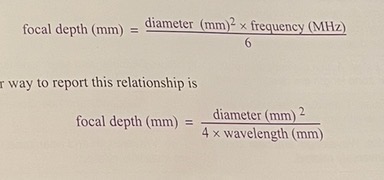
Describing the relationship between frequency and focal depth in soft tissue
focal depth (mm) = (diameter (mm)2 x frequency(MHz)) / 6
focal depth (mm) = (diameter (mm)2 / (4 x wavelength (mm))
equations are more for understanding the concept, not mathematical application
What is beam divergence
it describes the gradual spread of ultrasound beam in far field
What characteristics of the transducer determine the spread of the beam in far field
transducer diameter
frequency of the sound
How is transducer diameter and beam divergence related in far field
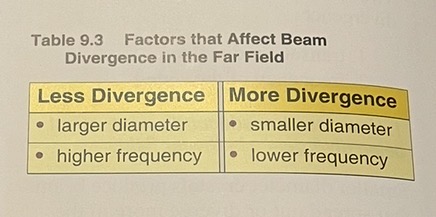
they are inversely related.
small diameter crystals spread more in far field
large diameter crystals diverge less in far field

Does larger or small diameter crystals improve lateral resolution in far field and why
larger diameter because they diverge less
How is frequency and beam divergence in far field related
they are inversely related.
lower frequency = more divergence
higher frequency = less divergence

does high or low frequency sound improve lateral resolution on far field
higher frequency
describing the effect of transducer diameter and frequency on beam divergence
sin divergence angle = 1.85 / (diameter (mm) x frequency (MHz))
sin divergence angle = (1.2 x wavelength) /diameter

2 factors that create less divergence in far field
large diameter
higher frequency

2 factors that create more divergence in far field
smaller diameter
lower frequency
How are V shaped waves formed (aka spherical waves, diffraction patter, or Huygens wavelet)
when sound waves are produced by very small sources, which are usually about the size of the sound wavelength

What are Huygens sources
small sound sources that create V shaped sound waves
What does the Huygen principle state
It explains the shape of imaging transducer emitted sound beam based upon in-phase and out-of-phase wavelets interfering with each other.
that large active elements are millions of tiny distinct sound sources, and each one is a Huygen source that creates a Huygen wavelet with a V shape. the hourglass shape produced by large crystal is a result of interface of many Huygens wavelets emitted from numerous sources. some re in-phase and interfere constructively, creating the hourglass appearance to sound beam. Destructive interference occurs when wavelets are out-of-phase and sound beam is cancelled
