Fetal Chest abnormalities
 Call Kai
 Learn
 Practice Test
 Spaced Repetition
 Match
 Flashcards
 Knowt Play
1/48

There's no tags or description
Looks like no tags are added yet.
49 Terms
Normal fetal lung development occurs in these 5 stages:
Embryonic - 4-5 weeks, the larynx, trachea, and lung bud form
Pseudoglandular- 7-16 weeks, airways are created
Canalicular - completed by 25 weeks, development of gas exchange portion of lung
Saccular - From 26 weeks until term, last airspaces of bronchial tree evolve
Alveolar - From approximately 32 weeks into early childhood growth of more bronchioles
Coronal view is best to see
Diaphragm and both lungs
Gold star standard for assessing lung maturity
Amniocentesis
Lung maturation testing using the Lecithin/sphingomyelin ratio to determine
If fetal lungs are mature enough to deliver the fetus early
Predicts potential for fetal respiratory distress
L/S Ratio <2:1 ratio indicated…
High probability of FRD
Pulmonary hypoplasia is caused by
Restriction/compression of developing lung tissues and olioghydramnios/anhydramnios
Pulmonary hypoplasia
Incomplete development of lung tissue
Severe chest and lung hypoplasia are usually lethal to fetus
Measure thoracic circumference to confirm diagnosis
Bell/pear shaped chest
Most common cause of pulmonary hypoplasia
Diaphragmatic hernia
>50% of cases with pulmonary hypoplasia have…
Coexisting cardiac, GI, GU and skeletal dysplasias
Pulmonary hypoplasia is associated with
Potter syndrome (bilateral agenesis of kidneys reduces fluid)
Fetal thoracis circumference/abdominal circumference ratio <__ indicates significant thoracic hypoplasia
0.77
Severe chest and lung hypoplasia is suspected if thoracic circumference is <__ th percentile for GA
5
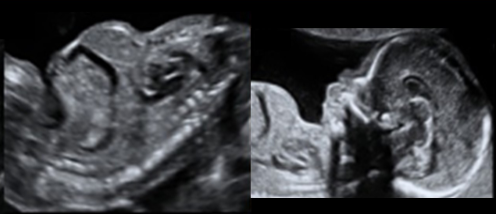
Pulmonary hypoplasia
When a chest mass is identified, it is important to evaluate the pregnancy for:
Mediastinal shift, AFI levels (poly), Signs of hydrops
Most common chest mass in a fetus
Congenital cystic adenomatoid malformation or CPAM/CCA
Congenital cystic adenomatoid malformation or CPAM/CCA
Usually unilateral but effects entire lung
Can cause mediastinal shift and cardiac malposition
Can lead to inversion of diaphragm; concave shape instead of convex
Prenatal administration of __________ is used to reverse the effects of hydrops or prevent hydrops
Corticosteroids
CCAM is associated with
Polyhydramnios and ascites
CCAM types
Macrocystic (2-10cm)
Medium cystic (0.5-2cm)
Microcystic (<0.5cm)
CCAM types 1 and 2 demonstrates…
Single or multiple cystic structures within chest cavity replacing normal lung tissue
CCAM type to demonstrates…
Microscopic cystic that cause an overall increase in echogenicity of affected lung
Type 3 is associated with…
Fetal hydrops and demise
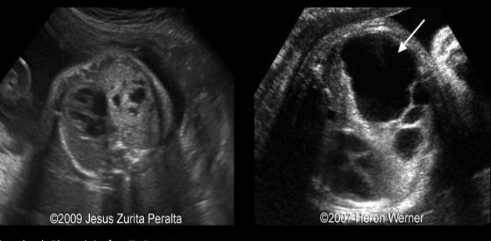
CCAM Type 1
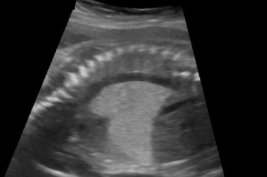
CCAM type 2
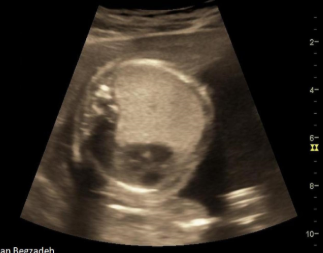
Type 3 CCAM
Bronchogenic cysts
Usually demonstrates a single unilocular cyst located centrally in lung parenchyma
Most are right sided, near midline, and adjacent to tracheobronchial tree
Location at midline and the lack of surrounding echogenic lung tissue differentiates this cyst from CCAM
Pulmonary sequestration
Mass of nonfunctional lung tissue that does not communicate with bronchial tree
Separate blood supply from AO
May regress
Appears as echogenic triangular-shaped mass in fetal chest
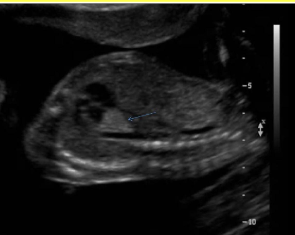
Pulmonary sequestration
CHAOS syndrome
Congenital high airway malformation
Complete atresia of airway is commonly associated with tracheoesophageal fistula
Lethal
CHAOS syndrome is caused by
Obstruction of fetal upper airway
CHAOS syndrome USA
Dilated, fluid-filled trachea
Bilateral symmetrically enlarged hyperechoic fetal lungs
Flattened or everted hemidiaphragms
May see polyhydramnios
Diaphragmatic hernia
Abdominal organs herniate into chest cavity through an opening in diaphragm
May see peristalsis in chest
Coronal view is best
Can be bilateral but usually on left side
Associated with polyhydramnios
Most common cause for pulmonary hypoplasia
Diaphragmatic hernia
Most common reason for shift of cardiac axis/position
Diaphragmatic hernia
Classic diaphragmatic hernia classic sign
Fetal stomach is visible at the same level of the heart in a trans or coronal view
Bochdalek hernia
Posterior left lateral defect
MOST COMMON
Morgagni hernia
Anterior to right medial defect
Lung-head ratio
lung AP x lung width/HC
predicts outcome and plan treatment
Congenital diaphragmatic eventration
Developmental defect of muscular portion of diaphragm
Results in weakness of diaphragm
Can mimic diaphragmatic hernia
Easier to fix
Unilateral eventration is associated with
Beckwith-Weidemann syndrome and Trisomy 13 and 18
Bilateral eventration is associated with
Toxoplasmosis and cytomegalovirus
Hydrothorax
Pleural effusion or fluid in lung cavities
Bilateral or uni
“Bat wing” sign for unilat
Associated with hydrops, chromosomal anomalies and polydactyly
Hydrothorax is most commonly caused by
Chylothorax
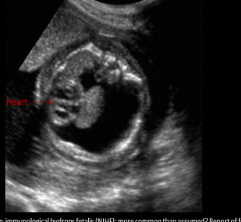
Pleural effusion
Pericardial effusion
Anterior fluid collection
Can compress lungs against posterior chest wall
Associated with hydrops, heart failure and some cardiac tumors
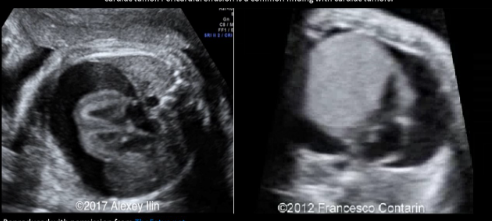
Pericardial effusion
Fatal lung disorders
Type 3 CCAM
CHAOS syndrome
Pulmonary hypoplasia
Which of the following correctly describes a fetal diaphragmatic hernia?
Usually on right side
Associated with oligohydramnios
Decreased survival rate if fetal liver has herniated into thoracic cavity
Most common cause of pulmonary sequestration
Decreased survival rate if fetal liver has herniated into thoracic cavity
The 3 lung abnormalities associated with polyhydramnios
Diaphragmatic hernia, CHOAS, CCAM