Lab
 Call Kai
 Learn
 Practice Test
 Spaced Repetition
 Match
 Flashcards
 Knowt Play
1/15

There's no tags or description
Looks like no tags are added yet.
16 Terms
Lola history

Physical exams of Lola

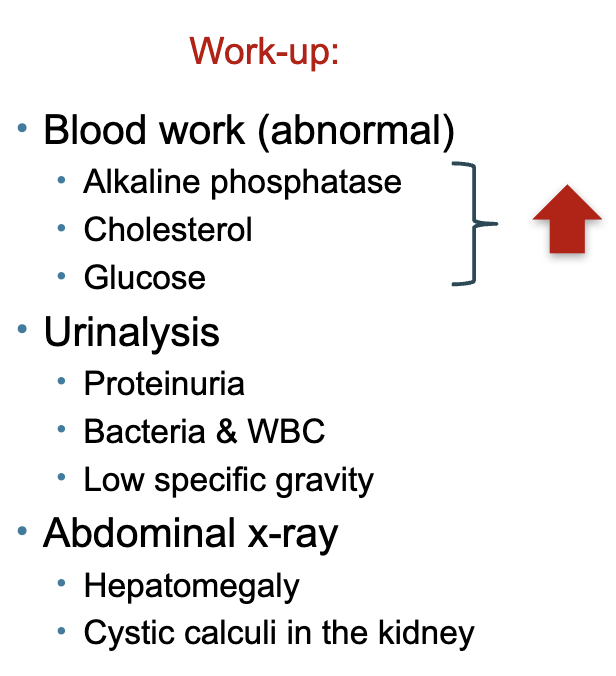
Work-ups of Lola
Alkaline phosphatase (ALP)
Non-specific (can come from many sources within the body) but normally low in circulation and a good indicator of malfunction. High levels often associated with liver damage, intestinal disease, hyperthyroidism, hyperadrenocorticism...
Cholesterol
Can be elevated with fatty meals, liver disease, hyperadrenocorticism, diabetes mellitus, hypothyroid
Glucose (mild increase)
Can be elevated with stress, high carbohydrate meals, hyperadrenocorticism and diabetes mellitus
Differential diagnosis
Alopecia
Hypothyroidism
Seasonal flank alopecia
Hyperadrenocorticism
Parasite
Polyuria/polydipsia:
Behavioural
Urinary tract infection
Diabetes mellitus
Hyperadrenocorticism
Polyphagia
Diabetes mellitus
Hyperthyroidism
Behavioural
Hyperadrenocorticism
Tumour impacts on pituitary and adrenal gland

Next steps for Lola
ACTH stimulation test (works for pituitary dependent Cushing’s diagnosis)
Measure cortisol levels
Abdominal ultrasound - Bilateral enlargement (pituitary dependent) or atrophy (adrenal dependent) of the adrenal glands
Can also do a Dexamethasone suppression test to differentiate pituitary from adrenal dependent Cushing
Diagnosis of Lola
Hyperadrenocorticism (aka. Cushing’s)
A chronic slowly progressing disease
A syndrome caused by an excess of one or more adrenal steroids (most commonly cortisol)
Pituitary dependent = 80-85% of cases
Adrenal tumor = 15-20% of cases
Iatrogenic can occur due to glucocorticoid administration
Why is polyurea/polydipsia observed in Hyperadrenocorticism?
Because excessive cortisol leads to high level of blood glucose overwhelming the kidney (similar to diabetes mellitus)
Why is alopecia occurring?
Because cortisol causes atrophy of the hair follicle
In a normal dog, what would happen with the administration of dexamethasone (artificial glucocorticoid)?
Pituitary secretion of ACTH will be inhibited causing a decrease in cortisol levels
Because the dexamethasone administered will cause negative feed back to the hypothalamus & pituitary so that ACTH production will be decreased leading to a decreased production of cortisol.
Would the administration of dexamethasone suppress the plasma cortisol concentration with adrenal dependent hyperadrenocorticism?
No
Because the adrenal tumor functions independently of the pituitary ACTH. So, if you give a dog with adrenal dependent. Cushing’s a high dose of dexamethasone negative feed back would occur causing a further decrease in ACTH however will have no impact on the cortisol produced
Endogenous ACTH levels in pituitary dependent hyperadrenocorticism (PDH) should be:
Increased
Endogenous ACTH levels in pituitary dependent hyperadrenocorticism (PDH) will be increased, as the pituitary will not respond normally to the negative feed back as result of the high cortisol levels.
With adrenal dependent hyperadrenocorticism the pituitary will still be able to respond normally to the cortisol negative feedback and as a result ACTH levels will be low.
Treatment for Lola
Trilostane (inhibitor of 3β-hydroxysteroid dehydrogenase 3β-HSD)L A competitive inhibitor of 3-beta hydroxysteroid dehydrogenase thereby reducing synthesis of cortisol, aldosterone and adrenal androgens.
Vetoryl
Prognosis for Lola
Survival with therapy averages ~30 months
What will treatment do?
Reduce cortisol production with subsequent reversal of clinical signs
Why is the survival time only 30 months?
“Lola” is already an older dog and may reach her normal life span in 2.5 more years
The treatment focuses on symptoms and does not treat the cause
Complications can arise due to the disease (e.g. immunosuppression with high cortisol levels