Lecture 12 - Water Relations
 Call Kai
 Learn
 Practice Test
 Spaced Repetition
 Match
 Flashcards
 Knowt Play
1/42

There's no tags or description
Looks like no tags are added yet.
43 Terms

Tallest fossil tree?
120 m

Tallest living tree?
116 m Redwood
112 m Eucalyptus


Modes of water movement
bulk flow
osmosis
diffusion

Bulk flow
overall movement of water driven by potential energy
driven by pressure gradient
mechanism of long-distance travel via xylem
Diffusion
Net movement from more to less concentrated zone, towards equilibrium
Rapid over short distances, slow over long distances


Osmosis
Movement of water across selectively permeable membrane
Osmotic properties

Osmotic forces on cells

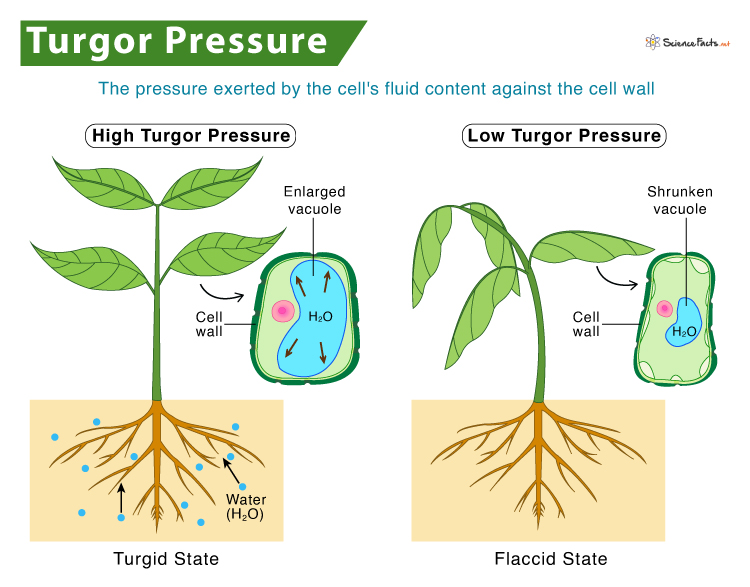
Turgor pressure
Water pressure in plant cells keeps plant tissue rigid
Plasmolysis
Separation of protoplast from cell wall because of water movement by osmosis
occurs with any high contrast solution

Plasmodesmata
Cytoplasmic strands that interconnect protoplast of adjoining plant cells
Cell-to-cell communication
Modes of solute transport across a membrane
simple diffusion
facilitated diffusion
active transport
Carrier protein types
Uniporter
Symporter
Antiporter
Uniporter
One solute moved directly across in one direction
Symporter
Two different solutes moved in same direction
Antiporter
Two different solutes simultaneously moved in different directions
Primary active transport
Directly energy requiring, against gradient
Secondary active transport
Driven indirectly by primary pumps, using H+ protons and sucrose
Transpiration
Loss of water vapor in plants
~99% of water taken up by plant is transpired, up to 100 gallons from a single tree per day

Water movement up a tree
Root pressure
Capillary pressure
Adhesion/cohesion
Transpiration
Capillary pressure
Water climbs up a small tube
Smaller tube, higher water climb
Cohesion
water/water attraction
Adhesion
water/other substance attraction
Transpiration stream
Flow of water through the xylem through the roots to the leaves where water vapor is evaporated through the stomata
Open stomata
due to increased turgor pressure
Closed stomata
Decreased turgor pressure
Factors that influence stomata
CO2 concentration
light, open in light, closed in dark
blue/red light
high temps close stomata
circadian rhythm
Continuous water network
Continuous network of water in xylem that forms columns from root, through stem, out to stomata in leaves
Cohesion-Tension theory
Water is pulled to treetop via water tension and cohesion, as water molecules evaporate out of the stomata, tension in the cohesive water column network pulls water up from roots
Why can’t trees get any taller?
above 110m, the force of gravity is greater than that of cohesion
How water gets to the top of tallest tree
Combo of:
Cohesion-tension (mostly)
Capillary pressure - 1m
Root pressure - variable, small
Vacuum pump - 11m
Cavitation
Rupture of water column or embolism, breaking water connections due to vessels filling with air
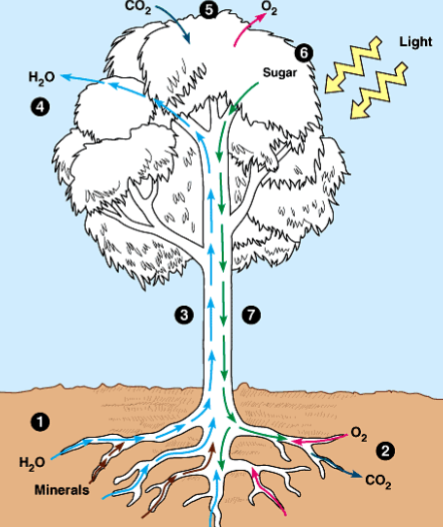
Net flow in whole plant
Transpiration moving water in xylem from roots to leaves
Assimilate transport moving sugars in the phloem from sources to sinks
Source
organ such as mature leaf or starch storing root that produces more sugars than it requires
Sink
organ that consumes sugar
Examples of sinks
root
flower
developing fruit
Source and sink development
Sources and sinks change during development
Assimilates
Sugars
Flow of water/assimilates
Assimilates are transported through the phloem from the source/production site, to the sink
Aided by interaction of xylem transpiration stream

Assimilate transport in phloem
Requires loading of sucrose into phloem at source
Bulk flow
Unloading at sink
Assimilate Transport - Bulk Flow
high sugar at source
sugar diluted with water from xylem, creating pressure
sugar unloaded at sink, then metabolized to starch
excess water flows to xylem back to source
What type of transport does assimilate movement use?
Active - loading/unloading of sucrose into phloem
Passive - bulk flow
Also, osmosis
Net flow - whole plant
Transpiration - water movement in xylem from roots to leaves
Assimilate transport - moving sugars in the phloem from sources to sinks