Factors that affect party success
 Call Kai
 Learn
 Practice Test
 Spaced Repetition
 Match
 Flashcards
 Knowt Play
1/51

There's no tags or description
Looks like no tags are added yet.
52 Terms
6 factors that affect party success
Leadership
Unity
Media
Events
Policy
Opposition
Importance of leaders
Potential PM!
Public face of the party for the electorate
5 qualities needed by leaders
Effective communication of the party’s message
Ability to unite the party
Clear sense of purpose
Vision
Ensure party efficacy when in power/opposition
6 qualities voters look for in a leader
Experience
Decisiveness
Ability to lead (duh)
Media image
Intelligence
Apparent honesty
Leaders who enhanced their party’s fortunes - Margaret Thatcher
Ran the country with an iron fist, held strong to her New Right values
Leaders who enhanced their party’s fortunes - Tony Blair
Changed the fate of L by creating ‘New Labour’
Had an excellent media presence
Maintained tight control over party messaging
Won 3 GEs
Saw off 4 Tory leaders
Reformed Clause IV of the Labour Party constitution on nationalisation to fit his messaging, which remains to this day
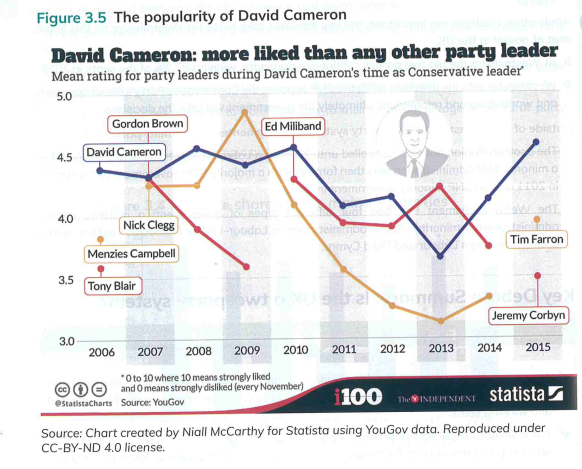
Leaders who enhanced their party’s fortunes - David Cameron
Had one of the highest approval ratings of all party leaders during his term at about 4.5
2015 - bought home an unexpected election victory
Was the first sitting C to increase the party’s vote share since 1955
Leaders who enhanced their party’s fortunes - Nicola Sturgeon 👑
Was incredibly impressive in TV debates (and still when she speaks now)
Performed amazingly in opinion polls
Got into a bit of trouble re. financial mismanagement and her husband
Leaders who enhanced their party’s fortunes - Nigel Farage
Was favourable in debates for UKIP and RUK, gaining a kind of cult of personality
Is a master of the media and always ensures his party is constantly in the news (be that TBP or RUK)
Leaders who enhanced their party’s fortunes - Charles Kennedy
Was popular and strong, taking LD to their most successful result in 2015
Leaders who’ve damaged the prospects of their party - Tony Blair
Made highly controversial decisions because he could due to his personal leadership style
2003 - entered the Iraw War
Introduced tuition fees
Leaders who’ve damaged the prospects of their party - David Cameron
Ran a party divided by Europe
Attempted to manage these divisions through the Brexit ref, but ultimately left a deeply split party in the wake of his resignation that is yet to reconcile
Leaders who’ve damaged the prospects of their party - Gordon Brown
Called a voter a bigot while on mic with the Sun (by accident)
Leaders who’ve damaged the prospects of their party - Ed Miliband
Ridiculed for his voice and appearance
‘Hell yeah I’m tough enough!’
Ate a bacon sandwich incredibly awkwardly
Leaders who’ve damaged the prospects of their party - Nick Clegg
Formed a coalition with C and promptly broke a manifesto promise - raised tuition fees
2010-2019 - increasing significance of leaders
Although leaders don’t win or lose elections in the UK like they do in the USA, the fortunes of their parties are influenced by their performance and image
Incl in devolved assemblies
Importance of unity in the fate of political parties
Political commentators say a disunited party has no hope of being elected
Divided parties appear weak, unable to lead and deliver policy promises
Divisions prevent parties from focusing on the key issues of the day
This is especially the case when the leadership is at war with its members (e.g. Corybn and the MPs)
1980s - Conservative unity
C was united around Thatcher
Two huge GE victories - 1983 and 1987
1980s - Labour divisions
Was incredibly split between left and right wings - modernising or maintaining its old Labour principles
1981 - actually split
Suffered 2 crushing GE defeats
Late 1990s - Labour unity
Blair united L in the 90s under the banner of New Labour
Had an incredibly impressive GE victory in 1997
Late 1990s - Conservative division
C divided under Major re. UK’s position in Europe
Suffered a crushing election defeat in 1997
2010-2017 - Conservative division
Huge divisions re Europe
Still emerged as the largest party in the HoC across 3 elections
2017 - Labour comeback
Radical new manifesto and leadership led to an improvement in its fortunes, but still didn’t win
2019 - Conservative unity
C united around Getting Brexit Done
BoJo suspended all moderate Tories from the party
Mandated all candidates to sign a pledge to ‘get Brexit done’
2019 - Labour divisions
Divided over
Brexit
Antisemitism
Its radical manifesto
Conclusion
Unity is an important factor, but divided parties are still elected from time to time
Importance of media
Shapes perceptions in the wider public
Better media presence = easier to project the party message to the public → more votes!
Sways wavering voters
Blair and the media
Blair had excellent media skills
L ‘courted’ owners of the print media
Sun switched its alliance from C to L
2017 - Labour media strategy
Social media
Impacted the election result positively for L
Strengths of the media - party leader exposure
TV debates can give excellent exposure to party leaders, as detailed below
Weaknesses of the media - doesn’t guarantee success
L did not win in 2017
May (C) had strong printed media support in 2017 but didn’t get a majority
Weaknesses of the media - existing affiliations
Media reinforces existing political affiliations rather than changing minds
+ive correlation between political views of readership and of newspaper
Weaknesses of the media - actual influence (2017)
Vast majority of UK newspapers supported C (because of their owners) but C actually lost its HoC majority
Corbyn wasn’t supported by print media but still did well, and was supported by non-trad media but still lost
Weaknesses of the media - neutrality
TV and radio broadcasters (especially the BBC and ITV) have to be neutral
This is by law and regulated by OFCOM
Nick Clegg & the media
Did v well in TV debates, leading to Cleggmania
Led to the LD/C coalition
Ed Miliband & the media
Performed badly in TV debates
Led to L losing the election
Also: was very awkward and got photographed/videoed doing silly things and looking silly
Jeremy Corbyn & the media
Performed surprisingly well in TV debates
Embraced all forms of media, especially social media
Was negatively viewed by all print newspapers but still did well in the election
Theresa May & the media
Refused to participate in televised debates
Perceived negatively by the media
Positive consequences of social media
Politicians can talk directly to the electorate
Bypasses rules about media coverage that some may find excessively restrictive
Decreases influence of traditional media outlets that favour certain narratives and perspectives
Negative consequences of social media
Difficult to control
Difficult to measure/quantify effects and importance
Can be used in intrusive and forceful ways
Often ethically dubious
E.g. Cambridge Analytica and Facebook data
Acts as an echo chamber like print media, so people’s ideas are never challenged
Conclusion
Influential long-term
Can have less influence short-term
Policy explanation
Both in manifesto commitments and then delivery while in office
Thatcher - important policy
‘Right to buy’
Allowed W/C people to buy their council house at a discount to own their own home (and therefore improve circumstances)
V popular, allowed C to dominate elections
Johnson - important policy
‘Get Brexit Done’
Contrary to L’s position of re-negotiation and a new referendum
Led to soaring polls and an election victory
1992 - Labour
Held an internal policy review and moved to a more moderate policy programme
Still didn’t win due to
Leadership: doubts about Kinnock
Media: newspapers whipped up the doubts about Kinnock
1983 - Falklands War
Ended in victory, cementing Thatcher’s image as the Iron Lady
Allowed her to then conclusively win the 1983 election
1992 - Black Wednesday
Damaged Major’s financial reputation
Led to C defeat in 1997
2008 - financial crisis
Damaged Brown’s financial reputation
Led to L defeat in 2010
2003 - Iraq
Blair seriously messed up with Iraq (and also had lots of backbench rebellions) yet still comfortably won the 2005 election
Blair
C was weak during his reign due to infighting re Europe and Thatcherism
Leaders: Hague, Duncan-Smith
Unable to cut through to wider public
Allowed him to sail through on large majorities, easily winning GEs
1992
C had lots of issues
Division over Europe
Terrible Poll Tax
Inexperienced new leader (Major from Thatcher)
Yet still won a 21-seat majority
2024
C was an incredibly weak opposition, damaged by terrible leaders and terrible decisions
Made it easy for L to win a large majority