parental and infant brain development
 Call Kai
 Learn
 Practice Test
 Spaced Repetition
 Match
 Flashcards
 Knowt Play
1/42

There's no tags or description
Looks like no tags are added yet.
43 Terms
What is the distinction between Morphogenesis and Plasticity in early brain construction?
Morphogenesis: The genetically determined sequence of physical events that guides brain construction (nature).- from single cell to brain cell
Plasticity: The brain's adaptive capacity to change, reorganize, and evolve its structures based on environmental experiences (nurture).
Define the Laminar Organization of the adult cerebral cortex.
Neurons are highly structured across six distinct structural layers. Different layers possess specific functional specializations (e.g., color processing, sound translation, planning).
In the adult brain network, what are the baseline percentages of Excitatory versus Inhibitory neurons, and what unique evolutionary feature do primates display?
Excitatory neurons: Make up approximately 80% of the network.
Inhibitory interneurons: Make up approximately 20% of the network.
Primate feature: Primates possess a significantly higher density of inhibitory interneurons than lower mammals.
Astrocytes & Oligodendrocytes
Derive directly from the Ectoderm layer.
Microglia & Blood Vessels
Derive directly from the Mesoderm layer.
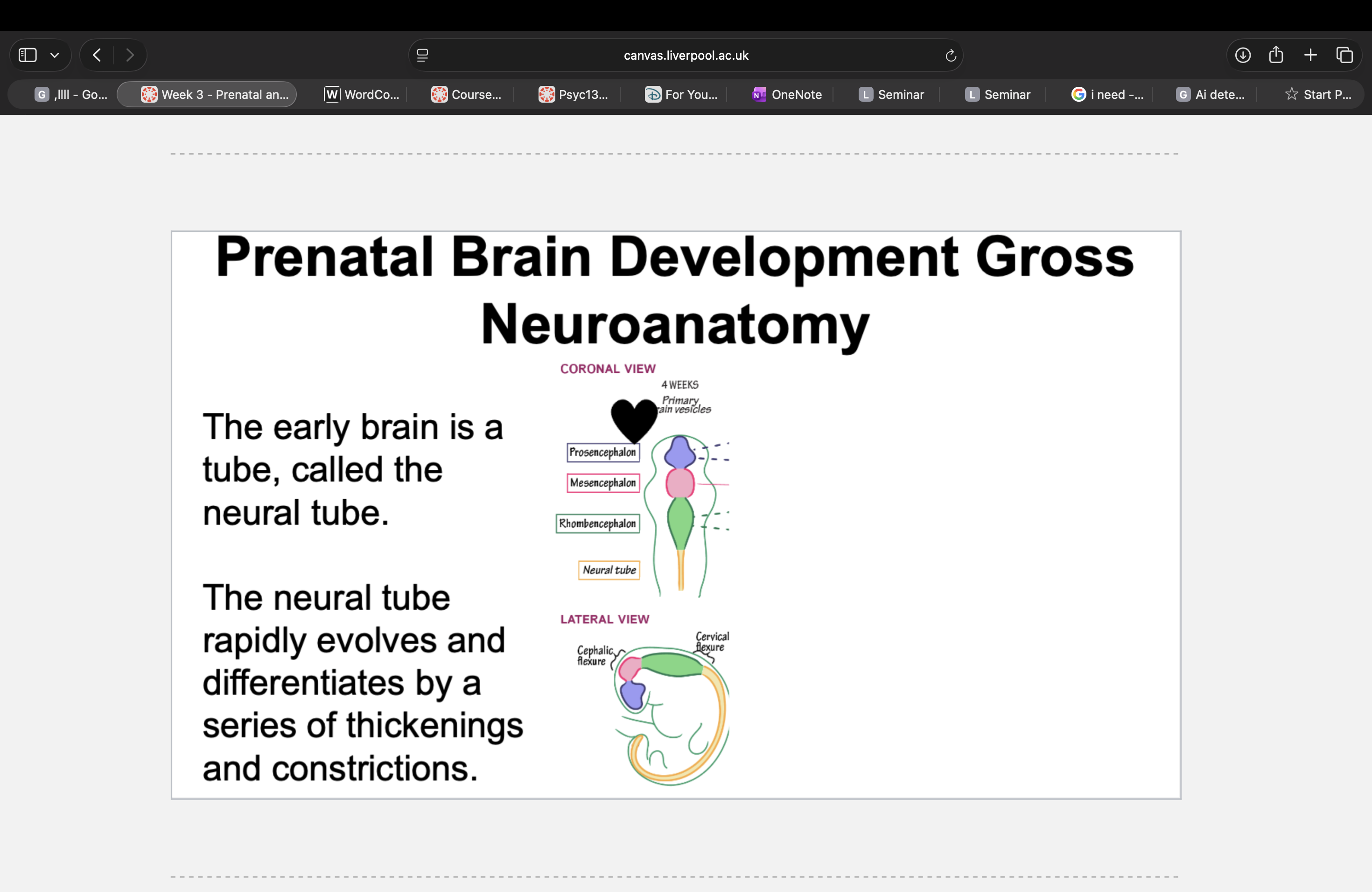
What is the primitive macro-structure of the early embryonic brain, and how does it begin to differentiate?
It begins as a simple, hollow neural tube. It rapidly differentiates into more complex sub-regions through a sequential series of structural thickenings and constrictions.
Map the three primary brain vesicles identified at 4 weeks of gestation to their secondary transformations at 5 weeks:
Prosencephalon:
Mesencephalon:
Rhombencephalon:
Prosencephalon: Differentiates forward into the Forebrain structures.
Mesencephalon: Becomes the Midbrain.
Rhombencephalon: Differentiates backward into the Hindbrain structures.
True or False: Birth represents the absolute peak milestone of neural structure maturity for a human brain.
False. While fundamental structural foundations are pre-wired before birth, the vast majority of architectural maturation, wiring optimization, and cellular organization occurs postnatally (after birth).
Name the five sequential stages of micro-neurodevelopment that build a human brain network.
Cell proliferation
Cell migration
Cell differentiation
Programmed cell death (Apoptosis)
Synaptic rearrangement
When does the massive peak window of Neural (Cell) Proliferation occur, and how many of your total lifetime neurons are present at birth?
Peak window: Occurs between 2 to 4 months of gestation.
Birth status: Humans are born with more or less all the neurons they will ever possess during their entire life.
From what common starting point do all brain cells arise, and what rule guides cortical layer assembly during Cell Migration?
Starting point: Undifferentiated neural precursor cells (which can choose to become either neurons or glia cells).
Assembly rule: The cortex is assembled inside out. The earliest cells to migrate settle in the deepest layer (Layer 6), while later cells push through them to form the outer layers.
Describe how a traveling axon tip knows exactly which target neurons to connect to during structural wiring.
The growing tip of the axon is actively guided across the brain by tracking special signaling proteins; it is attracted toward its correct target and repulsed away from wrong pathways.
What is Apoptosis, and what rule determines whether an individual neuron survives this stage?
Definition: Programmed cell death where entire populations of redundant neurons are discarded.
Survival rule: It is an elimination process based on connectivity—any neuron that fails to find a proper target/receiving neuron disappears
Why does the infant brain possess 50% more synapses than an adult brain, and how is this corrected?
why: The early brain goes through a phase of explosive, unoptimized wiring that is highly inefficient.
Correction: Corrected via Synaptic Rearrangement (Elimination). Synapses enter a competition stage where wires that do not receive active electrical signals are pruned, while the most efficient, activity-dependent pathways survive.
Anatomically, how do the eyes strictly map their pathways to the Primary Visual Cortex (V1) in a healthy adult brain?
The right and left eyes send electrical signals to completely alternate, alternating bands in V1, creating a precise physical pattern called Ocular Dominance Columns (Stripes).
True or False: The precise structural mapping of Ocular Dominance Columns is completely hard-wired by genetics alone before birth.
False. While genetics put the baseline map pathways in place, this layout requires post-birth visual stimulation and synaptic rearrangement to finalize its functional organization.
multimodal experience regarding vision and hearing?
The idea that vision and hearing normally work together to give the brain consistent, matching information about where an object is located in space.
What is the major cross-system takeaway from the Knudsen & Knudsen owl experiment?
It proves that sensory experience can rewrite genetic wiring; a visual change directly forced an anatomical change inside the hearing network.
Define Brain Plasticity in simple terms.
The brain’s structural ability to modify, adapt, or reorganize itself. It proves the brain is not a rigid, unchangeable structure—IT CAN LEARn
True or False: Brain plasticity is a completely positive process that always improves cognitive function.
While essential for learning, plasticity can also lead to negative trends or structural decline (seen in aging, brain injury, illness, or drug exposure).
What did Maguire (2000) discover regarding the brains of experienced London taxi drivers?
Experienced taxi drivers possess a significantly larger posterior hippocampus compared to controls, with volume directly matching their total time on the job.
What happens to the structural pattern of Ocular Dominance Columns (ODC) if one eye is completely occluded (covered) early in development?
the healthy eye aggressively takes over cortical resource space, leaving the occluded eye with an abnormally restricted, shrunken share of the visual cortex.
If an eye is occluded during development and its ODC permanently changes, can adult training fix this structural defect later in life?
No. If an eye is covered during that entire developmental timeline, the abnormal ODC arrangement becomes permanent and will NEVER change later.
Define a Critical Period in neurodevelopment.
A strict, time-limited biological window during which a specific brain mechanism or organ must receive environmental stimulation to develop normally.
What baseline biological formula describes how a total lack of sensory input shapes developing neural pathways?
No stimulation = No function = elimination (pathways that do not fire are completely dismantled and pruned).
According to the diagram, why does closing one eye early in life cause an abnormal distribution of cortical resources?
Because the open eye keeps sending signals while the closed eye sends nothing; the active eye wins the competition and takes over the entire visual network.
How do critical periods change the overall nature of brain plasticity as a child grows up?
Critical periods act as a biological countdown timer; they put a strict, formatting time limit on the brain's highest levels of plasticity.
In Staudt (2010), what clinical adaptation was observed in children younger than 5 years old who suffered severe left-hemisphere brain damage?
Their brains completely reorganized and shifted all language processing over to the healthy right hemisphere.
True or False: An adult brain can fully relocate its core language centers to the opposite hemisphere following a massive stroke.
: False. This full cross-hemisphere backup trick is an exceptional feature of early infancy when neural flexibility is at its absolute peak.
According to Dehaene-Lambertz & Spelke (2015), what happens to Grey Matter and White Matter during the first 14 weeks after a full-term birth?
Grey Matter: Goes through a rapid wave of maturation and density changes across the cortex.
White Matter: Shows massive structural stabilization, including the direct development of long-range association tracts (the long-distance communication wires of the brain).
What is the long-term consequence of the neural networks put in place during early infancy?
These early networks become permanently crystallized for life, meaning early developmental conditions can leave lasting structural marks on adult behavior.
What is the biological function of the MAOA gene, and why do criminologists study it?
It produces an enzyme involved in regulating impulses and violent behavior; certain genotypes can structurally alter brain volume in emotional centers like the amygdala.
In the landmark study by Caspi et al. (2002), did simply having the "Low MAOA activity" genotype automatically make individuals develop antisocial conduct disorders?
No. Having the low-activity gene alone did not cause violence. Antisocial behavior only skyrocketed if the individual also experienced severe maltreatment as a child.
What core developmental concept does the Caspi et al. (2002) MAOA study prove for your exam?
It is a textbook example of a Gene-Environment Interaction. The environment acts as a key that physically activates the genetic vulnerability during a critical period of childhood development.
Vision as an immature sense
6 months- blurry no 3d perception at birth
Face perception
P1 Is an electric component typically recorded when u process a visual stimulus, infants display the same electric patten as adults but timing of response is slower—- therefore ice perception improves with age
Soud perception Decasper and Spencer 1986
30 weeks GA the auditory system of foetus allows it to perceive external sounds, newborns can discriminate their mothers vocals at birth or recognise songs .
Responses of the primary auditory system
first month of life=slow
Language
Same language network is activated in infants even though they can’t process speech, newborn extract words from continuous speech
Experience and maturation
Brain maturation is entangled with exposure
takeaway
Biological brain maturation—not just extra exposure—is the limiting factor for early language discrimination.
A preterm baby's brain cannot take advantage of extra months of hearing speech until it reaches the necessary biological maturity (around 15 months post-conception, equivalent to a 6-month-old full-term baby
Learning outcomes of this
Know the different stage of construction of the
brain network
Can explain the interaction gene/environment in
the construction of the brain
Understand the notion of plasticity and critical
period
Can describe in what the infants brain is immature