limno Lab
 Call Kai
 Learn
 Practice Test
 Spaced Repetition
 Match
 Flashcards
 Knowt Play
1/15

There's no tags or description
Looks like no tags are added yet.
16 Terms

Two symmetrical halves
Chlorophyta, Closterium

Chlorophyta, Pediastrum

Large, complex colonies containing 1000’s of cells.
Chlorophyta, Volvox

Each filament can be a few cm’s in length, forming mats. Distinctive spirally arranged chloroplasts
Chlorophyta, Spirogyra

Unicellular, flagellated
• Mostly freshwater (highly eutrophic habitats)
• Autotrophic & heterotrophic!
• cell wall made of protein
Euglenophyta, Euglena

Armour-plated with distinct groove that houses flagella
• These genera common in f.w.
Pyrrhophyta, Ceratium

Armour-plated with distinct groove that houses flagella
• These genera common in f.w.
Pyrrhophyta, Peridinium
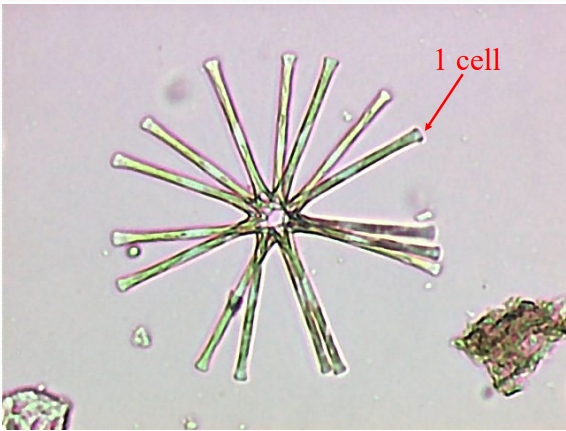
Star shaped colony
Bacillariophyta, Asterionella

forms “raft” of cells (ribbon-like colonies)
Often present in spring blooms in f.w. lakes
Bacillariophyta, Fragilaria

Can form thick layers on stream beds choking out invertebrates
Major problem in N.Z.
Blooms even in nutrient poor conditions
No control methods available
Bacillariophyta, Didymosphenia

Division mostly marine but ~ 5% in f.w.
found in slow moving streams
Colonial alga with whorls of branches around a central axis
Not planktonic, but attached to substrate
Rhodophyta, Batrachospermum

Unicelluar with 2 flagella (unequal length)
Distinctive bean shape with unequal base
Lakes; planktonic
Cryptophyta, Cryptomonas
Division is uncommon in f.w.
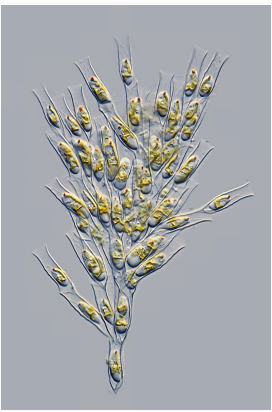
Dinobryon common in oligotrophic and mesotrophic lakes in temperate regions, planktonic
Planktonic, can be unicellular or in branching colonies
Chrysophyta, Dinobryon

Filamentous, planktonic
Can produce neurotoxins = toxic if blooms
heterocysts are often obvious
Cyanophyta, Anabaena

Filamentous alga that appears to ‘oscillate’ or move
Common in ponds, lakes; planktonic and mat forming
Cyanophyta, Oscillatoria

Very small cells in a thick mucilaginous colony
Becomes amorphous as they break apart
Found in nutrient-rich waters and can produce dangerous toxins (microcystins)
Cyanophyta, Microcystis