Chapter 8: Alkyl Halides and Elimination Reactions
 Call Kai
 Learn
 Practice Test
 Spaced Repetition
 Match
 Flashcards
 Knowt Play
1/116

There's no tags or description
Looks like no tags are added yet.
117 Terms
elimination
Reactions in which elements and/or groups from adjacent carbon atoms are lost in order to form a new π bond are called ________ reactions.
alpha, hydrogen
Dehydrohalogenation is an example of an elimination reaction involving the loss of a halogen from the ________ carbon and the loss of a ________ from the β carbon.
B, C
Which of the following are examples of alkoxides, the most common bases used in elimination reactions?
A. NaOH
B. KOC(CH3)3
C. LiOCH3
D. NaSCH2CH3
E. NH3
RO-
An alkoxide has the general formula ________.
False
(T/F) In a carbon-carbon double bond, each carbon is sp hybridized.
True
(T/F) In a carbon-carbon double bond, each carbon has a trigonal planar geometry; has a bond angle of 120 degrees.
stereoisomers, cis, trans
Due to the restricted rotation about the double bond of 2-pentene, two ________ of this compound are possible. These are labeled as ________ (having two C groups on the same side of the double bond) and ________ (having two C groups on opposite sides of the double bond).
True
(T/F) In a dehydrohalogenation reaction, a proton is lost from the β carbon.
diastereomers
Cis-3-heptene and trans-3-heptene are _____.
alkoxide, negatively
The most common bases used in elimination reactions are called ________, which are made up of alkyl groups attached to ________ charged oxygen atoms.
B, has less steric interactions
Which compound is more stable, and why?
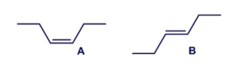
A (tetrasubstituted alkene)
Select the most stable alkene from the pair shown in the figure.

Yes, Yes
Do these alkenes have the same connectivity? Do they have the same molecular formula?

unimolecular, bimolecular
E1 is a ________ elimination while E2 is ________.
E2
Dehydrohalogenation usually proceeds by an ________ mechanism.
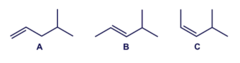
B, C, A
Rank the following alkenes in order of decreasing stability.
concerted (E2)
In a _____ reaction, bonds are formed and broken in a single step.
4, base, leaving group
In the transition state for the E2 reaction of an alkyl halide, there are _________ partial bonds with the negative charge being distributed between the _________ and the _________.
True
(T/F) A stronger base will increase the rate of an E2 reaction.
rate = k[alkyl halide][base]
What is the generic rate equation for an E2 reaction (dehydrohalogenation)?
A, C, B, D
Rank the following according to the relative reactivity in an E2 reaction. Place the most reactive substrate first.

solvated, hydrogen, aprotic
In an E2 reaction, as the strength of the base increases, the rate of reaction increases. In polar protic solvents such as H2O, the base is ________ as a result of ________ bonding and therefore polar ________ solvents are favored in E2 reactions.
increases, opposite to
As the number of R groups on the carbon bearing the leaving group _________, the rate of the E2 reaction increases. This trend is _________ the reactivity observed in SN2 reactions.
aprotic
Polar ________ solvents increase the rate of E2 reactions.
C, A, B, D
Rank the following alkyl halides in order of decreasing reactivity in an E2 reaction. Place the most reactive species first.

minor, major
If a β elimination reaction can produce two different alkenes, the less substituted alkene will be the ________ product, whereas the more substituted alkene will be the ________ product, according to the Zaitsev rule.
A, C, E
Which of the following are NOT characteristic of an E2 reaction? Select all that apply.
A. a two-step mechanism
B. second-order kinetics
C. the more basic the leaving group, the faster the reaction
D. favored by using polar aprotic solvents
E. more substituted alkyl halides react more slowly than less substituted systems
F. the reaction is favored by strong bases
constitutional isomer
A reaction is regioselective when it yields predominately or exclusively one _________ when more than one is possible.
True
(T/F) Increasing the stability of the double bond by adding R groups lowers the transition state energy of an E2 reaction.
more
The Zaitsev rule predicts that the major product of a β elimination reaction will be the ________ substituted alkene.
C
Which of the following molecules would be considered the major product of the E2 reaction shown?
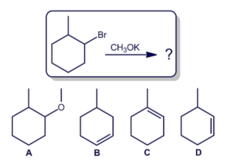
True
(T/F) An E1 reaction exhibits first-order kinetics with a mechanism of two or more steps.
regioselective
A reaction is ________ when it yields predominantly or exclusively one constitutional isomer when more than one is possible.
more, lower
In the transition state of an E2 reaction, the ________ alkyl substitutents around the forming alkene, the ________ the energy of the transition state.
False
(T/F) In E1 reactions, the bond to the leaving group breaks after the π bond is formed.
A (trans)
Which of the following molecules would be expected to be the major product of the E2 reaction shown?

True
(T/F) In an E1 reaction, the slow step in the mechanism is unimolecular.
constitutional isomer
A reaction is regioselective when it yields predominately or exclusively one _________ when more than one is possible.
phosphates
In biological elimination reactions, _________ can act as leaving groups.
False
(T/F) E1 reactions require a good nucleophile to take place.
syn, anti
Consider the stereochemistry of the E2 elimination. The dihedral angle for the C-H (β) and C-X bonds is 0° for the ________ periplanar arrangement and 180° for the ________ periplanar arrangement.
anti, opposite, rich
E2 elimination reactions have a favored orientation of _________ periplanar in which the leaving group and the β proton are on _________ side(s) of the molecule. This orientation allows the two electron-________ species, the base and the leaving group, to be farther away from each other.
B
Select the major product of the E2 reaction shown.

strenght, strong, weak
The ________ of the base is the most important factor in determining the mechanism for elimination. ________ bases favor the E2 mechanism, while ________ bases favor the E1 mechanism.
elimination
An alkyne can be prepared from a vicinal or geminal dihalide by two successive ________ reactions.
axial
For E2 elimination reactions to occur, chair conformations of halocyclohexanes must have both the β H and the X atom in ________ positions on the cyclohexane ring.
A
What is the product of the following reaction?

A
Select the major product of the E2 reaction shown.

D
Select the minor product of the E2 reaction shown.

strength of the base
The most important factor in determining whether the reaction of an alkyl halide favors the E1 or E2 mechanism is the _________.
E2
Consider the reaction shown in the diagram. What mechanism will occur in this reaction?

vicinal and geminal dihalide
What are the starting materials that could be used to prepare an alkyne.
C, D
Select the major product(s) of the reaction shown.

A, C
Select all of the reactants (A-D) that could be used to prepare the alkyne shown.

B
Select the major product of the E2 reaction shown.

A
Select the major product of the reaction shown.

rate = k[starting material][bulky strong base]
What rate equation would be observed for this reaction?

I
Which substrate would create only A through E2 elimination?

I
What is the starting material for the reaction shown?

II and III
What is/are the elimination products for the reaction shown?

B, A, C
Rank the following in terms of E1 and E2 reactivity, listing the least reactive first (remember its the same for both reactions).

bronsted-lowry bases
Elimination reactions are undergone with ________.
dehydrohalogenation
Another word for alkyl halide elimination reaction is ________.
hydrogens, a halogen
The beta carbon is the one with ________, while an alpha carbon is one with ________.
Negatively charged oxygen compounds and alkyl derivatives
What are the common bases for elimination reactions?
Alkene
What is the product if a single elimination reaction?
sp2, trigonal planar, 120
In an alkene, each carbon atom is ________ hybridized, ________ geometry, and a bond angle of ________.
carbon, carbon-carbon double bond
Alkenes are classified by the number of ________ atoms bonded to the ________.
two, cis, trans
Because of bond restriction in an alkene, ________ stereoisomers are possible. These stereoisomers are either ________ or ________.
>
Trans stereoisomers (>/
A, C, B
Order the following in terms of increasing stability: A. monosubstituted alkene
B. trans-disubstituted alkene
C. cis-disubstituted alkene.
E2
Which elimination mechanism is the most common and useful?
Strong, negatively charged bases
What type of base is usually run with E2 reactions?
Strong, sterically hindered nitrogen bases
Beyond strong, negatively charged bases, what are the other two bases used in E2 reactions? Examples are DBU and DBN
Polar aprotic
What type of solvent is most preferred by E2 reactions?
increases
For an E2 mechanism, an increase in R groups (increases/decreases) the rate of the reaction.
increase
A higher number of R groups are preferred by E2 reactions because they (increase/decrease) the stability of the alkene.
The Zaitsev Rule
The rule that states that the major product in beta elimination has the more substituted double bond.
Regioselectivity
The preferential formation of one constitutional isomer over another.
True
(T/F) E2 and E1 reactions are regioselective.
more
E1 and E2 reactions prefer the (more/less) substituted alkene.
after
In E1 reactions, the pi bond is formed (after/before) the leaving group departs.
True
(T/F) In E2 reactions, the first step is the rate-determining step.
weaker
E1 reactions prefer a (stronger/weaker) base.
Polar protic
What type of solvent is preferred by E1 reactions?
Because E1 reaction compete with SN1 reactions to form a mixture.
Why are E1 reactions less useful than E2?
True
(T/F) SN1 and E1 reactions have the same exact first step.
it is attacked by a nucleophile
What happens to the carbocation in SN1 reactions?
the base removes the proton creating a pi bond
What happens to the carbocation in E1 reactions?
hydrogen, halogen, carbon
The transition state of an E2 reaction consists of four atoms in the same plane: 1 ________ atom, 1 ________ atom, and 2 ________ atoms.
eclipsed
Syn-periplanar alkyl halides have a(n) ________ conformation.
staggered
Anti-periplanar alkyl halides have a(n) ________ conformation.
anti-periplanar
Which does E2 reactions more prefer: syn-periplanar or anti-periplanar alkyl haldies?
axial
For a halocyclohexane to be in anti-periplanar conformation, it must have both the hydrogen and halogen in an ________ position.
False
(T/F) For halocyclohexanes, the Zaitsev Rule is always followed in E2 reactions.
first
E1 does not react with ________ degree alkyl halides.
The strength of the base
When choosing between E1 or E2 reactions, what is the most important factor?
two
Alkynes are produced by _________ E2 reactions.
vicinal and geminal dihalides
What are the two starting materials used in alkyne synthesis by E2 reactions?
stronger
For alkyne synthesis by E2 reactions, a (stronger/weaker) base is necessary than for alkene synthesis.