Organic Chem topics 5-9
 Call Kai
 Learn
 Practice Test
 Spaced Repetition
 Match
 Flashcards
 Knowt Play
1/71

There's no tags or description
Looks like no tags are added yet.
72 Terms
covalent bonds
strong attractions between atoms within a molecule
intermolecular forces
weak attractions between separate molecules
which are shorter and stronger: covalent bonds or intermolecular forces?
covalent bonds are shorter and stronger than intermolecular forces wihch are longer and weaker
Non-polar Covalent Bonds
the bonding electrons are shared equally (ex. H-H bond)

Polar covalent bonds
two atoms share electrons unequally because one atom has a stronger pull (higher electronegativity) than the other (ex. H-F)

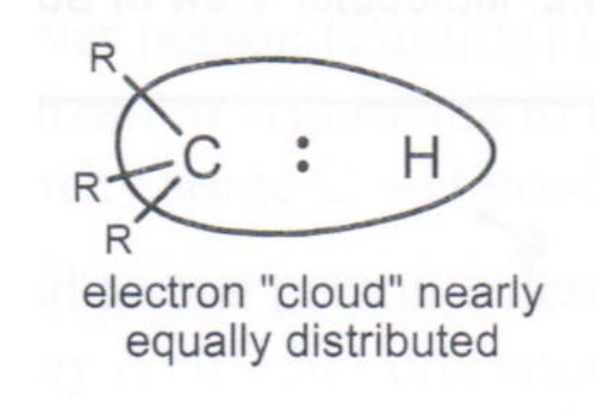
is C-H a polar or non-polar bond?
C-H bonds are considered to be non-polar because the electron cloud is nearly equally distributed
ionic bonds
the extreme case of a polarized bond (such as in NaCl, the Na atom is not very electronegative and therefore gives up all of its bonding electrons to the Cl) electrons are not shared at all

electron cloud
Organic chemists think of electrons in a bond as forming a fine mist of negative charge
what are delta charges used for?
to represent partial electric charges that occur when atoms share electrons unequally in a polar covalent bond
electronegativity
The electronegativity (EN) of an atom is a measure of its ability to attract electrons toward it, can be used to predict the polarization of a bond in a molecule
what are dipole moments used for?
The polarity of a bond is often represented with a dipole moment arrow showing separation of positive and negative charges

EN difference
EN difference = |EN of atom one – EN of atom two|
most electronegative element
fluorine
what happens when the net dipole moment is zero
the molecule is overall non-polar, non-polar molecules do not have dipoles
how does boiling point relate to intermolecular forces?
intermolecular forces can often be overcome by a small amount of heat, the more heat required to overcome the intermolecular forces the higher the boiling point of that compound
which is more important surface area or molecular weight for predicting boiling point?
surface area is more important than molecular weight for predicting boiling point, the larger the surface area of a molecule the more chance it has of sticking to neighboring molecules
induced dipole-induced dipole forces (LDF)
attractive forces that hold non-polar molecules together in the liquid state
dipole-dipole forces
intermolecular attractive forces that hold polar molecules together
instantaneous dipole
when a non-polar molecule accidentally creates a dipole by chance and impacts the molecules around it temporarily
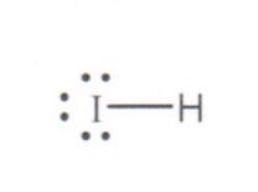
what strong acid is this?
hydroiodic acid

what strong acid is this?
hydrobromic acid

what strong acid is this?
hydrochloric acid

what strong acid is this?
sulfuric acid (when R=OH)

what strong acid is this?
nitric acid

what strong acid is this?
hydronium ion (when R=H)
what does a strong acid do?
A strong acid easily donates an H+
what is another name for a strong acid?
an extreme H-bond donor
what is another name for a strong base?
an extreme H-bond acceptor
what is an acid (also called a hydrogen-bond donor)
any molecule (or positive ion) with an H
what is a base (also called a hydrogen bond acceptor)
any molecule (or negative ion) with a lone pair or a pi bond
when will hydrogen bonds form?
only between a lone pair on N, O, or F and an H attached to a N, O, or X (when X is not F)
why can an H attached to an N or O atom participate in a hydrogen bond, while an H attached to a C cannot
carbon and hydrogen have very similar electronegativities so carbon does not pull electron density away from the hydrogen and has no strong partial charge
how strong is a hydrogen bond compared to a covalent bond?
A typical hydrogen bond is about 5% as strong as a typical covalent bond
what does a strong base do?
A strong base easily accepts an H+
strong base =
an ion with a lone pair and a -1 formal charge on an H, C, N, or O atom
what are conjugate acid-base pairs?
two chemical species that transform into each other by gaining or losing a single proton (H⁺)
conjugate base
What remains of an acid after it donates a proton
conjugate acid
what is created when a base accepts a proton (H+)
why do conjugate bases and acids form?
molecules react because they are unstable and want to be lower energy
the conjugate base of a strong acid is…
always a weak base
the conjugate acid of a strong base is…
always a weak acid
the stronger the acid…
the weaker its conjugate base and vice versa
what is an energy diagram
a graph that charts the total energy during a chemical reaction vs time
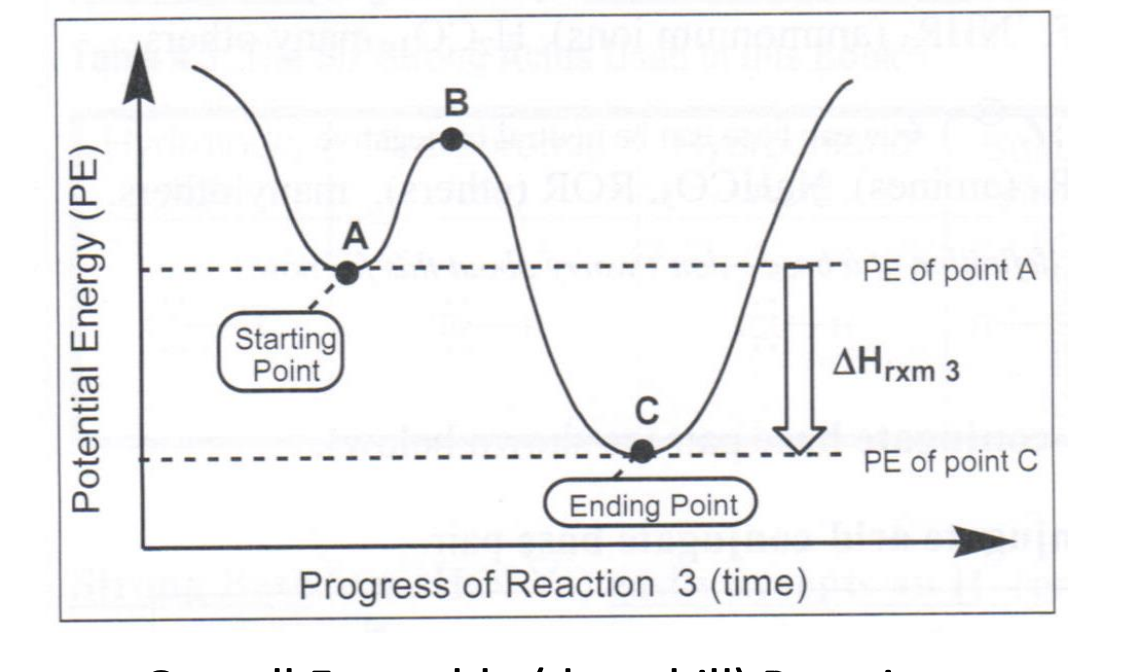
what is a potential energy change from high to low considered?
downhill, negative, or exothermic (overall favorable)

what is a potential energy change from low to high considered?
uphill, positive, or endothermic (overall unfavorable)
Making a bond is…
favorable, downhill, negative, exothermic because energy is released by the molecule
Breaking a bond is…
unfavorable, uphill, positive, endothermic because energy must be added to the molecule
what is pKa?
a measure of the energy difference between the conjugate acid and the conjugate base in the solvent, water
pka is an estimate of…
the amount of energy needed to break the bond of hydrogen
a strong base has a pKa of…
greater than 14
how much energy does a strong base releases when it makes a bond to H+
a large amount
Assume E act ≈
+1 pKa unit for all acid-base reactions
activation energy (E act)
the energy required to start a reaction
Which H is most acidic?
the H that requires the least amount of energy to remove
The Inductive Effect
Polarization caused by an electronegative atom that can induce minor polarization in neighboring bonds
how strong is the inductive effect?
it is weak, it cannot change that an H on a positively charged atom is more acidic than an H on a neutral atom
where does the inductive effect peak?
At the Beta atom (second)
The higher the pKa of an acid the stronger or weaker the acid?
the weaker the acid
The lower the pKa of an acid, the stronger or weaker the acid?
the stronger the acid
For a given base, the higher the pK, of its conjugate acid, the stronger or weaker the base?
the stronger the base
For a given base, the lower the pK, of its conjugate acid, the stronger or weaker the base?
the weaker the base
what is the highest energy orbital?
sp3 hybridization
what is the lowest energy orbital?
sp hybridization
what are Li°, Na°, K°?
metals
If you don't see the zero superscript (°) after Li, Na, or K…
assume it is an inert +1 cocounterion
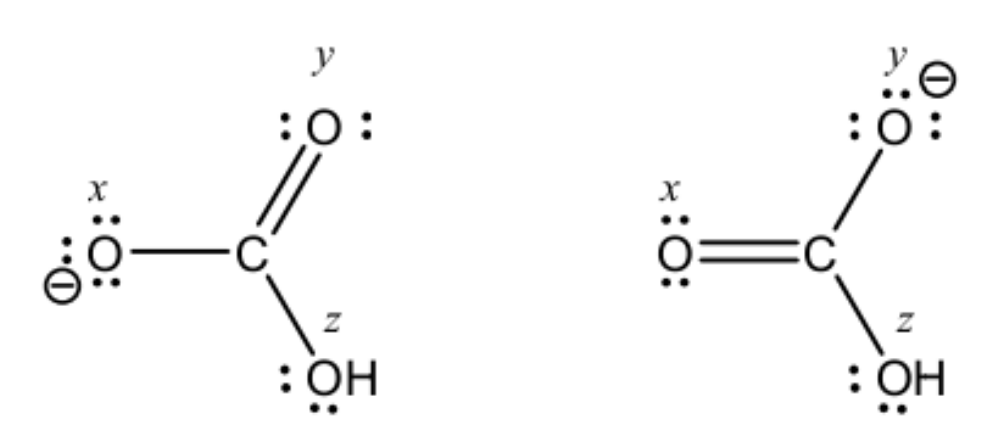
what molecule is this?
hydrogen carbonate (bicarbonate)

In which location is the Na+ most likely to reside?
halfway between Ox and Oy because the negative charge is not fixed on either atom it is delocalized and shared equally therefore the positive Na is attracted to both atoms equally.
3 types of curved arrows:
lone pair to pi bond to an adjacent atom
pi bond to lone pair of electrons on an atom in that bond
pi bond to pi bond on an adjacent atom
what types of arrows do you use for anions?
lone pair to pi bond to an adjacent atom
pi bond to lone pair of electrons on an atom in that bond
what type of arrows do you use for cations?
pi bond to pi bond on an adjacent atom
first-order resonance structures
those with the minimum number of +1 and -1 formal charges
what is the C=O double bond called?
carbonyl bond