sinus, mandible, TMJ anatomy & pathology- erin & ashlyn
 Call Kai
 Learn
 Practice Test
 Spaced Repetition
 Match
 Flashcards
 Knowt Play
1/80

There's no tags or description
Looks like no tags are added yet.
81 Terms
what are the 4 sinuses?
frontal
sphenoid
ethmoid
maxillary
what serve as a resonating chamber for the voice, decrease the weight of the skull by containing air, help to moisten & warm inhaled air, act as shock absorbers in trauma, and possibly control the immune system
sinuses
what is developed at 6/7 years old?
frontal, spehnoid, ethmoid bones
when are the parnasal sinuses completely developed?
until age 17 or 18
what are Merrill’s truest air fluid levels guidlines?
pt must be erect & central ray must be perpendicular to IR
what is the joint classification for the TMJ?
synovial, hinge, gliding

what is a?
maxillary sinuses
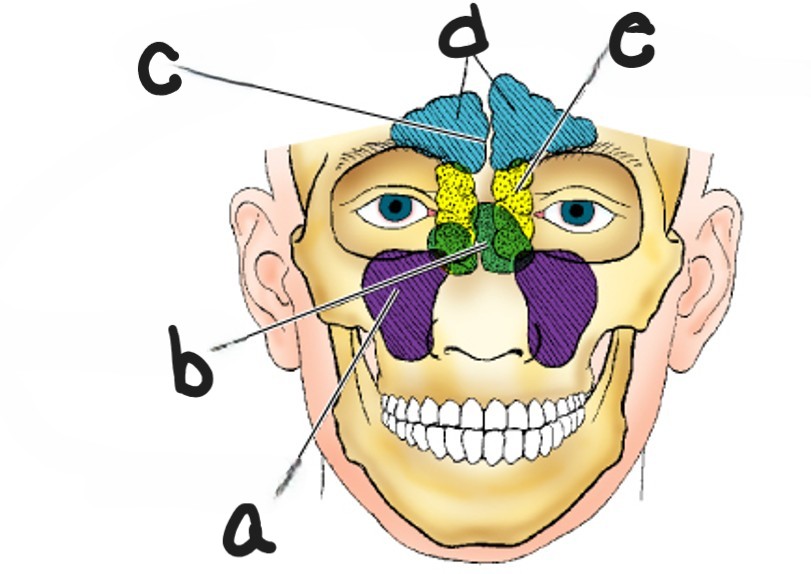
what is b?
sphenoidal sinuses

what is c?
intersinus septum

what is d?
frontal sinuses

what is e?
ethmoidal sinuses

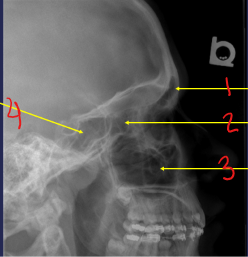
what is #1?
sphenoidal sinus

what is #2?
ethmoidal air cells

what is #3?
frontal sinus

what is #4?
maxillary sinus

what is #1?
angle (gonion)

what is #2?
condylar process

what is #3?
condyle

what is #4?
neck

what is #5?
alveolar portion

what is #6?
symphysis

what is #7?
coronoid process

what is #8?
ramus

what is #9?
body

what is #10?
mental protuberance

what is #11?
mental foramen

what is a?
mental protuberance

what is b?
symphysis

what is c?
alveolar portion

what is d?
coronoid process

what is e?
neck

what is f?
condylar process

what is g?
mandibular notch

what is h?
ramus

what is i?
angle (gonion)

what is J?
body

what is k?
mental froamen

what is a?
temporal bone

what is b?
ear canal

what is #1?
jaw closed

what is #2?
jaw open

what is #1?
squamous portion

what is #2?
mastiod portion

what is #3?
external acoustic meatus (EAM)

what is #4?
mastoid process

what is #5?
tympanic portion

what is #6?
styloid process

what is #7?
mandibular fossa

what is #8?
articular tubercle

what is #9?
zygomatic process

what is a?
condyle

what is b?
coronoid process

what is c?
ramus

what is d?
body

what is e?
symphysis

what is circled in light blue?
maxillary sinuses

what is circled in red?
sphenoidal sinuses

what is 1?
frontal sinuses

what is 2?
ethmoidal sinuses
what is 3?
maxillary sinuses

what is 4?
sphenoidal sinuses
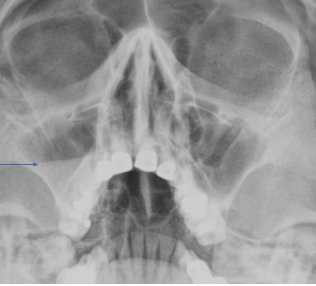
what is this image showing?
air fluid level

what is circle in yellow?
frontal sinuses

what is circled in pink?
ethmoid sinuses

what is circled in green?
maxillary sinuses
the mandible is the ___ and ____ of the facial bones
largest and most dense
the symphysis is the most ____ part of the mandible.
anterior
the TMJs slant posteriorly ____ degrees and anteriorly/medial____ degrees
15 degrees and 15 degrees
what pathology has the radiographic appearance of thickening of mucosa, air-fluid levels, and the sinus appears opacified
sinusitis

what are these images of?
sinusitis
what is TMJ syndrome
pain and clicking in the TMJ
what pathology has the radiographic appearance of abnormal relationship between the condyle of the mandible and the fossa in the temporal bone?
tmj syndrome

what is this an image of?
TMJ syndrome (Panorex)
what is the largest sinus & are they symmetrical?
maxillary & yes
where should the condyle be in the closed mouth shuller
anterior to EAM & in fossa
where should the condyle be in the open mouth shuller
inferior to articular tubercle (not in fossa)
what 2 things show the truest air fluid levels
patient erect & central ray perpendicular to IR (if pt cannot stand must do cross table only)
which sinuses are usually developed at birth?
maxillary & rest are developed by 18
why is technique important for sinuses
over exposed will burn out possible pathology & under exposed can make it look like there is a pathology that may not exist
how many air cells for anterior & middle ethmoid
2-8
how many air cells for posterior ethmoid
2-6