Structures Midterm2
 Call Kai
 Learn
Learn Practice Test
 Spaced Repetition
 Match
Match Flashcards
 Knowt Play
1/51

There's no tags or description
Looks like no tags are added yet.
Name | Mastery | Learn | Test | Matching | Spaced | Call with Kai | Chat |
|---|
No analytics yet
Send a link to your students to track their progress
52 Terms
Elements of structure
we are focusing on beam, column, truss, arch, frame. the rest are slab, wall, space truss, dome, vault/shell
Live loads
higher factors of safety because of more risk they will not be estimated correctly over the life of the building. Vertical: snow, earthquake. Horizontal: wind, seismic
Dead loads
lower factors of safety because less risk they will change over life of building. Vertical: weight of building. Horizontal: structures such as buttresses
Force
F=ma
Moment
Two forces equal and opposite separated at a distance. (torque) is force times perpendicular distance measured from the point in question to the line of action of the force. Force x perpendicular Distance.
Laws of statics
6 equations to be satisfied in order for a particle NOT to move. Equilibrium is when laws of statics are achieved. This does not necessarily mean that a structure is stable, since the least unbalanced force of moment could cause instability. Stability is the ability to stand and endure firmness. For the elements of structure we are considering, the applicable laws of statics are sum of forces Fx =0 sum of forces Fy=0 and sum of moments Mz=0
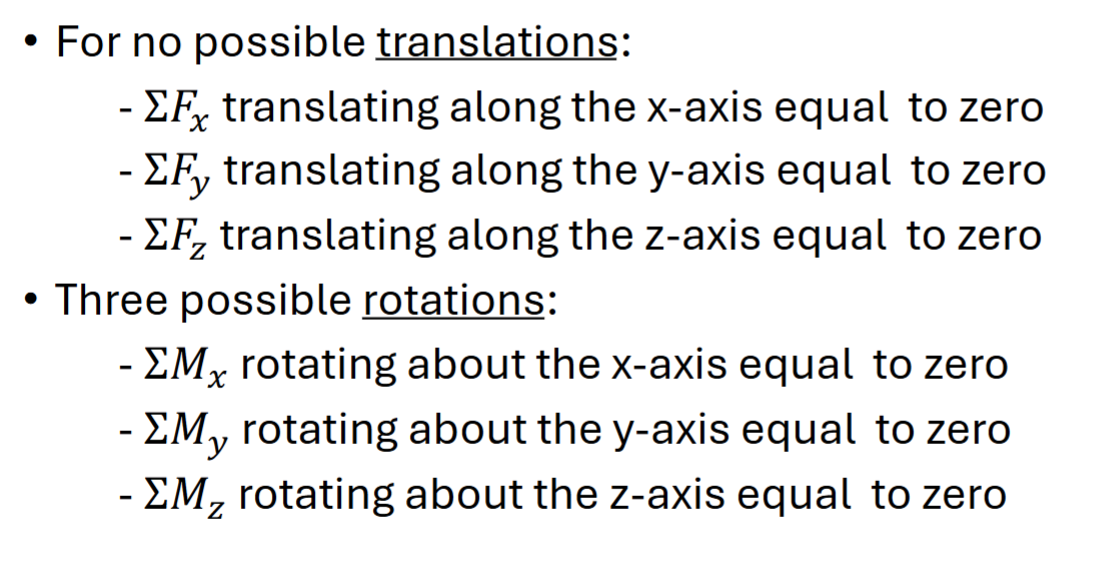
Boundary conditions
Free end: no restraints, 3 degrees of freedom
roller: 1 restraint, 2 degrees of freedom
hinge: 2 restraints, 1 degree of freedom
fixed: 3 restraints, 0 degrees of freedom
Concurrent Force Systems
Concurrent Coplanar Force System is a system of two or more forces whose lines of action ALL intersect at a common point.
non concurrent force systems
lines of actions of the forces do not intersect. Ex: vertical loads like people, furniture, weight of building.
Can you cut a structure?
you can cut a structure anywhere as long as you replace forces and moments at the cut to maintain equilibrium.
if you cut a cable…
If you cut a cable, which can only work the tension, you would replace a tension force that is tangential at the cut-line, preserving the extension of the cable under the load.
if you cut a beam…
If you cut a beam along its span, you would replace a force and a moment so the the distorted shape of the beam under the load is preserved.
Reactions arches
arches are the inverse shape of cables and working in compression. For uniformly loaded cable the horizontal reaction at the left and the right support is 𝑤𝐿²/8s where w is the load for unit of span, L is the span and s is the sag of the cable. Greater the value of the sag, the lower the horizontal reaction; the vertical reactions remain the same. For uniformly loaded cable the vertical reaction at the left and the right support is wL/2.
Statically determinate
Structure that can be solved by the 3 equilibrium equations from law of statics
what is a couple
A couple is two forces having the same magnitude, parallel lines of action, but opposite arrowhead direction. Couples have pure rotational effects on a body and no ability to translate the body into the vertical or horizontal direction. This is because the sum of the horizontal and vertical components is zero.
what is a truss
assembly of bar members into triangular configuration. the joints are pinned connections in which the loads are located at. each member is in tension, compression, or nothing.
truss stability
2j=m+r where 2 x joints, m is number of members, r is number of reactions. if both sides of equation are equal it is a true truss and stable. if left side is higher its a mechanism and not stable. if left side is lower it has a redundant member and is stable but statically indeterminate
FBDs of end fixities

stress
force divided by area. (f=P/a)
strain
change in length divided by original length (e=deltaL/L)
modulus of elasticity
ratio of stress to strain (E=f/e) would look like a rise over run thing in diagram for steel. helps us define what material properties are to use. wood and concrete are way lower.
stress/strain diagram for steel
Yeild point is if the structure goes past this point it cannot return to its original shape. its the point before the graph plateaus. sloped line up is elastic range where it can return to its original shape. flat line is plastic range where it cannot go back. The factor of safety is fb=2/3fy. after flat line it will go up more and reach point of ultimate stress in which it fails. Strain hardening is line that increases after the plateau.

Ductile vs. Brittle
Brittle breaks before yeild point, sudden and drastic failure. Ductile has a plastic range before reaching ultimate stress and failing.
moment of inertia
Moment of Inertia is a geometric property of the cross-section. For rectangles, the Moment of Inertia (I) = 1/12 𝑏ℎ³
shear
Shear is the sum of the forces to the left or right of a point in question. Slicing action.
bending moment
Bending moment is the sum of the moments to the left or right of a point in question. The shape of a bending moment diagram is the integral of the shear diagram. For a uniformly loaded, simply supported beam, the bending moment is maximum at its midspan. Point loads makes BM diagram with straight sloped lines and uniform loads make a parabola
3 beam failures
bending, shear, deflection
Neutral axis
While compression zone of a beam decreases in length and tension zone increases in length, there is a location on the beam that does not change in length. This is the Neutral Axis of the beam. Since there is NO change in length at the Neutral Axis, there is NO direct strain and, therefore, No direct stress.
Shear and bending moment in relation to neutral axis
At points where Shear is present, the shear stresses vary over the cross-section from zero at the edges to a maximum at the Neutral Axis. At points where Bending Moment is present, the direct stress due to bending varies over the cross section from maximum at the extreme fibers to zero at the Neutral Axis.
shear and bm diagram with point load

shear and bm diagram with uniform load

What things cause beam deflection, and what can you do to reduce it?
The deflection shape of a statically determinate beam depends on the magnitude of the loads, the location of the loads, the span and the end fixity, the geometry of cross-section and type of material.
The greater the load and span - the greater the deflection
The greater the E (modulus of elasticity) and I (moment of inertia) - the lower the amount of deflection
To limit deflection, increase Moment of Inertia
Name three types of support conditions?
Rollers, pins, and rigid connections.
What is a Determinate Structural System?
A structural system where all unknown reactions and internal forces can be found from the equations of equilibrium where the sum of the forces Y equals zero, sum of the forces X equals zero, and sum of the moments equals zero
what is a catenary
A curve formed if the loads are distributed uniformly along the length of a cable. Example is if a suspended chain is loaded by its own weight, then it forms the natural funicular shape called a catenary which is like a parabola.
How do you increase/reduce the horizontal/vertical reactions of an arch or sagging cable?
Increase span or loads to increase vertical reactions. Increase in sag means decrease in horizontal reactions.
How does a truss or maintain equilibrium when cut by, say, the method of sections
cutting the truss has you expose the internal axial forces which are equal and opposite. You replace at the cut line the forces to keep equilibrium.
How does bending moment and shear change across a beam?
shear force is greatest at the supports and zero at the midpoint. bending moment is zero at the supports and greatest at the midpoint.
How does the direct stress due to bending, as well as stress due to shear, change across the cross section (CX) of a beam?
stress due to bending: top of beam has greatest compressive stress. bottom has greatest tensile stress. the middle neutral axis has zero stress, strain, tension, compression.
stress due to shear: top and bottom have zero shear stress while neutral axis has greatest shear stress. it is opposite of bending stress.
How do you design for shear, bending, or deflection?
shear: increase cross setional area/web because it reduces shear stress
bending: increase section modulus and beam depth because it reduces bending stress
deflection: increase stiffness because it reduces deformation
direct stress
Remember that DIRECT STRESS is perpendicular to the cross-section of a structural member
shear stress
Remember that SHEAR STRESS is parallel to the cross-section of a structural member
strength
ability to resist loads without failure.
stiffness
ability to resist deformation. modulus of elasticity measures stiffness of a material
formula: stress
force divided by area (f=F/A)
formula: strain
change in length divided by original length (e=deltaL/L)
formula: modulus of elasticity
E=stress/strain (E=f/e)
formula: moment of inertia for a rectangle
I=bh³ /12
b=width of rectangle
h= height of rectangle
formula: section modulus for a rectangle
S=bh² /6
b=width of rectangle
h= height of rectangle
frame of reference
A frame of reference is a coordinate system used to describe the position, direction, and movement of a structure.
X-axis: Left and right
Y-axis: Up and down
Z-axis: Forward and backward (depth)
Degrees of Freedom
number of independent ways an object or structure can move. rotation and translation.
rotation: movement about an axis
translation: movement along an axis
centroid
A centroid is the geometric center of a shape or cross-section. It is the point where the entire area of the shape can be considered concentrated. It is the center of gravity.