LAT II: Common Equine Diseases
 Call Kai
 Learn
Learn Practice Test
 Spaced Repetition
 Match
Match Flashcards
 Knowt Play
1/79

There's no tags or description
Looks like no tags are added yet.
Name | Mastery | Learn | Test | Matching | Spaced | Call with Kai | Chat |
|---|
No analytics yet
Send a link to your students to track their progress
80 Terms
List the equine core vaccines:
Rabies
EEE/WEE
West Nile Virus
Tetanus Toxoid
The the equine risk-based vaccines:
Strangles
EVA
Potomac Horse Fever
Influenza
Rhinonumenitis
List the c/s of botulism?
Creeping flaccid paralysis
starts in the head and moves caudally
can cause respiratory paralysis
Sudden death
Muscle necrosis
How can we treat botulism?
Supportive care
Gastric lavage— if recently ingested
Antitoxins
How does botulism typically infect patients?
Contaminated feed.
What kind of areas of theh country is Canker usually seen in?
Wet year-round places— south and midwest.
What are the c/s of Canker?
Odor or friable
White cottage cheese frog
Lameness
How can we treat Canker?
Superficial debridement- a good trim
Topical antimicrobial agents
How is Lyme disease spread?
Via ticks.
What are common c/s of lyme disease?
Low-grade pyrexia (fever)
Depression
Stiffness
Lameness— shifting leg lameness
Loss of appetite
Joint swelling
Eye problems
How can we dx lyme disease?
ELISA or IFA.
How can we treat and prevent lyme disease?
Antibiotics
tetracycline or doxycycline (PO)
Prevention:
insecticide and vaccination
What is the endemic region for Potomac Horse Fever?
Northern California.
How can we treat potomac horse fever?
Supportive care.
How can we prevent potomac horse fever?
Vaccinate every 6 months and reduce snail numbers.
What is a way that horses can get potomac horse fever?
Snails.
Potomac horse fever is a concern when what is involved in pastures or trails?
Running water (rivers or streams).
What are some GI c/s you can see with potomac horse fever?
Anorexia
Colic
Colitis
Decreased GI sounds
Abortion in mares
Moderate to severe diarrhea with in 24-48 hours
Clinically ill horses with potomac horse fever are ____ contagious.
Not.
Horses with rain rot are typically seen in areas that are high in what?
High heat and humidity.
What are the c/s of rain rot?
Crusty scabs and matted tufts of hair.
What are the c/s of salmonella?
Carrier, mild clinical, and acute clinical”
Very profuse diarrhea
How do we treat salmonella?
Supportive care
Quarentine!
Why is salmonella a risk?
It is zoonotic.
What is the causative agent for strangles?
Streptococcus equi.
Strangles is most common in:
Horses under 5, foals, and yearlings.
How is strangles transmitted?
Sharing water buckets
nose to nose contact through nasal discharge
contact with people handling an infected horse
How long can Strangles survive in ideal conditions outside the host?
7-9 weeks.
How long are barns considered contaminated after an outbreak of strangles?
2 months.
What are the clinical signs of strangles?
Lymphadenopathy- submandibular and retropharyngeal
Cough and thick, mucopurulent nasal discharge
LN abscesses + rupture
Abscesses or lymph nodes in other areas of the body caused by strangles is called?
Bastard strangles.
What is the causative agent of tetanus?
Clostridium tetani.
How can horses become infected with tetanus?
Contamination of wounds.
What are some c/s of tetanus?
Sawhorse appearance
Recumbent
CNS
Photophobia- sensitive to light
Rigid paralysis
Lock jaw
How can we treat tetanus? What is the prognosis?
vaccinate- tetanus toxoid
50% mortality rate
If a horse has a wound or surgery 3-6 months or more after the tetanus vaccine, should it be boostered?
Yes; immediately.
What are clinical signs of thrush?
Odor
Black discharge
Lameness

How is EPM, Equine Protozoal Myeloencaphalitis, spread?
Sporocysts in opossum’s feces.
What are some c/s for EPM?
Asymmetric muscle atrophy in glutes and quads
Cranial nerve abnormalities- variable

Is EPM a reportable disease?
Yes.
How is piroplasmosis spread?
Transmitted by ticks.
What are some c/s or piroplasmosis?
Pyrexia (fever)
Depression
Anemia
Thirst
Eye problems
What is the causative agent for piroplasmosis? How does this play into dx?
Babesia equi.
It can be seen on RBCs.

What is the most common form of dermatophytosis in horses?
Ringworm.
What are the c/s of dermatophytosis?
Round, small lesions covered with scales.
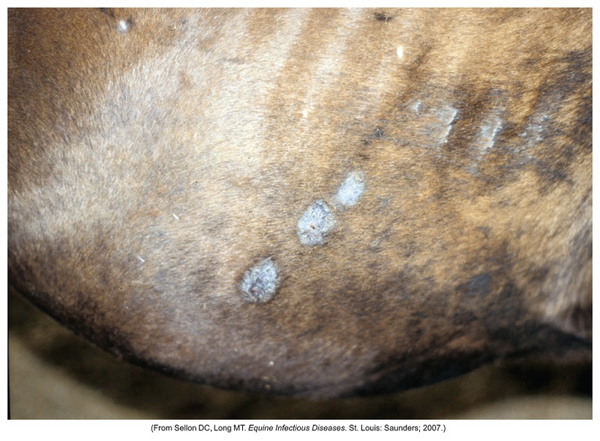
How can dermatophytosis be dx?
Wood’s lamp
Culture
Histology
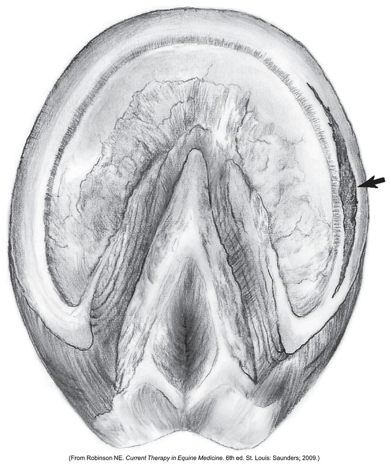
What are common c/s of White Line disease?
Cheesy material
Air pockets that pack with debris
Laminitis
Black, foul-smelling material
How is encephalomyelitis transmitted?
Through mosquitoes.
What are the 2 main types of encephalomyelitis we deal with in the US?
Eastern— most damaging to horses (50-90% mortality)
Western
Will horses that recover from encephalomyelitis have lasting neurological signs?
Yes.
What are some c/s of encephalomyelitis?
Hyper-excitability
Head pressing
Circling
How effective is the vaccine against encephalomyelitis?
Very effective.
What season should the encephalomyelitis vaccine be given? Why?
Spring.
Before mosquito season.
How is EVA, Equine Arteritis Virus, spread?
Contaminated semen
Venereal transmission
Artificial breeding
What kind of operations should vaccinate for EVA?
Breeding farm facilities.
What is EIA also known as?
Swamp fever.
How is EIA transmitted?
Bloodsucking insects.
horseflies and deer flies
What tests look for EIA? How often should this be done? How many states require this?
Serologic tests
Agar gel immunodiffusion
ELISA tests
Coggin’s test
All 50 states
What are some c/s of EIA?
Pale MM
Petechiae
Icterus
Neuro signs
Thrombocytopenia
Anemia
Is EIA a reportable disease?
Yes.
What type of nasal discharge do you see with equine influenza?
Mucopurrulent
How is equine influenza treated?
Supportive care
Rest
NSAIDs
How long is the recovery period for equine influenza?
2-3 weeks
Severe— 6 months.
Why is rabies so important?
It is zoonotic
Fatal
No tx—> euthenasia
How is rabies spread?
Saliva.
Is the rabies vaccination required by law in horses?
Yes—> core vaccine.
Is rabies a reportable disease?
Yes.
What is the causative agent for rhinopneumenitis?
Equine herpesvirus I
Equine herpesvirus 4
What are the clinical signs for rhinopneumenitis?
Mucopurrulent nasal dc
Abortion
Paralysis of the tail
How contagious is rhinopneumenitis?
Very contagious.
Where do you commonly see ulcerations with Vesicular stomatitis?
Oral mucosa
Coronary band
Belly
Muzzle
Prepuce
Udder

Is vesicular stomatitis a reportable disease?
Yes.
How is vesicular stomatitis spread?
Via biting flies.
How is west nile virus transmitted?
From avian reservoir host by mosquitoes
What are some c/s of west nile virus?
Low-grade fever
Lack of appetite
Colic
Personality changes
Neuro signs
Hyperesthesia
Cranial nerve deficits
Horses with west nile virus are hypersensitive to what being touched?
Head and neck.
What kind of cranial nerve deficits will you see with West Nile virus?
Facial paralysis
Drooping eyelids
Drooping face
Will horses show residual effects for up to 6 months after surviving west nile virus?
Yes; about 40%.
What is a common sign of Cutaneous Papillomas?
Warts.
How long will the warts resolve after treating cutaneous papillomas?
3-4 months.