small molecules
 Call Kai
 Learn
 Practice Test
 Spaced Repetition
 Match
 Flashcards
 Knowt Play
1/50

There's no tags or description
Looks like no tags are added yet.
51 Terms
What is a small molecule drug?
Drug molecules with relatively low MW (typically less than 1000 daltons).
Chemically synthesised and interact with specific biological targets e.g. enzymes
What are the key properties of small molecule drugs?
Favour oral administration.
Reach intracellular targets.
Chemical structure can be modified to alter distribution.
What is 1 dalton?
1/12th the mass of a carbon-12 atom.
What are the key features of the oesophagus?
Squamous epithelium.
Peristalsis.
What are the key features of the stomach?
Production of chyme.
Under fasting conditions, contains approximately 50 mg fluid.
What are the structural features of the small intestine?
Folds of Kerckring, villi and microvilli.
What are the structural features of the colon?
Crypts and folds.
What is the function of mucus in the GI tract?
Provides a protective layer and mechanical barrier.
What are mucins?
Glycosylated proteins.
What is the unstirred water layer?
Layer adjacent to the intestinal wall, created through incomplete mixing.
30–100 micrometres thick.
Acts as a diffusion barrier.

What is gastric emptying?
Refers to a drug traversing the stomach.
What factors affect gastric emptying?
Highly variable and dependent on fasted/fed state, posture, food composition and disease state.
What are the types of small intestinal transit movement?
Propulsive movement.
Mixing movement.
Why is small intestinal transit important?
is an important factor affecting drug bioavailability.
How long is colonic transit?
Highly variable, approximately 2–48 hours.
How does pH affect drug absorption?
Considerable pH variability throughout the GI tract.
Post-meal, gastric juice is buffered to a less acidic pH.
pH changes within different regions of the GI tract.
Which enzymes are present in the GI tract that can affect drug absorption?
Stomach: pepsin.
Small intestine: lipase, amylase and protease.
Can cause hydrolysis of esters.
Bacteria can also affect drugs.
How can disease affect drug absorption?
Changes in pH.
Surgical intervention.
How can food affect drug absorption?
Drug complexation.
Alters pH and gastric emptying.
Stimulates GI secretions.
Competes with absorption mechanisms.
Increases viscosity of GI contents.
What other food-induced changes can affect drug absorption?
Changes in presystemic metabolism.
Changes in blood flow.
What are the two main pathways of drug transport across the intestinal epithelium?
Transcellular pathway.
Paracellular pathway.

What are the mechanisms of transport through the transcellular pathway?
Passive diffusion (1).
Membrane transporters (3): active and facilitated transport.
Transcytosis (4).
What is the paracellular pathway?
Drug transport between cells.

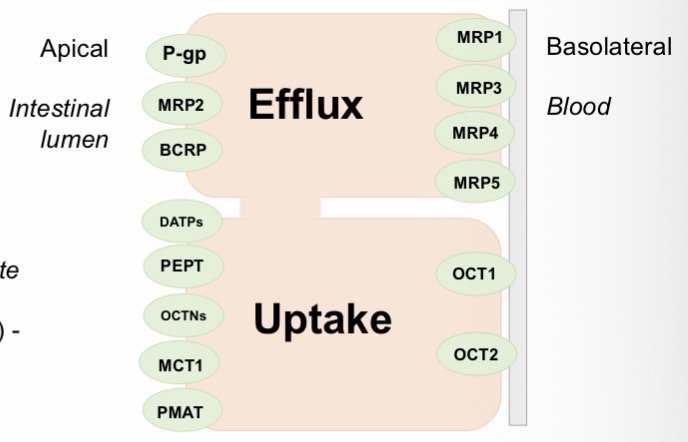
What are the two main superfamilies of drug transporter proteins?
ATP-binding cassette (ABC): efflux.
Solute carrier (SLC): uptake.
Which drugs are first-generation antihistamines?
Chlorphenamine, promethazine and hydroxyzine.
How do first-generation antihistamines enter the CNS and what effects do they cause?
Readily cross the blood-brain barrier (BBB) and accumulate in the CNS.
Bind to H1 receptors in the brain.
Cause sedation, drowsiness and anticholinergic effects.
Which drugs are second-generation antihistamines?
Loratadine and cetirizine.
How do second-generation antihistamines have reduced sedative effects?
Many are P-glycoprotein (P-gp) substrates.
P-gp on BBB endothelial cells removes drugs from the brain into the blood.
Results in low brain permeation and reduced sedation.
Why does cetirizine still cause some sedation?
It is less lipophilic and is not completely removed from the brain.
What is lipophilicity and why is it important for membrane crossing?
Drug molecules must be soluble in both water and lipid to cross membranes.
LogP is used to describe lipophilicity.
What is the partition coefficient (P) and how is LogP calculated?
P = Coctanol / Cwater.
Converted into a logarithmic value (LogP).
P = 1 means equal concentration in each phase, therefore LogP = 0.
What is hydrophobicity and what is it associated with?
Many new drugs are hydrophobic, particularly large molecules.
Associated with non-polar regions of drug molecules.
Why is hydrophobicity not always problematic?
Important for binding target receptors, absorption and medicines packaging.
What is pKa?
The pH at which 50% of a drug is ionised and 50% is unionised.
How does pKa relate to acid and base strength?
Lower pKa = stronger acid.
Higher pKa = stronger base.
How does pH affect the ionisation of acidic drugs?
pH less than pKa: mostly unionised.
pH greater than pKa: mostly ionised.
How does pH affect the ionisation of basic drugs?
greater than pKa: mostly unionised.
pH less than pKa: mostly ionised.

What are the key properties of API ionisation?
Most APIs are weak acids or weak bases.
Ionised compounds are more soluble in aqueous phases.
APIs largely unionised in the low pH of the stomach cross lipophilic membranes more readily.
Ionisation can be exploited depending on the drug's target/action.
Extent of ionisation depends on pKa/pKb and physiological fluid pH.
How does naproxen demonstrate pH-dependent ionisation?
Contains a carboxylic acid group and has pKa = 4.2 (weak acid).
Can be more or less lipophilic depending on environment.
In more basic conditions, becomes more ionised, increasing aqueous solubility.
How can aqueous solubility be improved using salt formulation (BCS)?
Acidic drug: DRUG-COOH → DRUG-COO⁻ X⁺.
Basic drug: DRUG-NH₂ → DRUG-NH₃⁺ Y⁻.
Which ions are commonly used to form drug salts?
Cations (X): usually metal ions e.g. Na⁺, Ca²⁺, Zn²⁺.
Anions (Y): chloride, sulphate and citrate.
Give an example of a drug formulated as a salt to improve solubility.
Soluble aspirin, formulated as a sodium salt.
How can introducing basic groups improve drug solubility?
Changes drug structure but may improve solubility.
Groups become protonated at physiological pH, increasing aqueous solubility.
What is drug permeability?
Ability of a drug molecule to cross a biological membrane.
Determined by physicochemical properties of the drug and formulation choice.

What are the models used to assess drug permeability?
CACO-2: labour-intensive, expensive and low throughput.
PAMPA: only measures passive diffusion.
What are the four criteria of Lipinski's rule of 5 for good oral absorption?
Molecular weight less than 500.
LogP less than 5.
Fewer than 5 hydrogen bond donors.
Fewer than 10 hydrogen bond acceptors.
Why do small molecule drugs remain important?
They continue to account for a significant proportion of marketed drug molecules despite advancing technologies.
What factors can present barriers to drug absorption?
Enzymatic activity, gastric motility, pH, food and diseases.
What are the main routes by which drugs cross plasma membranes?
Several routes are possible, but passive diffusion is preferred when considering drug absorption.
What are the two main drug transporter superfamilies?
ABC (ATP-binding cassette): efflux.
SLC (solute carrier): uptake.
Why are physicochemical properties of drugs important?
Closely related to pharmacokinetic and pharmacodynamic effects.
Influence formulation design.