sedimentary environments pt. 2 (mod #9.2)
 Call Kai
 Learn
 Practice Test
 Spaced Repetition
 Match
 Flashcards
 Knowt Play
1/40

Earn XP
Description and Tags
🍂
41 Terms
fluvial systems
TERRESTRIAL ENVIRONMENTS:
Encompass sediments generated by riverine and gravity-flow
processes;
Subdivided to alluvial fan and river settings
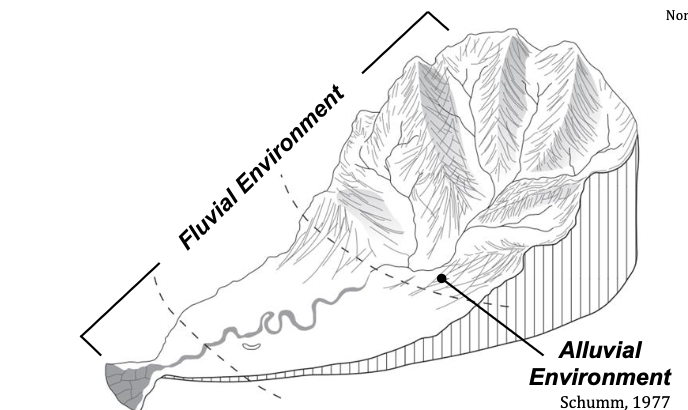
alluvial fan, poorly sorted
TERRESTRIAL ENVIRONMENTS:
conical (fan) segment with convex-up cross section with high relief and steep slopes;
transition of mountains and plains;
_____-sorted mud to gravel-sized sediments forming conglomerate, breccia and sandstone;
high-energy environment

conglomerate, breccia, sandstone
TERRESTRIAL ENVIRONMENTS (FLUVIAL SYSTEMS):
in alluvial fans, there are poorly-sorted mud to gravel-sized sediments forming ______, ______, & _______
river
TERRESTRIAL ENVIRONMENTS (FLUVIAL SYSTEMS):
Elongated bodies of water that flow through channels

meandering channel, low
TERRESTRIAL ENVIRONMENTS (FLUVIAL SYSTEMS):
Single channel with thalweg (deepest);
____ gradient and high sinuosity (many curves);
deposition at point bars and erosion at cut banks

thalwegs
DEFINITIONS:
this is the line of lowest elevation connecting the deepest points along the length of a stream bed, river channel, or subterranean valley

braided river, low sinuosity
TERRESTRIAL ENVIRONMENTS (FLUVIAL SYSTEMS):
Multiple channels with ____ sinuosity with multiple thalwegs and bars;
Occurs in areas with irregular water regime and abundant sediment supply
Deposits composed of alternating lenses of coarse gravel and sand

Terraces
TERRESTRIAL ENVIRONMENTS (FLUVIAL SYSTEMS):
elevated areas at the sides of channels
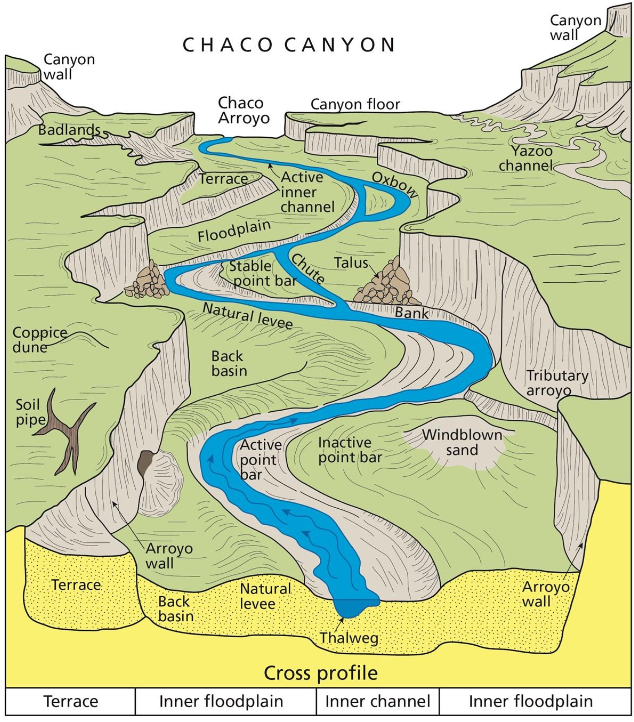
Yazoo Tributary
TERRESTRIAL ENVIRONMENTS (FLUVIAL SYSTEMS):
tributary running along the main channel;
tributary that is forced to flow parallel to a larger, major river within the same floodplain for a long distance before finally joining it at a delayed confluence
tributary - freshwater stream or river that flows into a larger stream, river, or lake instead of draining directly into an ocean

Natural Levees
TERRESTRIAL ENVIRONMENTS (FLUVIAL SYSTEMS):
accumulation of sediments along banks

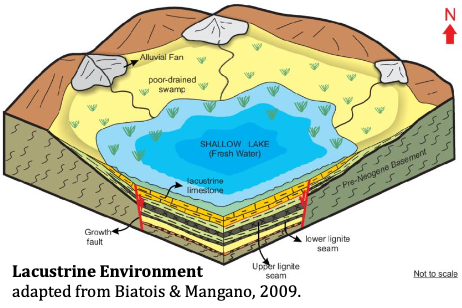
Lacustrine Environment
TERRESTRIAL ENVIRONMENTS:
Landlocked body of standing, fresh and non-marine water with circular plan and lenticular section;
Low energy depositing fine sediments (shales, laminated mudstone, sandstone) with well preserved fossils and structures that coarse upward-outward
Varves
TERRESTRIAL ENVIRONMENTS (LACUSTRINE):
alternating dark and light-colored mud laminations

Aeolian Environment
TERRESTRIAL ENVIRONMENTS:
Dominated by wind erosion and deposition;
Occurs in arid regions & has wind erosion
sandblasting, deflation

Sandblasting
AEOLIAN ENVIRONMENTS (WIND EROSION):
erosion from constant impact of grains carried by the wind
Deflation
AEOLIAN ENVIRONMENTS (WIND EROSION):
erosion of fine sediments, leaving coarser sediments to form desert pavements

Dunes
AEOLIAN ENVIRONMENTS:
wind deposited sands with windward gentler stoss side eroded and deposited to the steeper lee side

stoss
lee
UNDER DUNES:
side facing into the wind or water current; long, gentle, gradual slope
sheltered, downwind (or downstream) side facing away from the prevailing wind; short steep slope

Glacial Environment
TERRESTRIAL ENVIRONMENTS:
Glacial (ice) processes dominate;
High altitude and latitude regions;
Poorly-sorted mixtures of sediments

Glacial Till
GLACIAL ENVIRONMENTS:
unsorted sediments derived from glacial erosion and entrainment

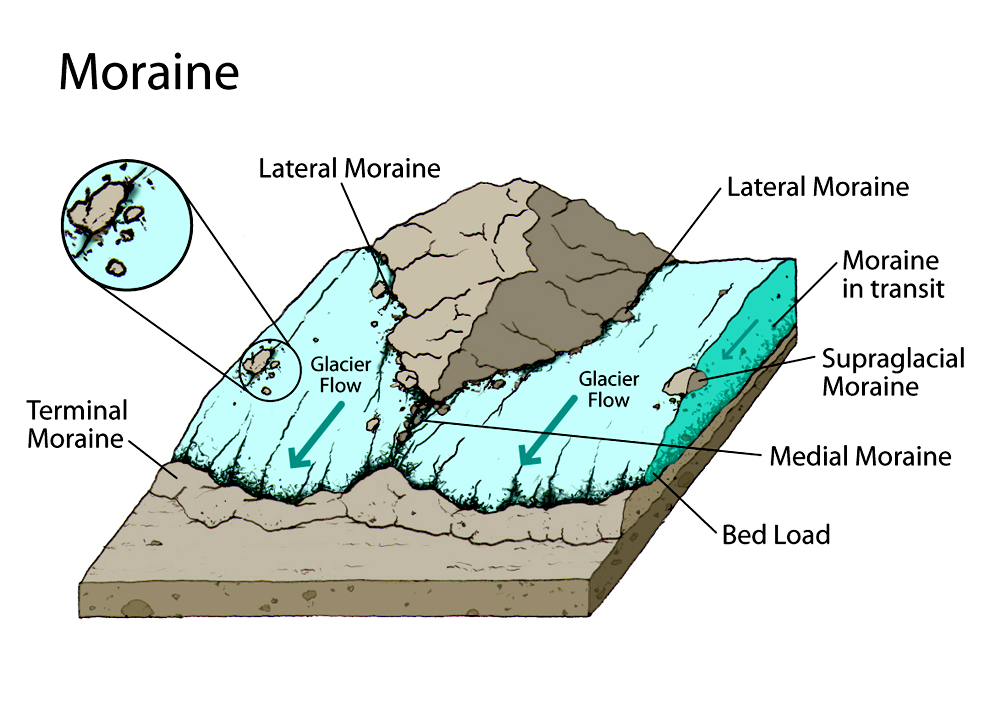
Moraine
GLACIAL ENVIRONMENTS:
landforms composed of glacial till that has been transported and deposited by a glacier or ice sheet
deltaic environment, low energy
TRANSITIONAL ENVIRONMENTS:
Triangular depositional bodies where a river drains into a larger body of water;
_____ energy except during flood events
False; beaches should be deltas
TRUE OR FALSE:
Beaches (transitional environments) are dominated by fine-grained sediments (mud and sand) with occasional gravel with grain size decreasing away from land and coarsening upwards (along a section) due to progradation.

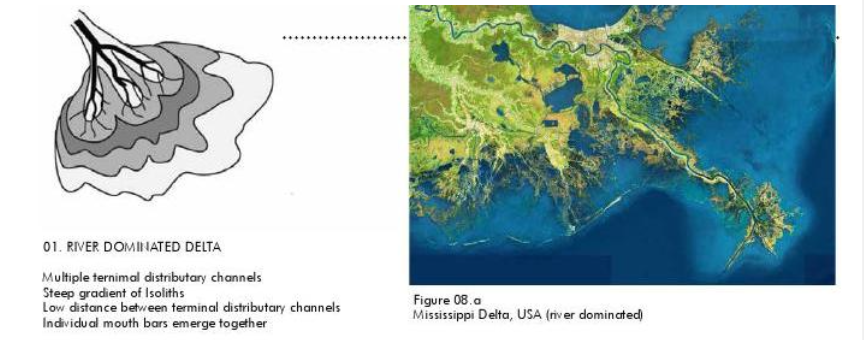
River-dominated
DELTAIC ENVIRONMENT
associated with high sediment load rivers;
lobate (moderate supply) to elongate (large supply)
Tide-dominated
DELTAIC ENVIRONMENT
exhibit linear inlets parallel to tidal flow and perpendicular to shore

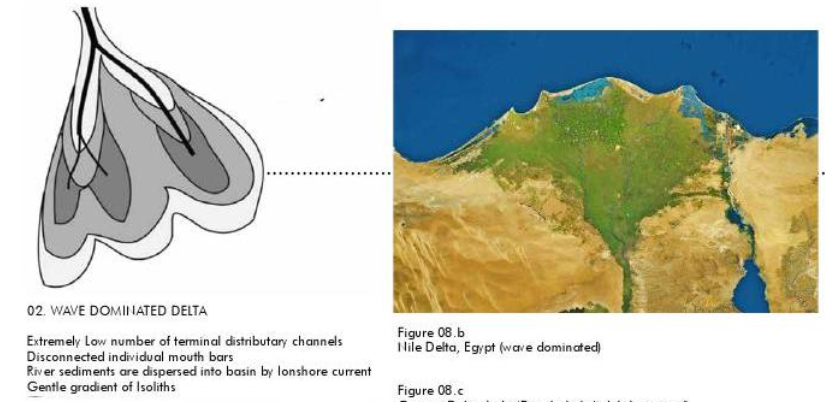
Wave-dominated, coarser
DELTAIC ENVIRONMENT
constantly reworked by wave action;
smoothly arcuate and contains _____ sediments
beach environment
TRANSITIONAL ENVIRONMENT:
shore area of a body of water formed and washed by waves and tides;
_____ energy environment;

False; should be well-sorted
TRUE OR FALSE:
Beaches are covered by poorly-sorted, loose, and highly reworked sand to pebble-sized sediments.
Longshore current
BEACHES:
current moving parallel to shore from swells sweeping into the coastline at an angle

longshore drift
BEACHES:
transportation of sediments along a coast parallel to the coastline

tidal flats, high salinity
TRANSITIONAL ENVIRONMENTS:
these are extensive marshy to barren tract of land that is cyclically submerged by tide with ______ salinity range from mixing of freshwater and salt water;
depositionary environment for finer grained sediments

False; should be low
TRUE OR FALSE:
Tidal flats are of high energy dominated by loose fine mud and sand sediments.
reef
MARINE ENVIRONMENTS:
wave resistant, mound-like structures composed of fossiliferous carbonates and sand along shallow marine settings
fringing, barrier, atoll
Fringing Reef
TYPES OF REEFS:
in direct contact with landmass;
grows directly attached to or closely seaward from the shorelines of islands or continents, separated only by a narrow, shallow lagoon or flat

Barrier Reef
TYPES OF REEFS:
separated by a lagoon from the landmass;
Run parallel to coastlines but sit much farther out at sea

Atoll
TYPES OF REEFS:
reef without an associated landmass;
Circular or oval-shaped rings of coral enclosing an open central lagoon with no central landmass left above water

continental shelf
MARINE ENVIRONMENT (CONTINENTAL MARGIN):
Continuous and underwater coastal plain;
Between shoreline and continental slope;
Dominated by mud, sand and carbonates (if above Carbonate Compensation Depth)

Carbonate Compensation Depth
MARINE ENVIRONMENT (CONTINENTAL MARGIN):
this is the depth below which the rate of formation of calcite is lower than of its solvation

continental slope & rise
MARINE ENVIRONMENT (CONTINENTAL MARGIN):
Between continental shelf and abyssal plain;
Gentle to moderate incline and smooth topography;
Associated with submarine canyon and fans
slope: steep descent that marks the true outer edge of the continental crust
rise: located at the base of the continental slope, sitting between the slope and the deep abyssal plain; wide slope

submarine canyons & fans
MARINE ENVIRONMENT (CONTINENTAL MARGIN):
______ _____ and _____ are associated with continental rise
fining upward sequence
MARINE ENVIRONMENT (CONTINENTAL MARGIN):
Turbidites are sediment laden by turbidity currents characterized by a ____ ____ sequence (conglomerate, sand to massive mud, shales)
sequence: grain size gradually decreases from coarse at the bottom to fine at the top
abyssal plain; low energy
MARINE ENVIRONMENTS:
Pelagic / Open ocean;
Flat and low relief region of the ocean floor
_____ energy environment
ex. Pelagic mud, micritic limestones (lime mud) and chert
