Section 1 - Matrix mechanics
 Call Kai
 Learn
 Practice Test
 Spaced Repetition
 Match
 Flashcards
 Knowt Play
1/95

There's no tags or description
Looks like no tags are added yet.
96 Terms
Why can't a single sine wave represent a particle?
A pure sine wave is completely delocalised and cannot represent a particle at a specific location.
What is a wave packet?
A superposition of waves with different wavelengths that produces a localised particle-like region.
Why does localisation require multiple wavelengths?
Different wavelengths interfere constructively in one region and destructively elsewhere.
What happens to momentum when localisation improves?
Momentum becomes less well defined.
What is the de Broglie relation?
λ = h/p.
What is the localisation-momentum trade-off?
Better localisation means poorer momentum definition; perfect momentum definition means no localisation.
Why are only certain Bohr orbits allowed?
Only orbits where the electron wave interferes constructively with itself are stable.
What is the Bohr quantisation condition?
n=Principal quantum number (positive integer: 1, 2, 3, ...)

What happens if the electron wave does not fit an integer number of wavelengths around an orbit?
Destructive self-interference occurs and the orbit is unstable.
What are the allowed hydrogen energy levels?

What energy must a photon have to excite an electron?

Why are atomic spectra discrete?
Only quantised energy transitions are allowed.
How is the state of a particle represented ( How is a quantum state represented) ?
By a vector |ψ(t)⟩ in a Hilbert space.
What do we treat a quantum state as?
A vector in an n-dimensional vector space
What is a Hilbert space?
The vector space in which quantum states exist.
Why is choosing a basis important?
A suitable basis simplifies calculations.
What type of transformation changes basis?
A unitary transformation.
What is a unitary basis transformation?
A change of basis that preserves inner products and physical predictions.
What is a ket?
A quantum state vector |ψ⟩.
What is a bra?
The dual vector ⟨ψ|.
What does ⟨f|i⟩ represent?
A probability amplitude between states.
What do observables correspond to in quantum mechanics?
Hermitian operators.
What do Hermitian operators represent?
Physical observables such as position, momentum and energy.
Why are Hermitian operators used for observables?
Measurement outcomes must be real numbers.
What condition defines a Hermitian operator?
Ω† = Ω.
What property of Hermitian operators ensures real measurements?
Their eigenvalues are real
What is one property of Hermitian operator eigenvectors?
They are orthogonal.
What condition gives orthogonal eigenvectors for a Hermitian operator?
ωn ≠ ωm.
What is an eigenbasis?
The basis formed from an operator's eigenvectors.
How does a Hermitian operator appear in its orthonormal eigenbasis?
As a diagonal matrix.
What appears along the diagonal of a Hermitian operator in its eigenbasis?
Its eigenvalues.
What is meant by the eigenbasis of a Hermitian operator?
The basis formed by its orthonormal eigenvectors.
What is degeneracy?
When two or more eigenvectors have the same eigenvalue (are equal).
Does degeneracy automatically imply orthogonal eigenvectors?
No
What can always be chosen within a degenerate subspace?
An orthonormal basis.
hat assumption is usually made in exam-level proofs?
A non-degenerate spectrum.
What condition defines a unitary operator?
U†U = I.
What do unitary operators represent physically?
Symmetry transformations, time evolution and basis changes.
What is one property of unitary operator eigenvalues?
They are complex numbers of unit modulus.
What is special about unitary eigenvalues?
They have unit modulus.
What form do unitary eigenvalues take?
e(iφ)
(The eigenvalues lie on the unit cirlce)
What is one property of unitary operator eigenvectors?
They are orthogonal.
hat quantity is preserved by a unitary operator?
The inner product between vectors.
What property do the columns of an n × n unitary matrix satisfy?
They form orthonormal vectors.
What property do the rows of an n × n unitary matrix satisfy?
They form orthonormal vectors.
What is the geometric interpretation of a unitary operator?
A rotation or reflection in Hilbert space.
What is the physical role of Hermitian operators?
To represent observables.
What is the physical role of unitary operators?
Represent symmetry transformations, time evolution and basis changes.
What does it mean if two operators commute?
Their commutator is zero.
What is the commutator of A and B?
[A,B] = AB - BA.
hat is true if Ω and Λ are commuting Hermitian operators?
They share a common eigenbasis.
What is another consequence of two Hermitian operators commuting?
They can be diagonalised simultaneously.
What does it mean for two Hermitian operators to share a common eigenbasis?
They share the same eigenvectors.
What do unitary transformations do between bases?
Rotate between bases without changing physical predictions.
Why is the order of operators important?
In general operator multiplication is not commutative.
What is the general relation for two operators Ω and Λ?
ΩΛ − ΛΩ ≠ 0.
What is the commutator [ ] of Ω and Λ?
[Ω,Λ] = ΩΛ − ΛΩ.
What is the anticommutator { } of Ω and Λ?
{Ω,Λ} = ΩΛ + ΛΩ.
What is the first principle of quantum mechanics?
The state of the particle is represented by a vector |ψ(t)⟩ in a Hilbert space.
What represents the independent variables x and p?

What is the position-space matrix element of the position operator X^?

What is the position-space matrix element of the momentum operator P^?

Why do we need infinite-dimensional vector spaces?
To generalise the mathematical framework to infinite dimensions and connect it to wave functions.
What was previously assumed about the dimension n of the vector space?
n was assumed to be finite.
Why is position space introduced?
To connect the vector space description with familiar wave functions.
What does each point xi correspond to in the discretised position space?
A basis vector |xi⟩.
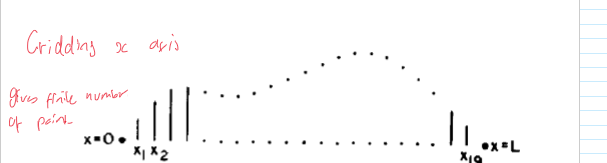
How is the basis vector |xi⟩ represented?
A column vector with a 1 in the i-th position and 0 elsewhere.

What is the orthonormality condition for the position basis vectors?

What is the completeness relation for the discrete position basis?
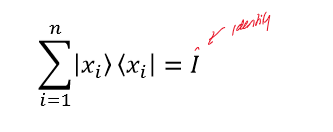
How can a function fn(x) be represented in the position basis?

What does fn(xi) represent in the vector expansion?
The projection of the vector along the i-th direction.
How is the inner product of two functions defined in the discrete basis?

Why is the factor Δ included in the inner product?
To obtain a smooth limit as n tends to infinity.
What is the inner product of two functions f and g in the continuum limit?

What is the norm of a function f?

How is a state expanded in the continuous position basis?

What corresponds to each position x in the continuous limit?
A basis vector |x⟩.
What is the orthogonality condition for continuous position states?
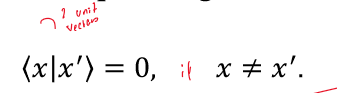
What is the completeness relation in the continuous basis?

What is ⟨x|f⟩ equal to?
f(x)
What is ⟨x'|f⟩ equal to?
f(x’)
What is the normalisation condition for position eigenstates?

What is the Dirac delta function equal to when x ≠ x'?

What is the integral property of the Dirac delta function?

What is the sifting property of the Dirac delta function?

What symmetry property does the Dirac delta function satisfy?
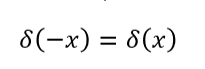
How does the Dirac delta function scale?

What operator is associated with position?
The Hermitian position operator X̂.
How does the position operator act on a position eigenstate?

How do local operators appear in the position basis?
They are diagonal in position space.
What does Ox represent?
The position-space representation of an operator in terms of position and its derivatives.
How can a basis vector |fi⟩ be expanded in the position basis?
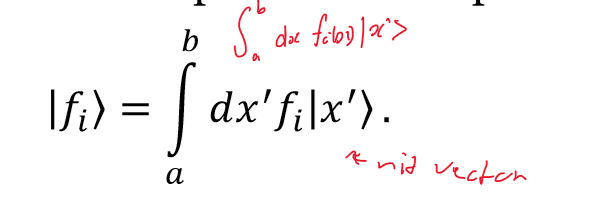
What operator is obtained from the derivative operator D̂?
K^

Why is K̂ introduced?
Because D̂ is anti-Hermitian and K̂ is Hermitian.
What are the eigenfunctions of K̂?
Plane waves.
What form do the eigenfunctions of K̂ take?
continue from here -line 29 on copilot