Ions
0.0(0)
Studied by 0 people Call Kai
 Learn
Learn Practice Test
 Spaced Repetition
 Match
Match Flashcards
 Knowt Play
Card Sorting
1/21

Earn XP
Last updated 7:03 AM on 11/11/22
Name | Mastery | Learn | Test | Matching | Spaced | Call with Kai | Chat |
|---|
No analytics yet
Send a link to your students to track their progress
22 Terms
1
New cards
What is an ion?
An atom or a group of atoms that has an electrical charge, either positive or negative
2
New cards
What charge does an atom have?
Neutral
3
New cards
How does an atom become an ion?
By losing or gaining (an) electron(s)
4
New cards
Why do atoms become ions?
To obtain a full valence shell of electrons and become stable
5
New cards
When are atoms unstable?
When they have an incomplete valence shell
6
New cards
What is a valence shell?
The outermost shell of an atom
7
New cards
What is the difference between an atom and an ion?
An atom always has a neutral charge, but ions have either a positive or negative charge
8
New cards
What is a valence electron?
An electron in the outermost shell of an atom
9
New cards
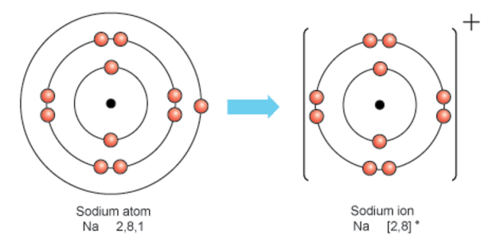
If a sodium atom has one valence electron, how will it become an ion in the most energy-efficient way?
It will lose one atom
10
New cards
If a sodium atom loses an electron, what will its charge be?
Positive
11
New cards
If chlorine has 7 valence electrons, how will it become an ion in the most energy-efficient way?
It will gain one electron
12
New cards
If a chlorine atom gains an electron, what charge will it be?
Negative
13
New cards
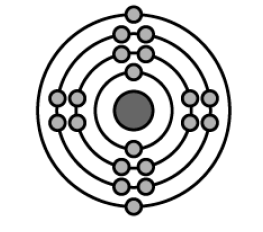
What is the difference between drawing a Bohr model of an atom versus a Bohr model of an ion?
A Bohr model of an atom has the atom symbol and the number of protons and number of neutrons written out. Then each shell is filled with the number of electrons, which is the same number as the number of protons (the atomic number). An ion is drawn the same way, but it has a full valence shell and it has square brackets around the model. It also has the ion charge written on the outside of the brackets. The ion charge is always written as number, then charge, not charge then number. Ex. it is 2+ NOT +2. Any additional electrons that were added are drawn in the opposite way as the original electrons. Ex. If you draw your electrons as dots, any added electrons in the ion should be drawn as X's.
14
New cards
Where do extra electrons come from when an atom turns into an ion by gaining an electron?
It comes from another atom that donates it's electron
15
New cards
What charge will an ion have if it loses an electron and why?
It will be positive because it has more protons than electrons
16
New cards
What charge will an ion have if it gains and electron and why?
It will be negative because it has more electrons than protons
17
New cards
Why do argon atoms not form ions?
Because it already has a full valence shell
18
New cards
Why can't carbon atoms form ions?
Because it has four valence electrons, it is in the middle. It would take a lot of energy to lose or gain four electrons.
19
New cards
Why do some elements have multiple ion charges?
Because they can form ions in more than one way
20
New cards
What charged ions do metals tend to form?
Positive ions
21
New cards
What charged ions do non-metals (excluding noble gases) tend to form?
Negative ions
22
New cards
What charged ions do elements in the same group often form?
Elements in the same group often form ions with the same charge