Nervous system pt 2 (anatomy & physiology)
 Call Kai
 Learn
 Practice Test
 Spaced Repetition
 Match
 Flashcards
 Knowt Play
1/39

There's no tags or description
Looks like no tags are added yet.
40 Terms
What is the difference between neuroglia and neurons?
Neuroglia cells structurally support, nourish, and protect neurons.
Neurons are the main cells of the nervous system that allow communication within the body.
What are dendrites?
The parts of a neuron that receive information.
A

What is the cell body (soma)?
The part of the neuron that contains the nucleus.
B

What is the trigger zone?
The axon hillock/initial segment, where an action potential is initiated.
C
What is an axon?
The part of the neuron that carries nerve impulses away from the cell body.
D
What do myelinated axons do?
They allow action potentials to move more quickly down the neuron.
What does SSRI stand for?
Selective Serotonin Reuptake Inhibitor.
How do SSRIs work?
They block the reuptake of serotonin.
What happens when serotonin reuptake is blocked?
Receptors on the postsynaptic neuron continue to be stimulated, resulting in elevated mood.

What is the resting membrane potential?
-70 mV.
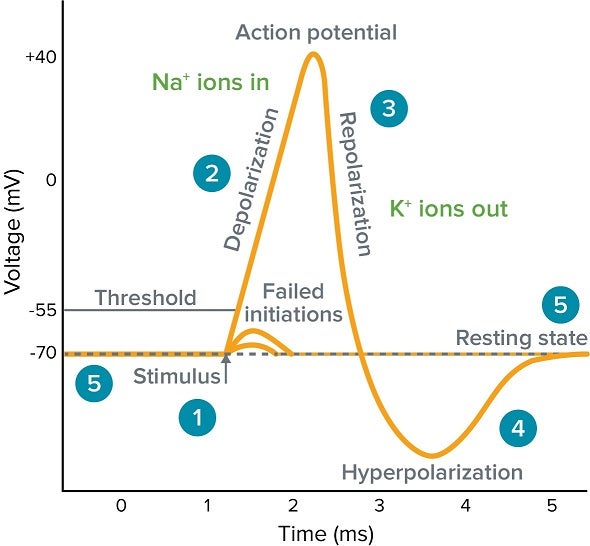
What is the threshold potential?
-55 mV.

Where is there a greater concentration of potassium (K+)?
Inside the neuron.

Where is there a greater concentration of sodium (Na+)?
Outside the neuron.
Which ion has more leak channels?
Potassium (K+).
Which ion has fewer leak channels?
Sodium (Na+).
Which direction do ions move through leak channels?
From high to low concentrations.
Is the inside or outside of a resting neuron more negative?
The inside of the cell is more negative than the outside.
What is a resting membrane potential?
The charge of a neuron when it is not conducting an impulse, about -70 mV.
What is an action potential?
An electrical impulse that travels down the axon.
What is a threshold potential?
The minimum charge needed to trigger an action potential, about -55 mV.
What are graded potentials?
Small, local voltage changes that do not spread but can add together to trigger an action potential.
What does the sodium-potassium pump do?
Uses active transport to move sodium out of the cell and potassium into the cell.
How many sodium ions are pumped out of the neuron?
3 sodium ions (Na+).
How many potassium ions are pumped into the neuron?
2 potassium ions (K+).
What is depolarization?
Sodium ions rush into the neuron through voltage-gated sodium channels.
What is repolarization?
Potassium ions move out of the neuron through voltage-gated potassium channels.
What is hyperpolarization?
The membrane potential becomes more negative than the resting membrane potential.
What causes depolarization?
Sodium (Na+) entering the cell.
What causes repolarization?
Potassium (K+) leaving the cell.
What happens when a neurotransmitter crosses the synapse?
It binds to protein receptors on the postsynaptic cell.
What is a receptor?
A protein that receives and binds a neurotransmitter.
What is a synapse?
The space between neurons where neurotransmitters travel.
What happens when an action potential reaches the axon terminal?
Voltage-gated calcium channels open, allowing calcium ions to enter.
What are the steps of synaptic transmission?
- Action potential reaches the axon terminal. 2. Voltage-gated calcium channels open and calcium enters. 3. Vesicles bind to the membrane at the axon terminal. 4. Neurotransmitter is released into the synapse. 5. Neurotransmitter binds to receptors on the postsynaptic neuron.
What is an EPSP?
An excitatory postsynaptic potential. It makes the inside of the neuron less negative, moving it closer to threshold (-55 mV).
What is an IPSP?
An inhibitory postsynaptic potential. It makes the inside of the neuron more negative, moving it farther away from threshold (-55 mV).
What happens during depolarization?
Voltage-gated sodium channels open and sodium rushes into the cell.
What happens during repolarization?
Voltage-gated potassium channels open and potassium moves out of the cell.
What happens during hyperpolarization?
The membrane potential becomes more negative than the resting membrane potential.
What is the difference between EPSPs and IPSPs?
EPSPs move the neuron closer to threshold, while IPSPs move the neuron farther away from threshold.