envsocty - unit 10
 Call Kai
 Learn
 Practice Test
 Spaced Repetition
 Match
 Flashcards
 Knowt Play
1/68

There's no tags or description
Looks like no tags are added yet.
69 Terms
urban structure
arrangement of land uses in cities
urban land uses (6 categories)
residential
industrial
commercial
institutional
transportation/infrastructure
public
residential areas
about 50% of urban area
variation (rich/poor + new/old + high/low density)
industrial areas
about 5-10% of urban area
heavy (traditional) production + light (innovative) production
commercial areas
about 5% of urban area
(ex. offices + retail)
institutional areas
about 5-10% of urban area
(ex. government buildings, universities, hospitals, churches)
transportation/infrastructure areas
about 25% of urban area (ex. roads)
public areas
about 5-10% of urban area (ex. parks)
accessibility
variable quality of a location (expressing opportunity for interaction with other locations)
how land uses are organized
competition for territory/location (desirability of location)
land value
ability or willingness to pay for land
central location = more accessible, less space
peripheral location = less accessible, more space
bid-rent curves
shows how willing certain land uses are willing to pay for location near central business district (CBD)
commercial = wants to be close to city
industrial = not as willing to be close
residential = less willing

central business district (CBD)
social + cultural + commercial + political + economic center of a city
concentric zone model
process where residential neighborhoods come to be associated with particular social groups (by Ernest Burgess)
the greater the distance from the CBD, the greater the wealth
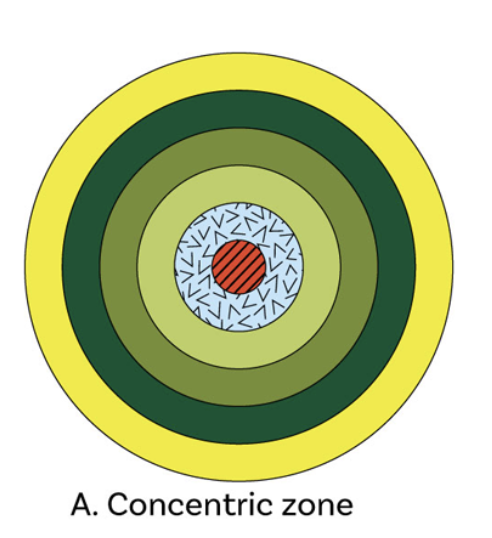
concentric zone model (5 zones)
CBD
zone in transition (industrial employment)
working class homes
middle class residences
wealthiest residences (wealthy commuter suburbs)
sector model
city differentiated into sectors based on land value (by Homer Hoyt)
(ex. growth occurs outwards from land area)

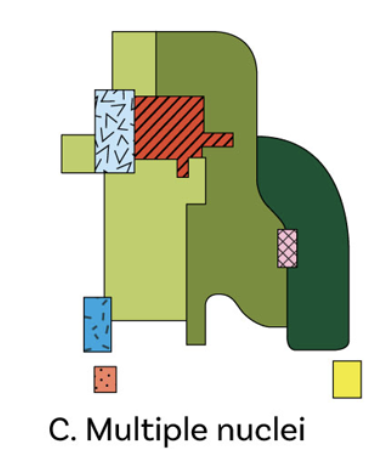
multiple nuclei model
cities initially develop around a CBD + additional notes/nuclei emerge within the urban area over time (ex. airport, suburban business centers, universities)
Jane Jacobs theory
higher density cities
walkable + mixed-use neighborhoods
anit-car-centric cities
Richard Florida theory
urban regeneration through placemaking + urban entrepreneurialism
3 “T’s” = technology + talent + tolerance
criticized for contributing to greater inequalities in cities
Neil Smith + David Ley theory
role of capital + culture in gentrification of urban residential neighborhoods
composite model (for European cities)
historic core (central to commercial + civic + social life)
core is ringed with residential areas (going through change)
suburban residencies are varied
commuting + middle/high-class households sit on urban periphery

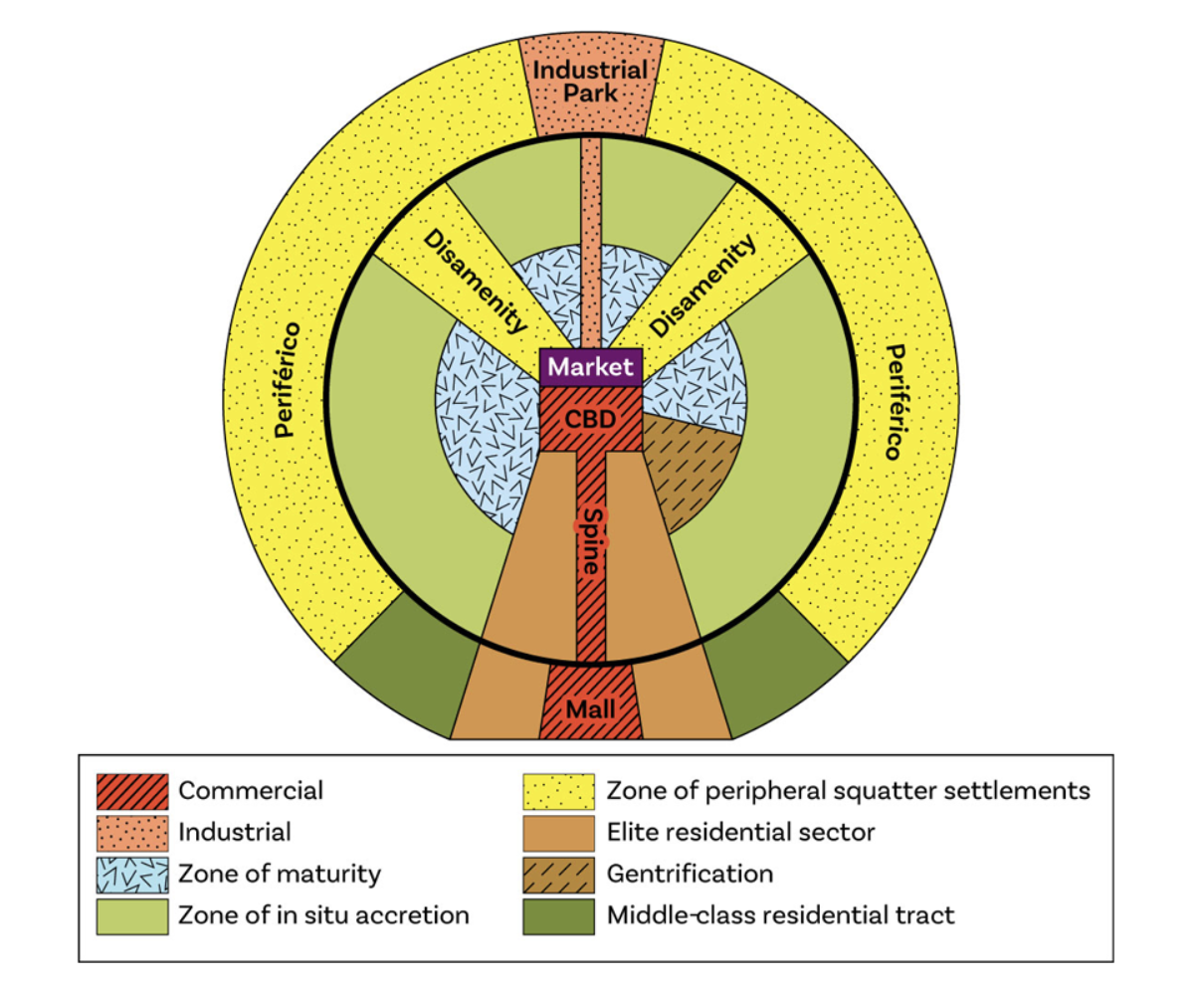
model for Latin America (Larry R. Ford)
centered around CBD
commercial spine (extension of CBD)
residential quality declines with increasing distance from CBD
model for Sub-Saharan African city
usually a commercial center (former colonial business district + traditional/informal marketplace)
sectors of residential neighborhoods + manufacturing clusters
high-quality housing located close to the center
model for Southwest Asian + North African city
majory central Islamic symbol (ex. mosques)
suburban mosques (creating separate nuclei)
many are reluctant to Westernized urbanization
model for South Asian city (Indigenous)
central bazaar/market
high-quality residences close to bazaar (quality declines with increasing distance)
scattered regions for other ethnic groups
model for South Asian city (colonial)
central historic military fort + with open space
sectors beyond open space (ex. business district, housing for indigenous population, area for european settlement)
outer fringe has residential areas (new wealthy + middle-class)
model for Southeastern Asian city
port zone
other zones + sectors
declining house quality with increasing distance (from port)
outer zones have formal suburbs + squatter zones (not legal living)
model for Chinese city
high population density
no downtown (multiple nuclei)
center of cities don’t have markets (rely on periphery of city)
development is lower in center
urban planning
a political + technical process concerned with the development + design + land use within built environments
involving organization of different land uses + social sources
solving problems related to past/present/future development
urban planning (history)
19th century response to rapid industrialization + lack of land organization (just competition for land)
application of sanitary + social + economic organizations to cities
urban planning (where today?)
the city (public sector)
the private sector (working for companies + giving them advice)
the public/citizens
urban planning (types of plans)
allocation of land
distribution of public services (ex. schools, hospitals, libraries)
infrastructure (rebuilding/adding new)
transportation
employment areas
housing
urban planning (goals)
meeting needs of competing interests (ex. developers + public + other stakeholders)
making city better (while trying to minimize large trade-offs)
planning for a better future without compromising the present (ex. not unfairly burdening people with costs)
various spatial scales of urban planning (how it works)
regional plans = Provincial Government
(ex. Places to Grow Act [for urban sprawl] + Moving Ontario Forward Act [transit plan])
municipal plans = City government
(ex. Transportation Master Plan)
neighborhood plans
(ex. land uses + transportation policies for specific area)
Pan-Am Stadium Plan (planning issues)
competition between 2 groups
supporters of City of Hamilton
supporters of Tiger Cats
competing interests
business owner VS.government
competing visions of stadium + utility of public infrastructure
city = to improve city
tiger cats = to gain revenue
competing views of where stadium should go
suburban VS. industrial
competing views of fan experience
transit-oriented VS. parking lots
why urban planning is complex
many different stakeholders + competing interests
central business district (CBD)
the social + cultural + commercial + political center of the city
usually has high-rise office + residential towers
has key municipal government buildings + civic amenities
civic amenities
theaters, arenas, retail centers, restaurants, hotels, city hall, etc.
neighborhoods
part of a city that shows some internal homogeneity (types of houses)
relatively uniform income levels +ethnic identify + other shared values
suburb
residential/mix-used area on periphery/edge of the city
neighborhoods comprised of
people (families/individuals)
residences (houses + apartments)
diversity (old/new + expensive/cheap + large/small)
housing market
housing viewed as commodity (to be bought/sold)
housing viewed as essential/universal/basic right
housing value
determined (alrgely) by its location
housing in Canada
seen as commodity (some subsidized housing by government)
residential mobility
individual/family decisions to relocate their place of residence (usually within urban area)
residential mobility (push + pull factors)
pull = improve quality of life
push = housing inadequacy, neighborhood liabilities, location
segregation
spatial separation of population subgroups within the wider population
creates distinct neighborhoods
involuntary segregation
based on discrimination (due to racial/ethnic background OR income level)
congregation
choice of segregation
ex.) income level in Toronto’s downtown (3 separate income levels)
ex.) North + South of 8 mile road in Detroit (difference racial composition of neighborhoods)
suburbanization
process where land on edge of urban area becomes urbanized over time (people + businesses move there)
American dream
desire to have more space + live in safer/quieter neighborhoods + have home ownership (1950s in US + Canada)
automobile trap
requires people who live in surbuan areas to have cars (requires more urban land + leads to urban sprawl)
urban sprawl
largely unplanned expansion of an urban area → rural areas
greenbelt
planed area of open/partially rural land surrounding an urban area (urban development is restricted)
intention = go get developers to build within under/unused areas in city
filtering
process where housing units transition from being occupied by members of 1 (income) group → members of different (income) group
downward filtering
homes built for middle/upper-income groups gradually become less expensive
housing degrades through neglect + neighborhood is less desirable
members move to more desirable neighborhoods
upward filtering
inexpensive homes become valued to middle/upper income groups as investments
gentrification
process of neighborhood social change resulting from in-movement of higher-income groups
through upward filtering
Neil Smith + David Ley
gentrification forms
form of revitalization (positive view)
higher income residents move in
higher property values (and taxes)
new cafes/restaurants/stores
form of displacement (negative view)
poor residents have to move out
local businesses pushed out + replaced
more social polarization
solutions to gentrification
mandate affordable housing + mixed-use development
class
large group of people of similar social status + income level
gated communities (form of inequality)
out of reach for lower income groups
forms of poverty near central city areas (2 ways they transition into this)
gentrify through investment + upward filtering
deteriorate through disinvestment + downward filtering + cycle of poverty
cycle of poverty
idea that poverty + deprivation are transmitted through generations
homelessness
circumstance of being without a permanent home
concentrated in city
NOT an inner-city problem
ex.) Toronto’s homeless shelters located in downtown core
economic activity + employment in city
manufacturing
commercial activity + business services
retailing + consumer services
manufacturing
urbanization + urban growth + industrialization
traditionally = occurred close to city center
today = occurs mostly on urban periphery
commercial activity + business services
largest segment of economy (in post-industrial economy)
decentralization of some office functions to suburbs + edge cities
many office functions remain in CBD
retailing + consumer services
traditionally = all downtown
today = suburban malls
future = completely online + delivered by suburban warehouses?