Module 1.05: Comparison of IFRS with Alternative Financial Reporting Systems
 Call Kai
 Learn
 Practice Test
 Spaced Repetition
 Match
 Flashcards
 Knowt Play
1/13

Earn XP
Description and Tags
Module 1: Introduction to Financial Statement Analysis
14 Terms
IFRS vs US GAAP basis for comparision
Stands for:
International Financial Reporting Standard
US Generally Accepted Accounting Practices
Who is IFRS and US GAAP developed by?
US GAAP
FASB (Financial Accounting Standards Board)
IFRS
IASB (International Accounting Standards Board)
What is IFRS and US GAAP based on?
US GAAP
Rule based
IFRS
Principle based
Memory trick:
GAAP = More rules
IFRS = More principles
How is Interest paid (cash flow statement) recorded?
US GAAP
Operating activities only
IFRS
Operating activities or
Financing activities
Inventory valuation
US GAAP
FIFO (First In First Out)
LIFO (Last In First Out)
Weighted average method
IFRS
FIFO (First In First Out)
Weighted average method
Memory trick: IFRS hated LIFO
Development costs
US GAAP
Treated as an expense
IFRS
Capitalised, only if certain conditions are satisfied
Reversal of Inventory write down
US GAAP
Prohibited
IFRS
Permissible, if specified conditions are met
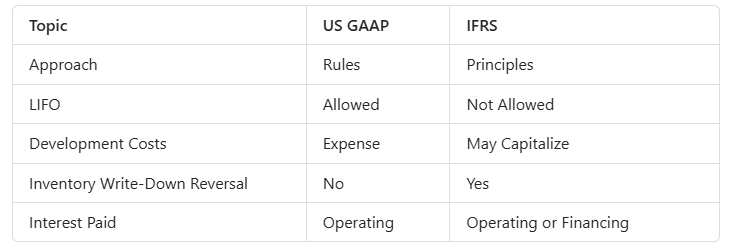
Quick summary of GAAP vs IFRS comparison
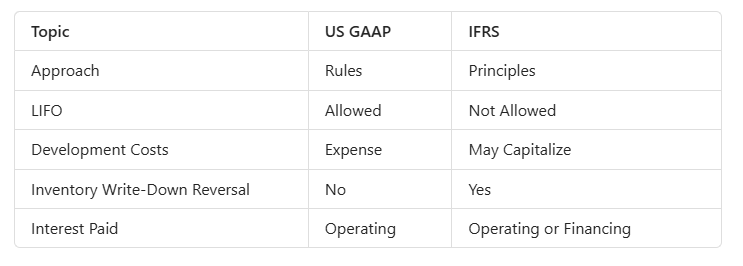
Why analysts care about IFRS vs US GAAP
The same company performance can appear different simply because different accounting standards are used.
This affects:
Profitability ratio
Efficiency ratios
Asset values
Valuation multiples
Comparability between companies
Convergence of Standards
The IASB and FASB have worked together to reduce differences
Examples of largely converged standards:
Revenue recognition
Leasing
Credit losses
Exam takeaway
The trend is toward greater consistency globally, though differences still remain
Why analysts must monitor financial reporting changes
Analysts are not accountants.
However, analysts must understand:
“How accounting changes affect financial statements, ratios, forecasts, and valuation.”
New Products and Transactions
Accounting standards sometimes lag behind innovation
Examples of accounting standards lagging behind include:
Fintech products
Cryptocurrencies
New financial instruments
When these arise:
Reporting treatment may be unclear
Comparability may be reduced
Analyst judgement becomes more important
Monitoring Standard Setters
Analysts should monitor:
IASB
Creates IFRS
FASB
Creates US GAAP
Why?
Because new standards can materially affect:
Earnings
Assets
Liabilities
Valuation
CFA Institute’s view of High Quality Reporting
Investors need:
Timelines
Transparency
Comparability
Consistency
The goal is to reflect economic reality