Aging Stereotypes
 Call Kai
 Learn
 Practice Test
 Spaced Repetition
 Match
 Flashcards
 Knowt Play
1/49

Earn XP
Description and Tags
Aging Stereotypes
50 Terms
What are stereotypes?
Overgeneralized beliefs about a group of people
Putting people in social categories and make assumptions based on that group
Stereotypes may apply to some people
Why do people have stereotypes?
The world is shaped by categories
Cognitive shortcuts for faster processing because there is too much for the brain to process
What does it mean to say that stereotypes cause major social costs?
Us vs them (in vs out groups)
Prejudice vs discrimination
What are the three groups most prone to stereotypes?
race
gender
age
What are the four negative aging stereotypes
physical
cognitive
emotional
sexual
What consists of physical stereotypes?
frail
dependent
shouldn’t/couldn’t exercise
What consists of cognitive stereotypes?
Can't learn new things
Dementia is inevitable
What consists of emotional stereotypes?
Lonely, depressed, and angry
Don't want or need relationships
What consists of sexual stereotypes?
No desire for sex or intimacy
Being sexual is considered gross
What are positive aging stereotypes?
Wisdom
Wealthy or financially stable
Caring and nurturing
Leisure
Origin of aging stereotypes: what occurs in childhood?
People begin to view older adults negatively as early as the age of 3
Children are sponges
Taking in all of these negative messages
Child-older adult interactions
Donorfio (1991): Kids paint an older person and younger person: how did they portray each?
Older people as sad, with walking aids, face wrinkles
Younger people as active and happy
Robinson et al. (2015) (not the findings)
141 children(8-12yo)
Were asked to draw an old person they knew
Were asked various questions about their drawings
What were the findings from this study?
Majority drew one of their grandparents
73% described their OA as happy/content
10% described OA as angry/grumpy
9% as sad
79% depicted their OA in a positive way
They may view OAs, as a group, negatively, but view their own OAs positively -> but doesn't carry over into the whole group = still view entire group negatively
Spreading of stereotypes (think about the ecological model)
Social Attitudes
Family, friends, etc.
Daily conversations/comments
Media
How do children’s programs portray older adults?
Lack of representation
Could send the message that older people are irrelevant
Robinson & Anderson (2006) not the findings
Content analysis: e.g., ABC kids, Nickelodeon, Cartoon Network
Coded presence of OA characters and their depiction
Watched 45 hours of content
Findings
Over 1000 characters shown across networks: only 8% were older adults
77% of OA were male
Children could be predisposed to OA characteristics of men
23% of OA were female
Most were older white men: POC were rarely depicted
Personality
59% had positive personality traits
41% had negative traits
Older Adults in Fiction TV Series (Markov & Yoon 2001): not the findings
Analyzed 112 episodes of popular American fiction from 2004-2018)
Randomly picked one episode of each show
Findings
Saw 2003 characters: 6.6% (133) were OAs
68% were men
90% were white
73% were upper/middle class
Common stereotypes
Mostly positive: golden ager (super healthy, very active…), perfect grandparent
Found more positive than negative
Some negative: complaining/grumpy
What was the overall theme?
Overall theme: presentation of older adults in children's and adults' TV isn't overly negative but needs more representation
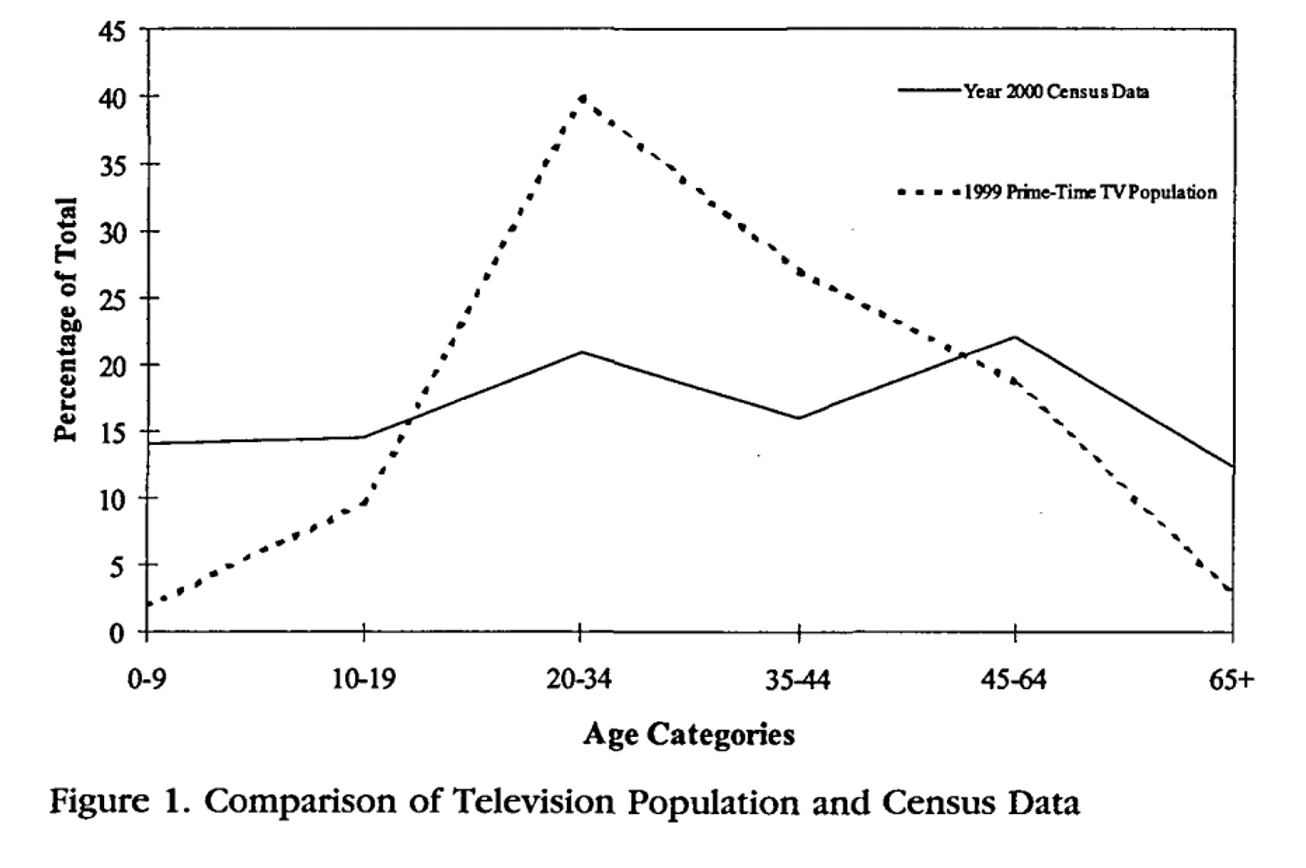
What is this image showing?
Black line = the number of people in the real world who are those ages
White line = age representation in the media
What are explicit biases?
Attitudes and beliefs we have about a person/groups on a conscious level
We are fully aware and these can be self-reported
Self reported beliefs
E.g., how warm do you feel towards those over 65
May conceal true opinions because of social desirability biases
What are implicit biases?
Unconscious attitudes lying below the surface -> may influence behaviour
Automatic social associations
E.g., implicit association test (IAT)
Captures attitudes people won't admit to or are unaware of
Evaluates reaction time differences between sorting faces and words the first time, and then the second time with the pairings switched around (good words with older people vs bad words with older people)
Being faster in one group indicates someone's beliefs/preferences
What are implicit attitudes?
Most people hold some level of implicit bias towards a group
These should be acknowledged and made into awareness -> reflect on our thoughts and actions to reduce the bias to change our future behaviour
What is subliminal and subliminal priming?
Subliminal
Things that cannot be processed by the conscious mind
Less than 500 ms
Flash words on screen fast enough to evade conscious awareness
Thoughts and actions can be influenced without conscious awareness of this -> could be why stereotypes are hard to change
What three ways do stereotypes affect older adults?
cognitive
physical
survival/longevity
Cognitive Effects: Chasteen et al., 2015
Correlation design
301 older adults (65-96yo)
Measures
Negative views (fear) of aging
Self-perceptions of their memory
Memory performance
Recall tasks
Findings
People who had a negative few of aging also showed lower self-perceptions, those perceptions predicted lower performance
Problem: could be that people have poor memory causing them to view aging negatively instead of the other way around
Why is there a need for longitudinal research?
Poor cognitive skills or physical health -> negative perception -> worse performance in studies
Cognitive Effects: Hess et al. (2003)
Lab experiment: priming
Measures
Positive aging message group
OA can use strategies to help memory with age
Negative aging message group
Memory declines with age no matter what
Participants then did a memory recall task
Average recall performance
Participants had better memory in positive group
Cognitive Effects: Levy (1996)
Lab experiment: subliminal priming
Measures
Positive aging primes
E.g., wise, guidance, learned, improved
Negative aging primes
Declines, incompetent, forgets, confused
Participants do a mindless distractor task while the subliminal priming words flashed on the screen then did a memory recall task
Findings
Before the prime
should be no major differences between groups, however, the negative group had better recall (even though no priming occurred yet = happened by chance)
After the prime
Negative primed found decreases in performances
Positive primed increased in performance
A summary of these studies
Negative aging views relate to poorer self-perceptions one of ones own memory and predict worse memory performance
Being primed to thinking negatively about aging predicts poorer cognitive performance
Even without knowing it
Physical Effects: Levy et al (2002)
Longitudinal Study (best design)
Findings?
Positive view of aging (50yo) -> better functional health (70yo)
Controlling for baseline measures of health measures (e.g., people in poor health but with positive stereotypes still aged better) and SES
Physical Effects: Levy et al (2000)
Lab experiment: subliminal priming
Measures
Subliminally primed to pos and neg aging stereotypes
Did "stressful" tasks (math task and to recall stressful event)
Measured cardiovascular responses (BP, heart rate)
Findings
Those primed negatively had a higher rate of change for BP
Exposure to negative aging views increases cardiovascular responses to stress
Survival/Longevity Effects: Levy et al (2000)
Lab experiment: subliminal priming
Measures
Given hypothetical medical scenarios resulting in a fatal condition but given possible intervention
Had to choose if they would take an intervention that would prolong life (but the intervention is not simple)
Positive aging primes
Negative primes
Findings
Those primed positively would choose the intervention
Survival/Longevity Effects: Levy et al (2002)
Longitudinal Study
Measures
Negative and positive view of aging
Findings
More positive view of aging (starting at 50yo) -- 23 years later -> lived 7.5 years longer than those with a more negative view
Controlling for age, health, and SES
Uniqueness of Aging Stereotypes (compared to other forms of stereotyping)
Everyone will become the stereotyped group
Importance of early intervention
Should be motivated to change attitudes