Anatomy Exam 2
 Call Kai
 Learn
Learn Practice Test
 Spaced Repetition
 Match
Match Flashcards
 Knowt Play
1/156

There's no tags or description
Looks like no tags are added yet.
Name | Mastery | Learn | Test | Matching | Spaced | Call with Kai | Chat |
|---|
No analytics yet
Send a link to your students to track their progress
157 Terms
Primary active transport
When energy is required to move a substance across a membrane, often with the help of carrier proteins against the concentration gradient.
Most common type of active transport
Protein pumps
Active transport energy requirement
Energy from ATP is required for the membrane proteins to transport substances across the membrane.
Sodium Potassium Pump
Transports sodium out of the cell while moving potassium into the cell.
Secondary active transport
A cellular process where molecules are moved across a cell membrane against their concentration gradient by using an established ion gradient.
Phagocytosis
The endocytosis of large particles.
Immune cells that engage in phagocytosis
Neutrophils
Macrophages
How does phagocytosis work?
Cells patrol the tissues looking for unwanted matter and phagocytize them and digest them.
Pinocytosis
Brings fluid containing dissolved substances into a cell through membrane vesicles.
Endocytosis
An active cellular transport process where a cell brings in extracellular fluids, macromolecules, and large particles by folding its plasma membrane inward to form a vesicle.
Exocytosis
The active transport process by which cells transport molecules and waste out of the cell, involving intracellular vesicles fusing with the plasma membrane and releasing their contents to the exterior.
Cytosol
Jelly-like substance within the cell, provides the fluid medium necessary for biochemical reaction.
Organelles
One of several different types of membrane-enclosed bodies in the cell, each performing a unique function.
Cytoplasm
The organelles and cytosol combined.
Endoplasmic reticulum
A system of channels that is continuous with the nuclear membrane covering the nucleus and composed of the same lipid bilayer material.
ER function
Provides passages throughout much of the cell that function in transporting, synthesizing, and storing materials.
Ribosome
An organelle that serves as the site of protein synthesis
Rough ER function
Makes proteins destined for the cell membrane of for export from the cell.
Protein path
A protein synthesized within the ribosome and released inside the channel of the rough ER before it is transported within a vesicle for packaging and shipping by the Golgi apparatus.
Smooth ER function
Synthesizes phospholipids, the main component of biological membranes.
Synthesizes steroid hormones.
Sequesters and regulates of the concentration of calcium ions.
Performs a detoxification role by breaking down certain toxins.
Free ribosomes
Sites of protein synthesis not attached to the rough Er.
Made of two separate RNA protein complexes known as the small and large subunits
Free ribosomes function
Produces proteins for intracellular use
Nucleolus
Non-membrane bound structure within the nucleus
Nucleolus function
Site for ribosome synthesis, which involves transcription of rRNA from DNA and its assembly with proteins into ribosomal subunits.
Golgi apparatus
Has two distinct sides with different roles.
Golgi apparatus function
One side receives products in transport vesicles. The products are then modified and released from the opposite side a secretory vesicles.
Secretory vesicle path after Golgi apparatus
Migrates to the cell surface and fuses to the cell membrane for exocytosis.
Mitochondria
A membranous bean shaped organelle.
Consists of an outer and inner membrane
Cristae
A highly folded inner membrane
Cellular respiration function
Converts nutrient molecules into ATP which provides usable energy for the cell.
Which organ systems use a ton of ATP?
The muscular system to sustain muscle contraction
The nervous system because ATP is needed for sodium potassium ion pumps
ATP
The main energy currency of the cell, and it is an end product of cellular respiration
When hydrolyzed it becomes ADP releasing energy
Cytoskeleton
A group of fibrous proteins that provide structural support for cells.
Critical for cell motility, cell reproduction, and the transportation of substances within the cell.
Three types of cytoskeleton fibers
Microtubules
Microfilaments
Intermediate filaments
Microtubles
Play a role in the positioning of the organelles and in cell division.
Core of cilia
Microfilaments
Thin actin fibers constitute a large component of muscle tissue along with the protein myosin.
Responsible for muscle contraction
Intermediate filaments
Intermediate in thickness
Provide mechanical support (maintain cell shape)
Resist tension - cell-cell junctions
Cilia
Short hair like mobile structures found in large numbers on the surface of certain cells
Cilia structure
A ring of nine outer microtubule doublets surrounds two central singlet microtubules.
Nucleus
The largest of a cell’s organelles
Nucleus function
The control center of the cell because it stores all of the generic instructions for manufacturing proteins.
Nuclear envelope
A membrane surrounding the nucleus made of two adjacent lipid bilayers.
Nuclear pore
A tiny passageway that regulates the passage of materials into and out of the nucleus.
Chromatin
Threads composed of DNA and associated proteins.
DNA
The genetic instructions that are used to build and maintain an organism are arranged in strands of DNA.
Genome
An organism’s complete set of DNA
Gene
A portion of the DNA that contains the code for a specific protein.
DNA structure
Double-stranded nucleic acid.
The structural unit is a nucleotide
Side rails of alternating sugar and phosphate groups
Genetic code is based on 3 bases forming a triplet
Components of a nucleotide
A nitrogenous base
Pentose sugar
Phosphate group
RNA
Single-stranded and contain no complementary strand
Contains a ribose sugar
Contains uracil instead of thymine
Protein synthesis
The process in which cells make proteins
Stages of protein synthesis
Transcription
Translation
Location of protein synthesis
Takes place in the cytoplasm at the ribosome
Transcription
The process that transfers the information from DNA to the mRNA
Transcription process
A region of DNA unwinds and the two strands separate
The triplets within the gene are used as the template to transcribe the complementary strand of RNA
Codon
A three-base sequence of mRNA
RNA polymerase
The enzyme responsible for transcription, synthesizing an RNA molecule complementary to a DNA template strand
RNA polymerase process
Bonds to a gene on the DNA
Unwinds a small section of the DNAReads the DNA template strand
Joins RNA nucleotides together to form an RNA strand
Stops when it reaches a termination sequence
Translation
The process of synthesizing a chain of amino acids called a polypeptide
Ribosomal RNA (rRNA)
Together with proteins, composes the structure of the ribosome
When an mRNA molecule is ready to be translated, the two subunits come together and attach to the mRNA
Transfer RNA (tRNA)
Carries the appropriate corresponding amino acids to the ribosome
Two sides of tRNA
One end is a binding site for a specific amino acid
The other end is a base sequence (anticodon) that matches the codon on the mRNA specifying the particular amino acid
Types of tissues
Epithelial
Connective
Muscle
Nervous
Epithelial tissue
The exterior cover of the surfaces of the body, lining of internal cavities and passageways, and makes up certain glands.
Epithelium function
Provide the body’s first line of protection from physical, chemical, and biological wear and tear
Act as gatekeepers of the body controlling permeability and allowing selective transfer of materials across a physical barrier
Many epithelial cells are capable of secretion and release mucous and specific chemical compounds onto their apical surfaces
Simple epithelial tissue
One layer
Stratified epithelial tissue
More than one layer
Simple epithelial tissue examples
Squamous
Cuboidal
Columnar
Stratified epithelial tissue examples
Stratified squamous
Keratinized and non-keratinized (moist)

Simple squamous

Stratified squamous
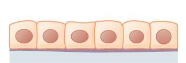
Simple cuboidal

Stratified cuboidal

Simple columnar epithelium
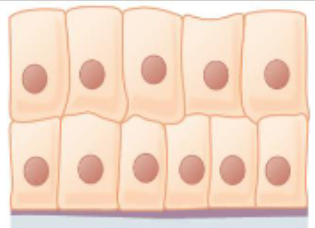
Stratified columnar epithelium

Pseudostratified columnar
What tissues do squamous cells make up?
The endothelium that lines vessels of the lymphatic and cardiovascular system.
Locations of epithelium where passage of chemical compounds is observed
Alveoli of the lungs where gases diffuse
Kidney tubules
Lining of capillaries (endothelium)
Simple cuboidal epithelium
The nucleus of the box like cells is round.
There are active secretions and absorptions of the molecules.
Simple cuboidal makes up the lining of…
Kidney tubules and in the ducts of glands
Simple columnar epithelium
Active in the absorption and secretion of molecules
Simple columnar epithelium makes up the…
lining of sections of the digestive system and parts of the female reproductive tract.
Pseudostratified columnar epithelium line…
the respiratory tract where some cells have cilia
Stratified squamous epithelium function
Protects against physical and chemical wear and tear
Two most common types of stratified epithelium in the human body
The top layer may be covered with dead cells filled with keratin (keratinized)-skin
The lining of the esophagus non-keratinized (moist)
Epithelial characteristics
Cells fit closely together
Tissue layer has one free surface - the apical surface
The lower surface (basal) is bound by a basement membrane
It is avascular and depends on diffusion
Regenerates
There is little or no extracellular material present between cells
Adjoining cells for a specialized intercellular connection called cell junctions
Basement membrane
All epithelia sit on a basement membrane
Consists of a basal lamina and reticular lamina
Basal lamina
A mixture of glycoproteins and collagen that provides an attachment sits for the epithelium
Reticular lamina
Secreted by the underlying connective tissue
Transitional epithelium
A specialized type of stratified tissue that changes shape as organs stretch and relax.
Tight junctions
Integral proteins in the cell membrane of adjacent cells fuse together forming an impermeable junction that encircles the cell
Gap junctions
Form intercellular passageway between the membranes of adjacent cells to facilitate the movement of small molecules and ions between the cytoplasm of adjacent cells
Tight junctions function
Helps prevent molecules from passing in the extracellular space between cells.
Gap junctions function
Allow electrical and metabolic coupling of adjacent cells, which coordinates function in large groups of cells.
Desmosomes
Serve as anchoring junctions. The are scattered like rivets and prevent cell separation.
Intermediate filaments extend from plaque across the cell to anchor on the opposite side
Plaque
A density on the cytoplasmic side of the membrane
Cadherins
Linker proteins that hold adjacent cells together
Microvilli
Finger like projections of the luminal plasma membrane found in many epithelial cells
What type of cells are microvilli commonly found in
Epithelial cells specialized for absorptive function
Striated or brush border
When microvilli are so numerus and regularly arranged they appear striated