ES1001 St Andrews
 Call Kai
 Learn
 Practice Test
 Spaced Repetition
 Match
 Flashcards
 Knowt Play
1/35

Earn XP
Description and Tags
Vocab for Earth Sciences
Name | Mastery | Learn | Test | Matching | Spaced | Call with Kai | Chat |
|---|
No analytics yet
Send a link to your students to track their progress
36 Terms
Chemical weathering
The breakdown of rocks and minerals caused by chemical reactions, changing their chemical composition and turning them into new substances
Physical/mechanical weathering
The natural breakdown of rocks and minerals into smaller pieces without changing their chemical composition
Effusive eruptions
Slow, non explosive eruptions of lava onto the ground
Contact metamorphism
Rocks are altered by intense heat and chemically active fluids when hot magma pushes into the cooler surrounding crust
Regional metamorphism
Rocks are altered over broad areas by intense heat, confining pressure, and directed tectonic stress deep within the Earth's crust
Dynamic metamorphism
Mechanical deformation and high shear stress grind, fracture, and crush rocks along narrow fault zones
Burial metamorphism
Low-grade metamorphic process that happens when sedimentary and volcanic rocks are buried deep within thick sedimentary basins (typically 8 to 15 kilometers, or over 2,000 meters deep) under the weight of accumulating overlying layers
Hydrothermal metamorphism
Chemical and mineralogical change in rocks caused by the circulation of hot, mineral-rich water and steam
Shock metamorphism
Hypervelocity impact event—such as an asteroid or meteorite colliding with a planetary surface—sends a high-energy shock wave through the target material
Lithosphere
Earth’s crust— the plates constantly moving
Asthenosphere
Mechanically weak, ductile layer of Earth's upper mantle that lies directly beneath the rigid lithosphere
Transform boundary
Place where two tectonic plates slide horizontally past each other
Constructive/divergent boundary
Two tectonic plates move apart from each other
Destructive/convergent boundary
Two tectonic plates move into one another
Hot spot
An area on Earth's surface that experiences active volcanism because it sits above an unusually hot, rising column of mantle rock called a mantle plume, independent of tectonic plate boundaries
Ice sheet
A massive layer of glacial land ice that covers an area greater than 50,000 square kilometers— Greenland or Antarctic ice sheets
Interior plateau
The thickest, slowest moving middle part of a glacier
Outlet glacier
A faster moving channel of glacier surrounded by rock

Ice stream
Faster moving channel of glacier surrounded by more glacier

Ice shelf
Formation of floating ice still attached to larger glacier

Ice cap
Smaller ice sheets typically found in mountain highlands

Cirque glacier
The smallest kind of glacier, found in bowl-shaped depressions called cirques

Valley glacier
Glaciers that flow through and completely fill valleys and form U-shaped valleys

Fjord glacier
When a glacial valley is partially filled by the sea and the valley glacier terminates at the sea

Piedmont glacier
Delta of a glacier, valley glacier that flows into and fills lowlands

Active soil layer
Top layer of permafrost that melts in the summer and re-freezes in the winter
Leads
Open water channels formed in sea ice

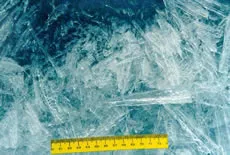
Frazil
Ice needles that are the first step in sea ice formation
Basal slip
Water at the base of a glacier decreases friction and increases sliding
Glacial surges
Unknown cause, increase of glacial movement, most likely due to increased meltwater at the base
Ablation
Calving, melting, evaporation, sublimation, glaciers going away
Mass balance (glacier equation)
Accumulation - ablation
Equilibrium line (glaciers)
Separation line between accumulation area and ablation area
Temperate glacier
Ice at melting point, prone to melting
Polar glacier
Ice well below melting point, difficult to melt
Polythermal glaciers
Glaciers with some areas at melting point and some below— mixed melting pattern