Exam II Practice Questions
 Call Kai
 Learn
 Practice Test
 Spaced Repetition
 Match
 Flashcards
 Knowt Play
1/18

There's no tags or description
Looks like no tags are added yet.
19 Terms
A storm sewer is carrying snow melt containing 1.12 g/L of sodium chloride into a small stream. The stream has a naturally occurring sodium chloride concentration of 20 mg/L. If the storm sewer flow rate is 2000 L/min and the stream flow rate is 2 m3 /s, what is the concentration of salt in the stream after the discharge point? Assume that the flow is completely mixed, the salt is nonreactive, and the system is at steady state.
Cout = 0.038 g/L

A chemical degrades in a flow-balanced, steady-state CMFR according to first-order reaction kinetics. The upstream concentration of the chemical is 20 mg/L and the downstream concentration is 2 mg/L. Water is being treated at a rate of 29 m3 /min. The volume of the tank is 580 m3 . What is the rate of decay? What is the rate constant?
r_k = 0.9 mg/L*min
k = 0.45 min

Before entering an underground utility vault to do repairs, a work crew analyzed the gas in the vault and found that it contained 29 mg/m3 of hydrogen sulfide. Because the allowable exposure level is 14 mg/m3 , the work crew began ventilating the vault with a blower. If the volume of the vault is 160 m3 and the flow rate of contaminantfree air is 10 m3 /min, how long will it take to lower the hydrogen sulfide level to a level that will allow the work crew to enter? Assume the manhole behaves as a CMFR and that hydrogen sulfide is nonreactive in the time period considered.
t = 11.65

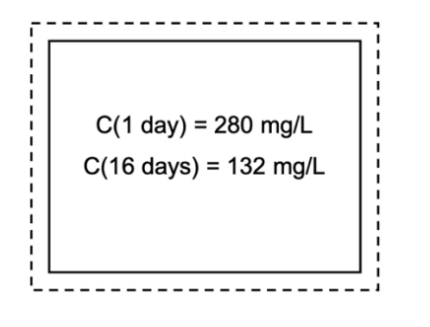
A contaminated soil is to be excavated and treated in a completely mixed aerated lagoon at a Superfund site. To determine the time it will take to treat the contaminated soil, a laboratory completely mixed batch reactor is used to gather the data below. Assuming a first-order reaction, estimate the rate constant, k, and determine the time to achieve 99% reduction in the original concentration. From the batch reactor data, determine (a) the 1st order decay rate constant, k; and (b) the time to achieve a 99% reduction.
k = 0.05 day^-1
t = 91 days
Textbook problem 4-31. For the following conditions determine whether a CMFR or PFR is more efficient in removing a reactive compound from the waste stream under steady-state conditions with a first-order reaction. Data: reactor volume = 280 m3 , flow rate = 14 m3 /day, reaction rate coefficient = 0.05 day-1 .
cmfr = 50%
pfr = 63%
Textbook problem 4-36. The lowest flow in the Menominee River in July is about 40 m3 /s. If the river temperature is 18°C and a power plant discharges 2 m3 /s of cooling water at 80°C, what is the final river temperature after the cooling water and river have mixed?
Tf = 20.95 C

Textbook problem 4-40. A cooling water pond is to be constructed for a power plant that discharges 17.2 m3 /s of cooling water. Estimate the required surface area of the pond if the water temperature is to be lowered from 45°C at its inlet to 35.5°C at its outlet. Assume an overall heat transfer coefficient of 0.0412 kJ/s/m2 /K.
A = 1747553 m2

Textbook problem 4-42. A small building that shelters a water supply pump measures 2 m x 3 m x 2.4 m high. It is constructed of 1-cm thick wood having a thermal conductivity of 0.126 W/m/K. The inside walls are to be maintained at 10°C when the outside temperature is -18°C. How much heat must be supplied to maintain the desired temperature? How much heat must be supplied if the walls are lined with 10 cm of glass-wool insulation having a thermal conductivity of 0.0377 W/m/K? Assume there is no heat loss through the floor. Ignore the wood in the second calculation
A. Esupplied = 12700.8W
B. Esupplied = 380.016

Textbook problem 4-44. Bituminous coal has a heat of combustion of 31.4 MJ/kg. In the United States the average coal-burning utility produces an average of 2.2 kWh of electrical energy per kilogram of bituminous coal burned. What is the average overall efficiency of this production of electricity?
efficiency = 25.22%


Textbook problem 12-1. Show by calculation that, in Figure 12-13, the incoming energy (in W/m2 ) and outgoing energy are in balance (1) at the top of the atmosphere and (2) at the earth’s surface.
Energy at top of atmosphere = 342
Energy at earth’s surface = 492

Textbook problem 12-2. In simplified form, radiative forcing of temperature change may be expressed as: ΔT = γ ΔF The climate sensitivity factor (γ) is between 0.34 and 1.03°C m2 / W. The radiative forcing (ΔF) is the change in Earth’s radiative emission. Estimate the range in change in temperature of the Earth’s surface if the albedo of the Earth decreases by 0.01 because of the melting of glaciers.
DeltaT Range = 1.19 to 3.605 C

Observe the following plots of PFRs with (A) a conservative substance
and (B) a reactive (nonconservative) substance. What differences do
you see? Why are there differences in Ceffluent between the two
situations?
Lower concentration of effluent than influent due to some form of decay in reactive substances.

Will formaldehyde levels exceed 0.10 mg/m3 in the bar?
t = 0.75 hour (~45 min)
A particular solar water heater is 1.5 m by 4.0 m and receives a flow rate
of 4.5 L/min of water. The average solar irradiance reaching the heater is
1000 W/m2. In the middle of the day, when the system is at equilibrium,
the temperature increase of water flowing through the system is +9.0ºC.
What is this heater’s efficiency? Recall c = 4184 J/kg*K for water and
assume no phase change.
n = 0.47

How long would it take to heat the water in a 40-gallon electric water heater (a
closed system) from 50°F to 140°F if the heating element delivers 5 kW?
Assume all electrical energy is converted to heat in the water, neglect the
energy required to raise the temperature of the tank itself, and neglect any heat
losses from the tank to the environment.
t = 1.76 hr
A small equatorial colony on Mars will have a 250 kWh/day energy demand. Ideally, the
colony would meet its needs with state-of-the-art photovoltaic cells with average efficiencies
of 30%. The solar constant (I) at Mars surface is about 590 W/m2. Assume 66% (2/3) of a
Martian day has sunlight of this intensity and that any excess power generated during the
day can be stored in perfect batteries (i.e., ones with no loss). Martian days are nearly
equivalent to Earth days in length. What amount (in m2) of PV cells are neede
Area = 88 m2
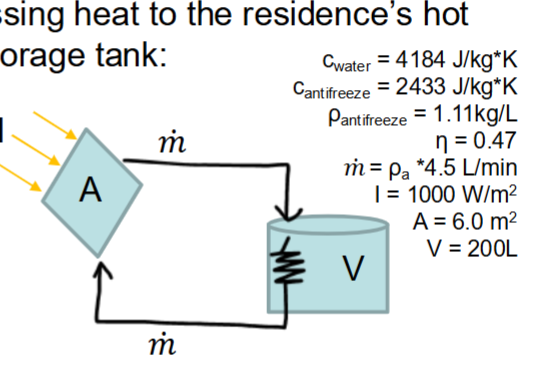
At solar heater is to be installed in a climate with particularly cold winters.
Therefore, the installation will involve antifreeze (ethylene glycol, c=2433 J/kgK)
circulating through the solar heater before passing heat to the residence’s hot
water via a heat exchanger within the water storage tank: If the solar heater used in this installation also has 47% efficiency, how long will it take to heat the stored water from 17ºC to
37ºC?
t = ~100 min
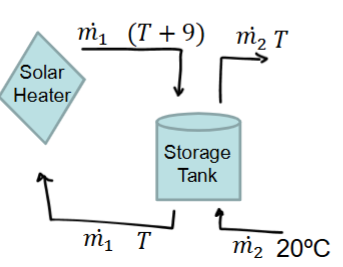
At a large multi-unit sustainable housing development, a roof-top solar
water heating array is used to provide hot water to residents with similar
performance to the device seen in the last problem.
Water is drawn from an an interior storage tank through the solar heater
and then pumped back into the storage tank at a rate of 4.5L/min. The
combined hot water usage of residents is 900L/day. City water (at 20ºC)
replaces water in the storage tank as it is used throughout the day. At
equilibrium (i.e., in the middle of the day), what temperature is the water
in the storage tank?
T = 360.5 K / 87.3 C
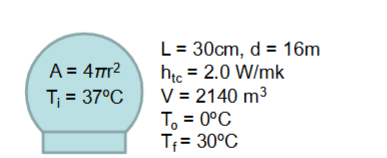
A wastewater treatment plant has experienced a power outage due to a winter
storm. An anaerobic digestor contains 2140 m3 of wastewater at 37ºC and the
digestor roughly spherical with 16 m diameter. If the temperature falls below
30ºC, the operation will fail. The digestor is made of concrete with thermal
conductivity of 2 W/mK. The concrete exterior is 30cm thick and outside
temperatures are 0ºC. How long do operators have to restore the heating system
before the operation fails? There is no sunshine and no wind. Ignore mixing and
assume the specific heat of the wastewater is that of water (c = 4.184kJ/kgK)
t = 3 ½ days