Gross Anatomy Exam 3
 Call Kai
 Learn
 Practice Test
 Spaced Repetition
 Match
 Flashcards
 Knowt Play
1/107

There's no tags or description
Looks like no tags are added yet.
108 Terms

Sagittal Suture

Coronal Suture
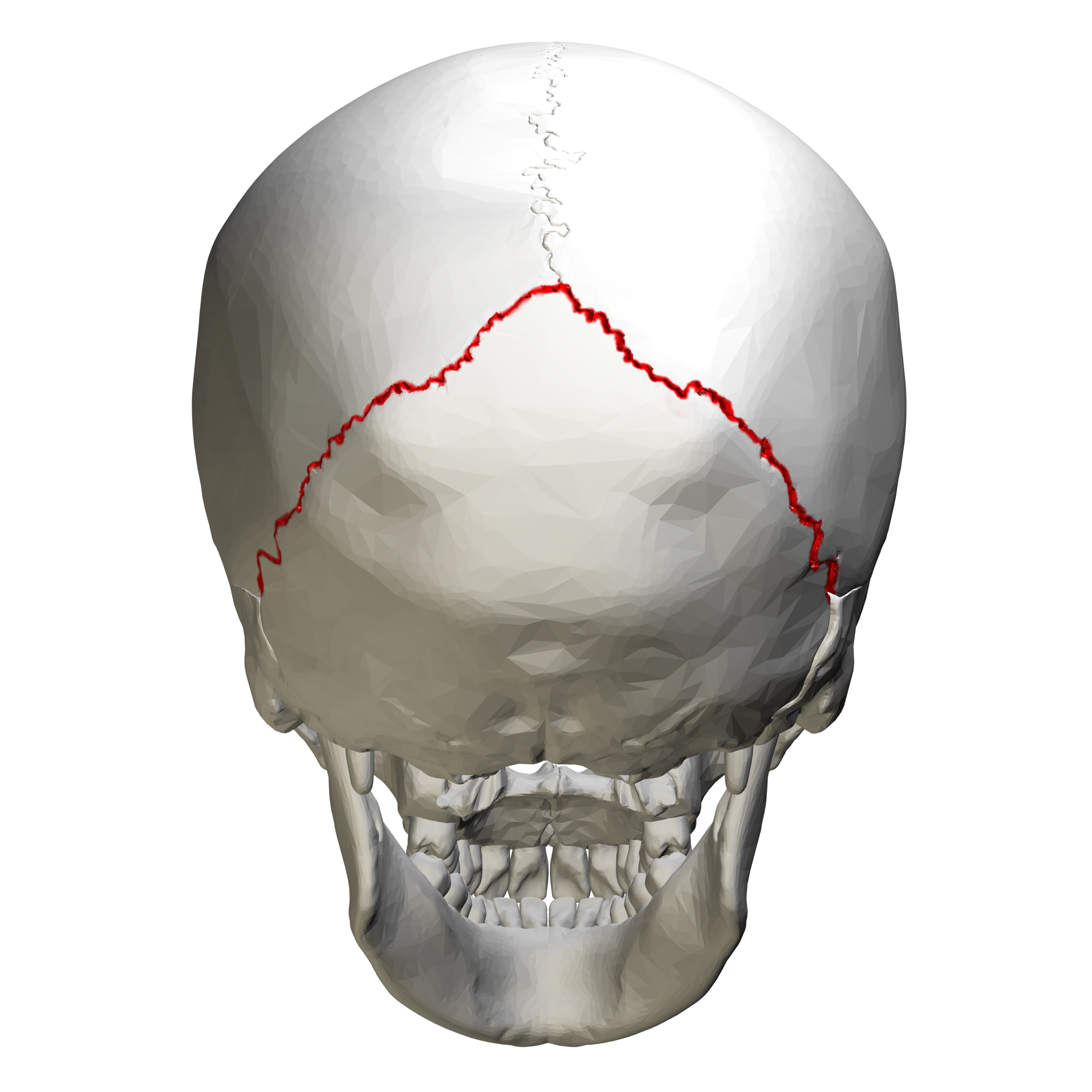
Lambdoid suture

Temporal Suture

Bregma
Bregma
Where coronal and sagittal sutures meet
Lambda
Where lambdoid and sagittal sutures meet

Lambda

Asterion
Asterion
Where temporal and lambdoid sutures meet
Pterion
Where frontal, temporal, sphenoid and parietal bones meet, thinnest part of the skull

Pterion

Lacrimal

Supraorbital foramen

Infraorbital foramen

Mental Foramen

Optic Canal

Zygomatic arch

Mastoid process

External Acoustic meatus

Styloid process

Hard Palate
Hard Palate formed by
Maxilla and palatine bones

Foramen Magnum

Foramen ovale

Carotid canal

Hypoglossal canal

1.1
Crista galli

1.2
Cribriform plate

Bone 1
Ethmoid bone

Bone 2
Frontal bone
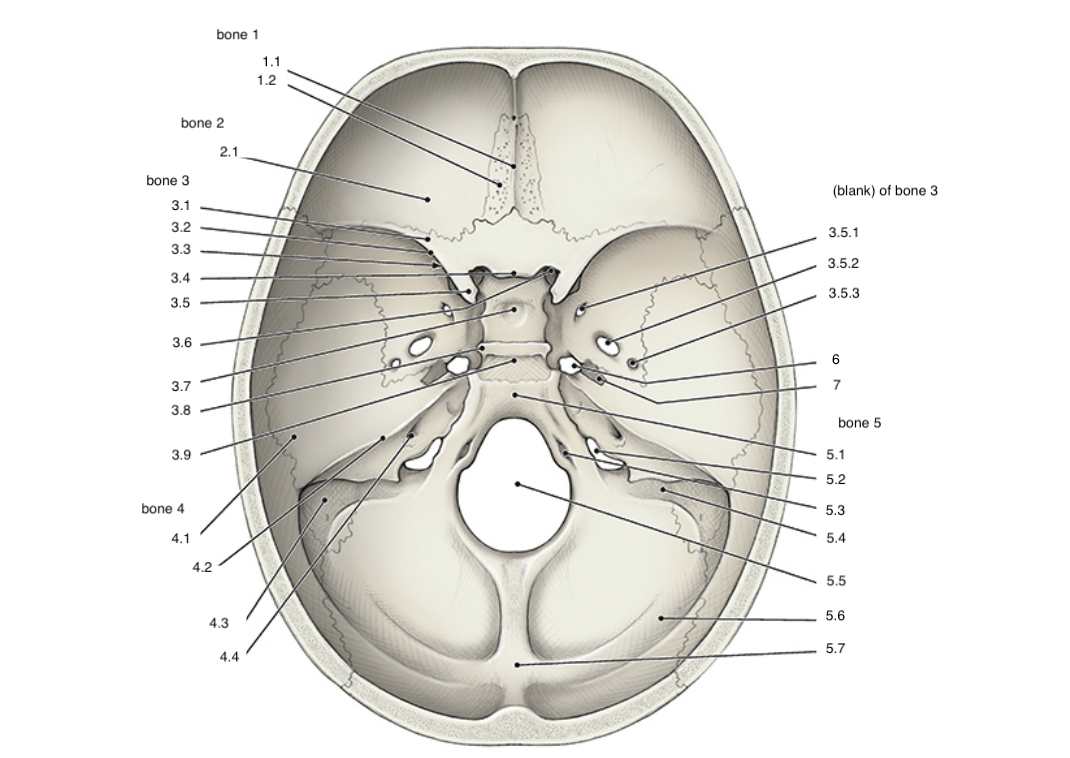
2.1
Orbital plate
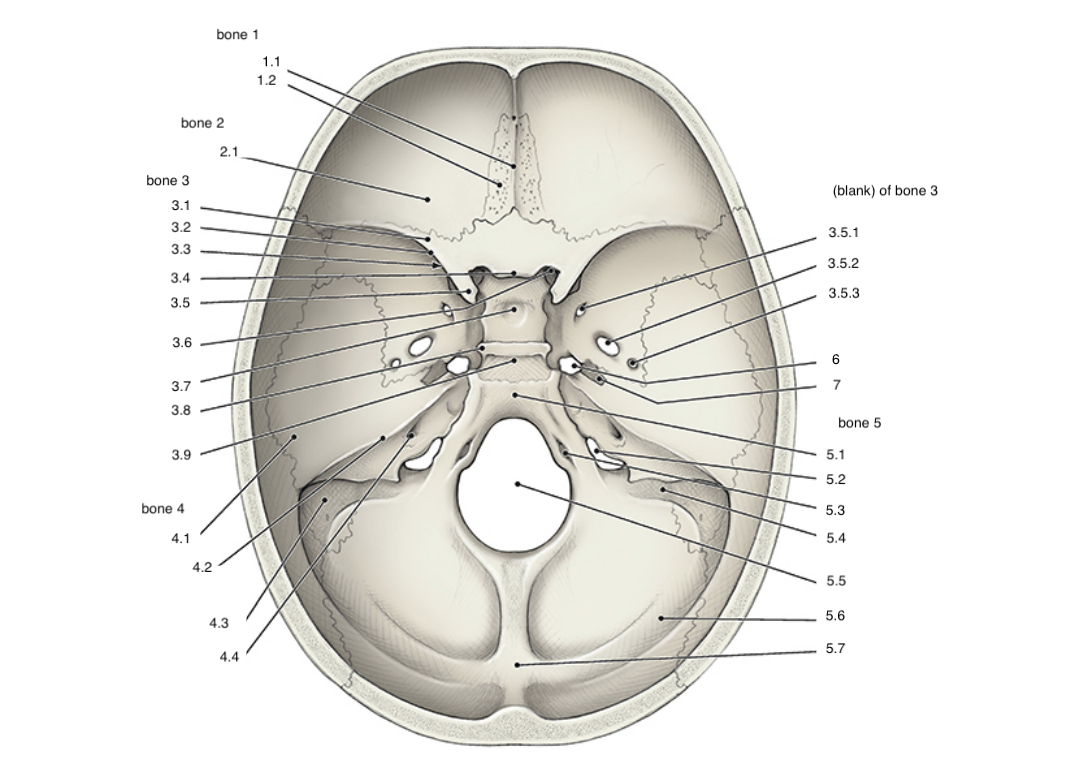
Bone 3
Sphenoid

Bone 4
Temporal bone

What part of bone 3?
Greater wing of sphenoid bone
How many CN pass through the anterior half of the brain cavity?
6
How many CN pass through the posterior half of the brain cavity?
6
What passes through the cribriform plate?
CN I, olfactory N
What passes through the Optic Canal?
CN II, Optic N and ophthalmic artery
What passes through the supraorbital fissure?
CN III, IV, V1, VI and Opthalamic vein
What passes through the Foramen rotundum?
CN V2, Maxillary division of trigimental n
What passes through the foramen ovale?
CN V3, Mandibular division of trigimental n
What nerves are located in the anterior half of the brain cavity?
CN I, CN II, CN III, CN IV, V1, CN VI, V2, V3
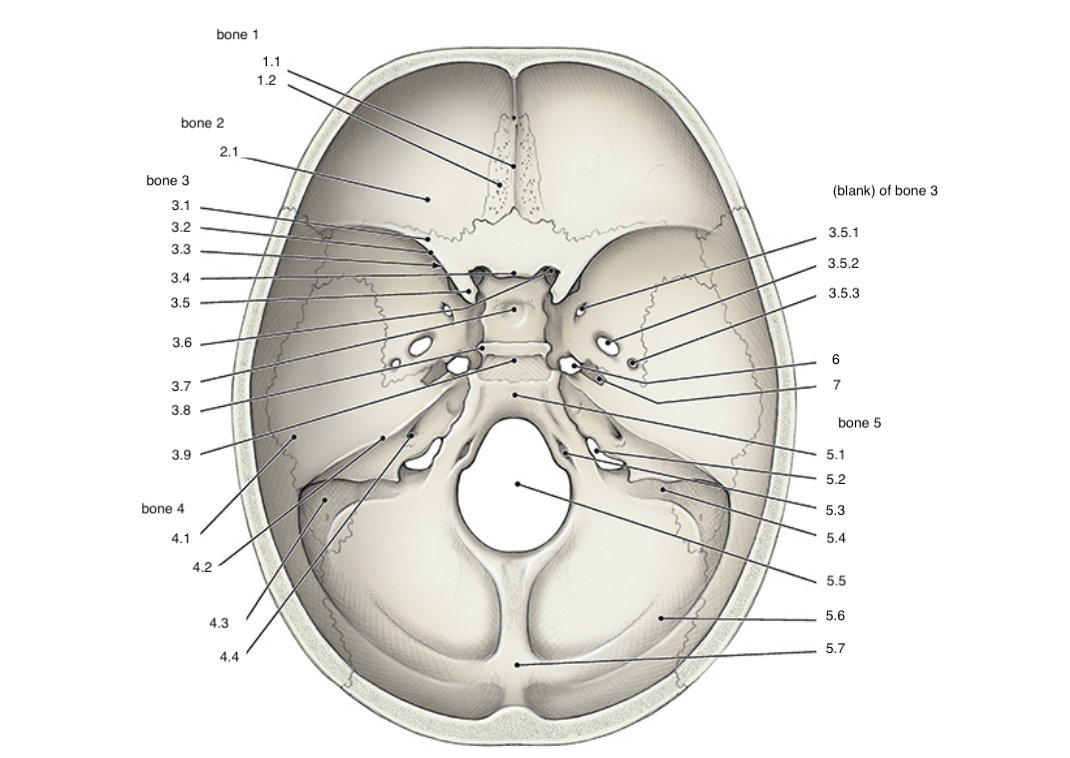
3.1
Lesser wing of sphenoid bone
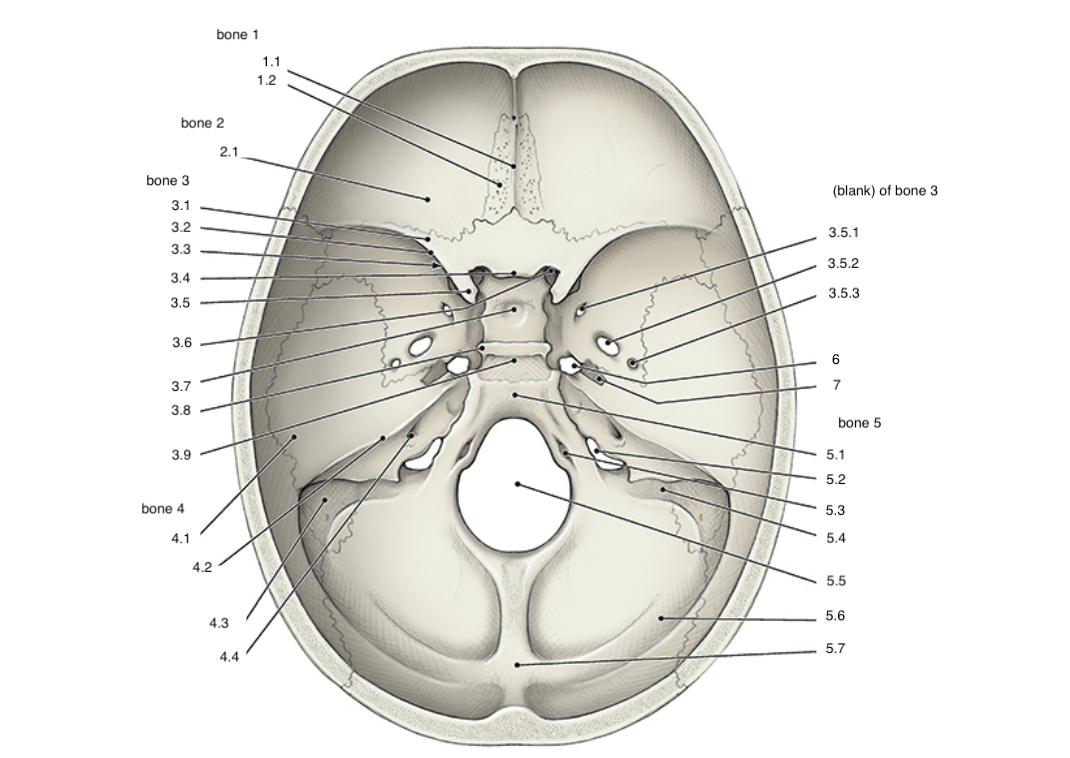
3.2
Sphenoid crest

3.3
Superior orbital fissure
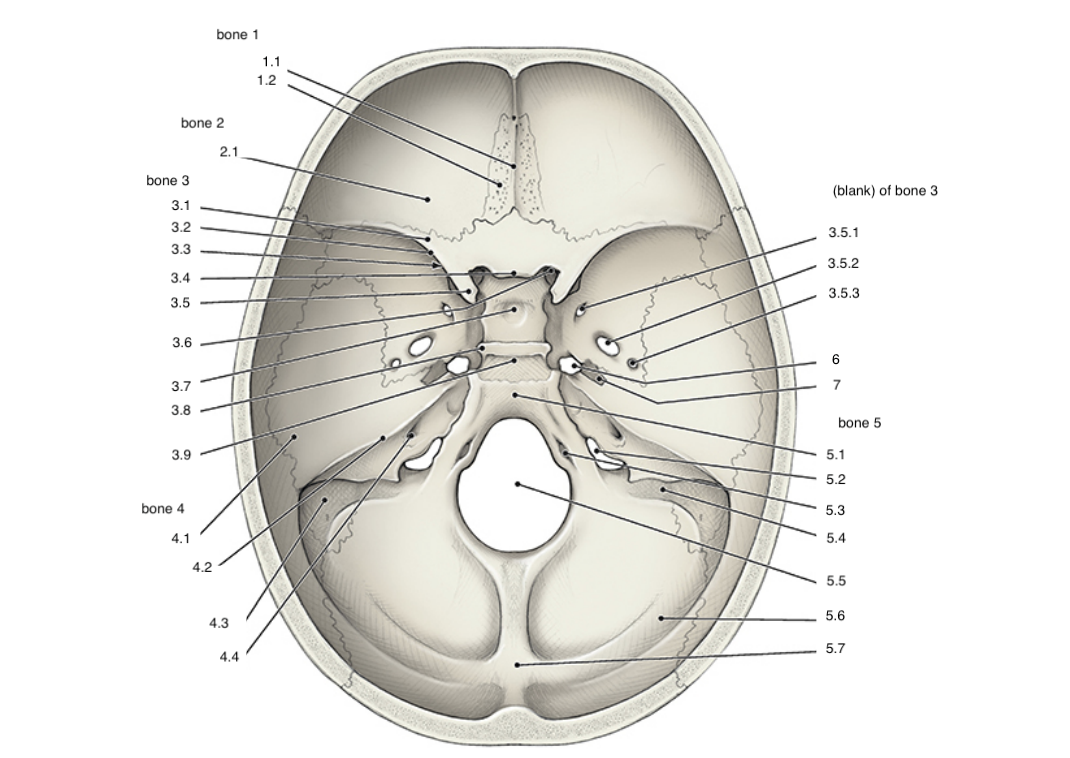
3.6
Optic canal
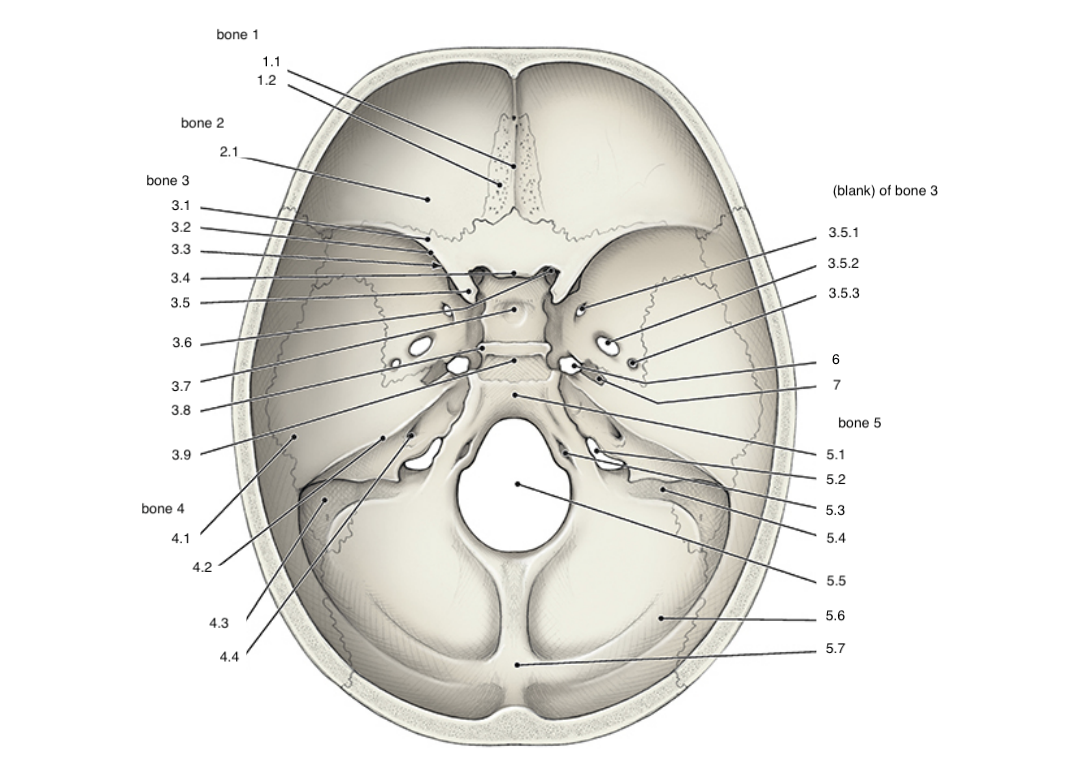
3.7
Hypophyseal Fossa

3.9
Dorsum sellae

4.2
Superior border of petrous part

4.3
Groove for sigmoid sinus

4.4
Internal acoustic meatus

3.5.1
Foramen Rotundum

3.5.2
Foramen Ovale

3.5.3
Foramen spinosum

6
Foramen Lacerum

7
Opening of carotid canal

Bone 5
Occipital bone

5.1
Clivus
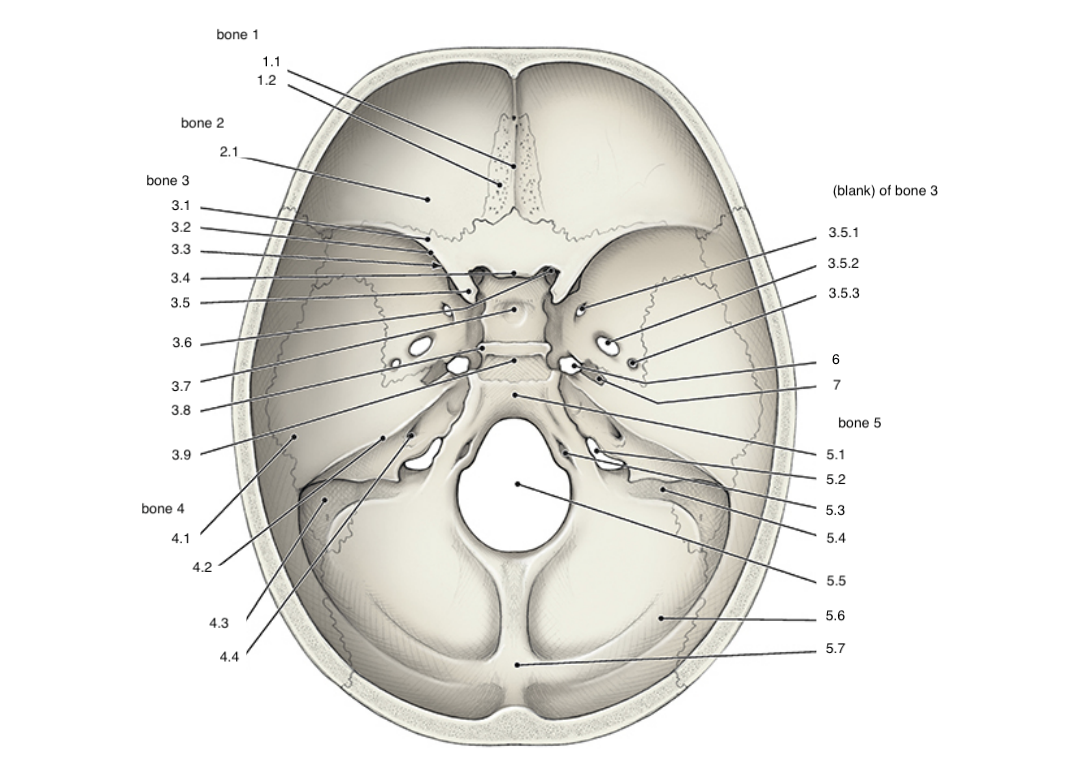
5.2
Jugular foramen

5.3
Hypoglossal canal

5.4
Groove for sigmoid sinus

5.5
Foramen Magnum

5.6
Groove for transverse sinus

5.7
Internal occipital protuberance
CN I
Olfactory nerve
CN II
Optic nerve
CN III
Oculomotor nerve
CN IV
Trochlear nerve
CN V
Trigemental nerve
CN VI
Abducent nerve
CN VII
Facial nerve
CN VIII
Vestibulocochlear nerve
CN IX
Glossopharyngeal nerve
CN X
Vagus nerve
CN XI
Spinal accessory nerve
CN XII
Hypoglossal nerve
What are the muscles of facial expression innervated by?
Facial Nerve, CN VII
Frontalis action
Wrinkles brow and forehead
Platysma action
Grimace, clench neck
Orbiculari oculi action
Squints the eye
Orbiculari oris action
Puckers lips, kiss
Levator labi superioris action
Smiling (grin), elevates corner of mouth
Depressor anguli oris action
Depresses corner of mouth, frown.
Depressor labi inferioris action
Depresses lower lip, pout.
Nasalis action
Flairs nostrils
Mentalis action
Wrinkles skin of chin
Zygomaticus minor and major actions
Pulls corners of mouth superior and backwards to form wider smile.
Does the lower lip have a levator muscle?
No, only the upper lip has a levator muscle.
Does the upper lip have a depressor muscle?
No, only lower lip has a depressor muscle.
Buccinator action
Whistling, sucking in cheeks.
Anterior belly of digastric origin
Digestine fossa of mandible
Ant. belly of digastric insertion
Intermediate tendon to body and greater horn of hyoid bone
Ant. belly of digastric action
Depresses mandible against resistance, elevates and steadies the hyoid bone.
Ant. Belly of digastric innervation
Nerve to mylohyoid (branch of inferior alveolar N)
Mylohyoid Origin
Mylohyoid line of mandible
Mylohyoid insertion
Mylohyoid raphe and body of the hyoid bone
Mylohyoid action
Elevates hyoid bone and floor of the mouth during swallowing and speaking.
Mylohyoid innervation
Mylohyoid N (Mandibular N, CN V3)
Temporalis origin
Floor of temporal fossa, deep surface of temporalis fascia.