118 chp 5
 Call Kai
 Learn
 Practice Test
 Spaced Repetition
 Match
 Flashcards
 Knowt Play
1/38

There's no tags or description
Looks like no tags are added yet.
39 Terms
why do we have brains
To efficiently and effectively move through space
This requires: integration of sensory input, organization of response output to those external stimuli, and modeling the world (predicting whats happening next)
what is the self control study and the results found from it
Procedure: Tested 36 species of mammals and birds using two tasks:
Food location: Animals had to find food after it was moved to a new location.
Transparent cylinder: Animals had to resist reaching directly for visible food and instead go around the barrier.
Findings: Species with larger absolute brain sizes generally showed better self-control, regardless of relative brain size or EQ

what 4 traits did the phylum chordata evolve
Dorsal hollow nerve cord (CNS)
Notochord (structural support and gets replaced by the vertebral column in vertebrates)
Gill slits (breathing)
Postnatal tail (swimming)
These are all adaptations for rapid sensory integration and movement
chordata evolved in water
what are features that evolved in the sub phylum vertebrata
Vertebrate skeleton:
Backbone: encases the spinal cord
Internal skeleton: allowed for evolution of antagonistic muscle systems (gave way to fine tuned movement)
Cranium (skull): encases the brain
what are the vertebrate brain strucutres (3)
Began as 3 bulges at the anterior end of spinal cord
Prosencephalon (forebrain)
mesencephalon (mid brain)
rhombencephalon (hind brain)
what structures make up the prosencephalon
Telencephalon (olfactory bulb, cerebral hemispheres, limbic system, striatum)
Diencephalon (thalamus, hypothalamus)
what structures make up the mesencephalon
Tectum and tegmentum
what structures make up the rhombencephalon
Cerebellum and brain stem (pons and medulla)
how does the evolution of the front end vs the back end of the nervous system compare to one another
Back end of the nervous system is more consistent across species whereas the anterior end is more variable (this is due to complexity of organism and the environment that shaped the species)
what is the evolution of spinal brain projections and the 4 different forms that took shape
Sensory or afferent information comes into the spinal cord through the dorsal roots and efferent or motor information travels away from the spinal cord through ventral roots
More direct connections between spinal cord and higher brain areas evolved as behaviors become more sophisticated, and required more direct communication between the brains “control centers” and the body
Spinoreticular evolution is of the spinal cord and reticular formation which illustrates many of the innate behaviors occur in the spinal cord
Spinocerebellar evolution is the spinal cord and cerebellum, the volution of jaws required more muscle coordination
Spinothalamic evolution is the spinal cord and thalamus which evolved to allow for more sensory integration
Palliospinal evolution is the spinal cord and the cerebral cortex which evolved as endotherms due to moving more and using more energy
what is the evidence of learning in the spinal cord (simple learning, associaion learning, instrumental learning)
There is also evidence of neural plasticity in the spinal cord.
In the bullfrog repeated stimulation of axons in the lateral column of the spinal cord leads to a decreased response output through the ventral root (habituation)
Pavlovian learning in spinal rats
Spinal cord is surgically disconnected from the brain spinal cord has to learn independently of the brain
During training the rats received a mild shock to the right leg, which preceded a fear inducing shock (CS+)
The left leg received the same mild shock which preceded the absence of shock (CS-)
During test they applied heat to the tail after stimulation of either legs and measured how long it took them to remove their tail from the heat
Found that after right mild shock they were able to leave the tail on the plate longer due to an analgesic response
The spinal cord predicts a strong shock, therefore initiating an analgesic reaction which induces pain suppressing hormones in anticipation of the pain.
Instrumental learning
The rats would receive a shock every time they relaxed their leg and learned to keep their leg flexed to avoid shock
Response outcome relationship is encoded here
where is the locus of eye blink conditioning and what is it
Have a third eyelid that is a membrane that causes blinking
Rabbits can associate a tone with a puff of air and blink in order to predict the puff
Locus of this condition happens in the cerebellum (IN) will start firing once it hears the tone which precedes the blink by 45 ms
Lesion studies have proved this
what are coincidence detectors
Neurons where the CS and US converge are called coincidence detectors
what is the role of mesencephalon
Mesencephalon consists mainly of the tectum (including the optic lobes), which contains nuclei that serve as centers for visual and auditory reflexes
Mediates most complex behaviors of fished and amphibians, integrating visual, tactile, and auditory information
Toads tectum have cells that respond to smaller stimuli (food) compared to larger stimuli (possible predators)
This visual detection combined with toads motivational state and experiences drive whether the toad will eat or protect itself
This is possible because the tectum is retinotopically organized with the retina
Plays a large role in birds, too, but the cerebrum took over some of the midbrain functions
In mammals the midbrain is mainly a relay center for information on its way to higher brain centers
what is the role of the diencephalon
Subdivision of the prosencephalon (forebrain)
Regulation of daily rhythms, thermoregulation, mating and migratory behaviors
These rhythms run through the pineal gland which converts serotonin to melatonin
what is the role of the hypothalamus (as well as its ability to learn) and the thalamus in the diencephalon
Hypothalamus
Regulates endocrine system via the pituitary gland
Some neurons release oxytocin a vasopressin to our bloodstream through the posterior pituitary gland
Other neurons release releasing factors to the anterior pituitary which release other hormones to act on other parts of the body
maintains homeostasis
Biases associative learning toward reward predictive cues
he LH works with the BLA and VTA to guide learning toward reward-predicting cues, using dopamine signals to indicate when rewards are better or worse than expected.
Escape learning too
Thalamus
Is the origin of many of the brain waves that regulate functional organization across cortex, striatum, and limbic systems
Basis of consciousness
Bc it is so integrated in so many cortical processes
what is the role of the subdivisions of the telencephalon
Pallium
Hippocampus (spatial behavior, episodic memory)
Birds that store food have larger hippocampus
Important for homing pigeons
Cortex (higher - order perceptual processing, working memory, semantic memory)
Subpallium
Amygdala (learning and emotional behavior)
Lesions impair fear conditioning
Basal ganglia (action selection, motor behavior, reward learning)
Damage to dopamine input is Parkinson's disease
These systems are deeply conserved across vertebrates
what is the emerging view of the brain as a prediction organ
Emerging view of the brain as a prediction organ
Simulates the world
Makes predictions of future states following actions
Then validates predictions by gathering sensory input to compare to predictions
learning/memory is the process of updating the model of the world when predictions are not confirmed
Feedback loop

what is the encephalization quotient and biological intelligence
EQ is the ratio of relative/expected brain size (determined by scaled body size)
Biological intelligence: capacity to construct a perceptual world (modeling)
Essentially how far the species is from the line of expected brain and body size
Above the line the eq is greater than one and larger than expected (encephalization)
what are examples of brain size increased more often than decreased
Brain size increased independently in cartilaginous fishes, somme bony fished, birds, mammals
Early mammals were nocturnal and relied on other senses instead of vision (which are processed in the brain)
Brain size decreased in salamanders, and eels
Brains are expensive to maintain
what is the comparative neuroanatomy (midbrain and forebrain))
Scale size of brain areas relative to whole brain
Relative volume of midbrain decreased and forebrain increased relative to rest of brain during vertebrate evolution
Why has there been an increase in reliance on forebrain vertebrate, especially mammalian evolution?
Increased behavioral flexibility
Body size got larger too
what is the learning of learning sets in mammals
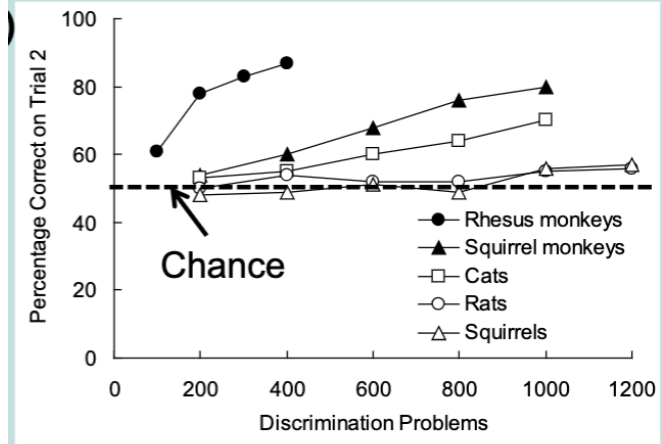
Stimulus discrimination task:
Two stimuli are presented in the apparatus and subject has to choose between the two. One stimulus (S+) gives a food reward and the other (S-) does not give a food reward
Experimenter will present stimuli over many trials until 80% success rate is observed. Then the experimenter will present a new set of two stimuli and continue this process over many trials and sets of stimuli.
Win-stay / lose-shift: new items are presented and you will stay picking the item that produces a win and shift if your choice presents a loss.
Experimenter then discriminated learning through measuring the percentage of correct choices on trial 2 (this is because once you understand the rules of the game it only takes one trial to be successful going forward)
Evidence of learning is shown when your percentage correct on trial 2 is above 50 percent (chance)
what are the two methods to study flexible behavior
learning of learning sets, and reversal learning
what is discrimination reversal learning
Correlated with degree of frontal lobe development in primates, that is these primates do better with reversal learning
Transfer index=rate of reversal learning compared to original learning
Positive = faster reversal learning
Negative = slower reversal learning
Same apparatus except stimuli remain constant rather the reward associated with the stimuli gets reversed once they reach proficiency (80 percent).
Lesions of the frontal cortex affect this test a lot (don't have impact on discrimination learning)
why are bigger brains better
Smarter
More flexible behavior
How does increased brain size produce increased intelligence?
Functional connectivity (neurons)
what are the two models for how neural networks change with size
Bigger brains have more neurons
Maintaining proportional connectivity
As number of neurons increase the number of axonal connections increases too
Absolute number of connections maintained
As number of neurons increase the number of axonal connections stays the same
There is more evidence for maintenance of absolute connectivity
Thus, larger brains have more subdivision and are more sparsely connected and have distinct functionalization
Analogy of a growing company and development of departments

what are the two types of evolution of new brain structures and example of least common one
Phylogenetic conversion: over evolutionary time (phylogenesis) over time the specific brain structure converted into a different type relative to the ancestral population
Mammalian neocortex: homologous to dorsal pallium of other vertebrates
Birds and other vertebrates = nuclei - ancestral condition
Phylogenetic proliferation(Common): the change in the brain created two new subdivisions (new areas proliferate from the original
what are the two forms of phylogenetic proliferation and examples
Phylogenetic addition: where the new structure is added additionally to the derived ancestral structure
Phylogenetic segregation: each of the new subdivisions changes relative to the ancestral state
Proliferation by phylogenetic segregation
None of the lemnothalamic nuclei in amniotes(lizards, birds, mammals) are homologous in a one to one manner to a single lemnothalamic nucleus in anamniotes(amphibians)
Proliferation by phylogenetic addition
“Old” homologous neocortical structures in red (primary and secondary sensory and motor areas). “New” areas include higher order sensory or association cortices
Larger brians have new higher order sensory cortices
what are the scaling rules of the cerebral cortex (dorsal pallium)
rules for cerebral cortex (dorsal pallium)
Nonprimate mammals: as number of neurons increases. Neuronal density decreases. That is as brain size increases, neurons ger larger and number of neurons per volume of brain tissue decreases.
Primates: as primate cortex gains neurons, neuronal density stays the same. That is as brain size increases, number of neurons per volume of brain tissue remains relatively constant
Birds follow same scaling rule
Therefore as cortex size increases, the number of neurons in cortex increasesat a much higher rate in primates than in non primates.
More neurons = more computing power
Thus a primate and bird will have more computing power than a non primate mammal of the same sized cortex (dorsal pallium)
what are amniotes and anamniotes
Amniotes are vertebrates that develop an amniotic sac during embryonic development, including reptiles, birds, and mammals. Anamniotes, such as amphibians and fish, do not have this structure and typically lay eggs in water.
what are the 4 evolutionary concepts in neuroanatomy
Parallelism: character similarity due to independent evolution from similar basal characters
Convergence: independent origin of similar traits from distinct ancestral features
Reversal: evolutionary return of a descendant trait to a remote ancestral state
Divergence: phenotypic differentiation of homologous traits
what are the 5 criterior for establishing neural homology
Topography: relative spatial position of the structure within the CNS
Pathways: pattern of afferent and efferent neuronal connections
Cytoarchitecture: cellular organization into layers, laminas, or nuclei
Neurochemistry: specific neurotransmitter and neuromodulator profiles
Gene expression: conservation of developmental gene or protein expression patterns
what are the two character stability: cranial nerves and neurochemical systems
Cranial nerves: Cranial nerves are formed by axons carrying afferent information from the periphery into the CNS and by axons carrying efferent information from the CNS to the periphery (muscles, glands, organs, and sensory receptors).
Also stable across species are the neurochemical systems: bundles of axons that connect different structures and use a specific neurotransmitter
Neuromodulators are substances that influence neurotransmitter receptors in the postsynaptic membrane or neurotransmitter release and reuptake in the presynaptic membrane.
what are mauthner cells in the spinal cord
Mauthner cells: a pair of a giant brainstem interneurons present in agnathans, teleosts, and amphibian larvae. Mauthner axons decussate and form fast electrical synapses with contralateral motor neurons, driving a rapid escape swim contraction away from predators
what is the role of the medulla, pons, cerebellum
The medulla, pons, and cerebellum are key brainstem structures that together coordinate vital functions. The medulla regulates autonomic functions like breathing and heart rate, the pons facilitates communication between different parts of the brain and controls sleep, while the cerebellum is involved in balance, coordination, and motor control.
What role does the telencephalon play in learning in goldfish?
Goldfish without a telencephalon can still learn basic associations and escape shocks but struggle with active avoidance. Stronger shocks improve their learning, suggesting the telencephalon helps regulate learning rather than directly store memories.
what is the principle of proper mass and mass action in terms of brain size
Principle of Proper Mass: The size of a specific brain region positively correlates with how much information it handles. For instance, visually oriented diurnal primates devote large areas to vision, whereas bottom-feeding catfish have enlarged brainstem nuclei to process taste inputs from their vagal nerves.
Principle of Mass Action: Proposed by Karl Lashley, this principle states that when brain functions are distributed across multiple areas, the severity of a learning deficit depends on the amount of tissue lost rather than where the damage occurs.
what is the example of artificial selection for brain size
Kotrschal et al. selectively bred guppies for high vs. low relative brain size over two generations
Cognitive Outcome: Large-brained females achieved significantly higher accuracy in a visual numerical discrimination task (4 dots vs. 2 dots) than small-brained females (no effect observed in males)
Fitness Trade-off: Large-brained guppies suffered an energetic trade-off, producing significantly fewer offspring in their first brood compared to small-brained controls
what are the two main determinants of brain size
Allometric change: Brain size increases as body size increases, partly through longer cell proliferation.
Encephalization: Natural selection favors a larger brain beyond what body size predicts.