Ecosystem Cycles Part 3
 Call Kai
 Learn
 Practice Test
 Spaced Repetition
 Match
 Flashcards
 Knowt Play
1/32

Earn XP
Description and Tags
Phosphorus
33 Terms
what three reasons do organisms need phosphorus?
1) ATP
2) DNA and RNA
3) Structure
what are the 4 principal classes of phosphorus fluxes?
1) weathering
2) assimilation
3) dissimilation
4) precipitation and sedimentation
where is most phosphorus stored?
rocks/minerals
weathering
physical and chemical degradation of a rock
What is the flux rate of weathering and what does this mean biologically?
phosphorus is released and enters ecosystem slowly
assimilation
producers directly absorb phosphate from soil and incorporate it into their tissues
soil binding
some soils hold onto phosphate tightly making it harder for plants to absorb
how does mycorrhizal mutualism between fungi and producers help plants scavenge phosphate?
fungi associate with plant roots and help them find and absorb more phosphate
dissimilation
decomposers break down dead organisms and animal waste releasing phosphate from organisms into nonliving pools
after dissimilation, what is the processed called when the released phosphate is immediately available for producers?
reuptake
sedimentation
phosphate containing particles settle and accumulate on the bottom, eventually forming sedimentary rock

regarding precipitation and sedimentation, what happens to phosphate in anoxic conditions (low oxygen)?
phosphate binds with sulfur and remains dissolved in water making it available for uptake
regarding precipitation and sedimentation, what happens to phosphate in well-oxygenated conditions?
phosphate binds with calcium and iron forming sold particles that precipitate (settle out of water)
on a large geological timescale, what can sedimentation cause?
can form rocks and be uplifted to form new land
how does mining impact the phosphorus cycle?
humans extract large amounts of phosphate material for agriculture and industry at rates that are faster than natural processes can replace it
how does runoff impact the phosphorus cycle?
excess phosphate washes into waterways causing eutrophication and dead zones
80% of phosphorus added to agriculture never reaches the food system due to runoff. So NCSU and partner institutions aim to reduce phosphorus demand and loss. Why is this biologically significant?
improving phosphorus efficiency reduces fertilizer waste and runoff preventing eutrophication and dead zones
nutrient regeneration
recycling nutrients through the breakdown of dead organisms and organic matter

biological loop
rapid recycling of nutrients between living organisms and the environment

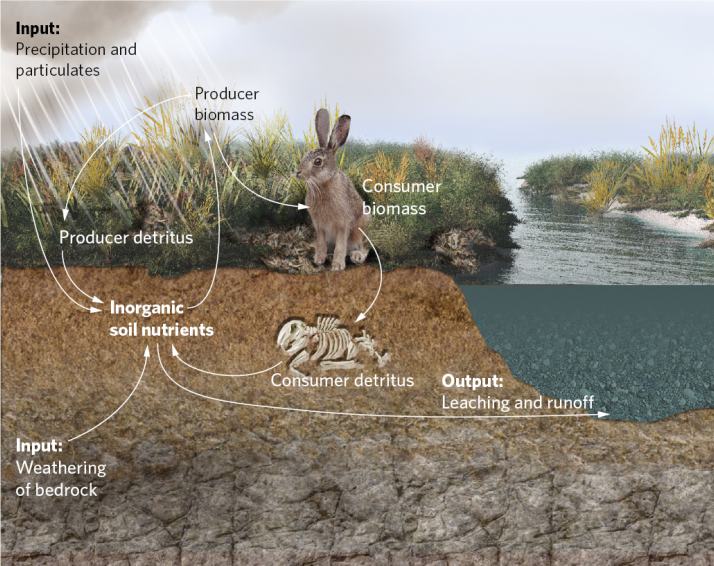
Explain the movement of the arrows in this diagram starting with producers.
producers absorb inorganic soil nutrients→ consumers obtain nutrients by eating producers → dead organisms and waste become detritus → decomposers break down detritus returning nutrients to soil→ producers reuptake nutrients
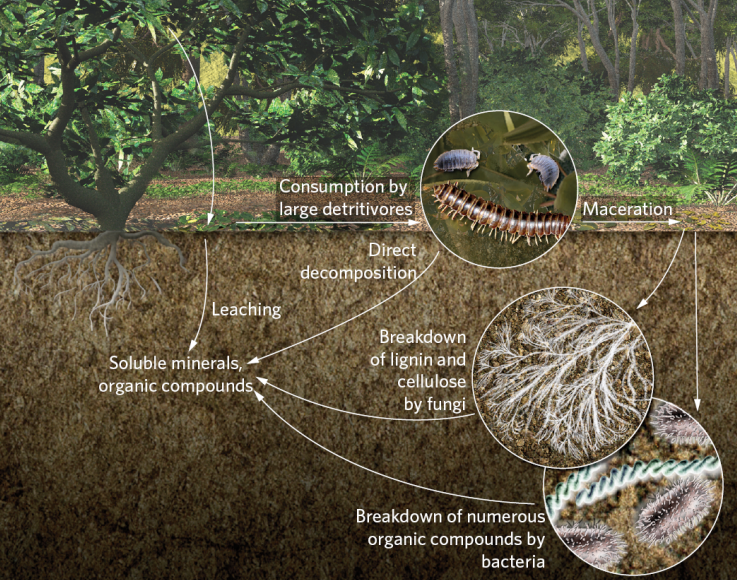
decomposition in terrestrial ecosystems: whats direct consumption?
detritovores eat pieces of dead leaves and excrete nutrient rich waste
decomposition in terrestrial ecosystems: whats leaching?
water carries soluble nutrients from leaves into the soil where fungi break them down
decomposition in terrestrial ecosystems: what makes cellulose and lignin difficult to decompose?
complex carbohydrates that require specialized fungi to break them down
decomposition is faster in what type of environments?
warm and wet environments
in what biome is decomposition fastest?
tropical rainforests
Direct consumption, breakdown of lignin and cellulose by fungi, leaching, and breakdown of organic compounds by bacteria all lead back to what?
soluble minerals and organic compounds that can be reabsorbed by producers
to control the rate of leaf litter decomposition what experiment did researchers conduct?
placed dead leaves from different trees species in mesh bags and measured remaining mass over time
what did the researchers find regarding their leaf litter decomposition experiment and why?
decomposition is initially fast then slows down because easily broken down compounds such as sugars and soluble nutrients decompose first than more resitant compounds such as lignin and cellulose take longer
decomposition in aquatic ecosystems: what is the decomposition rate in water?
slow
decomposition in aquatic ecosystems: whats recalcitrant organic matter?
difficult to break down material accumulates keeping nutrients trapped and unavailable to aquatic food webs
due to recalcitrant organic matter, what type of nutrient input does aquatic ecosystems rely on?
allochthonous (from outside) input
what experiment did researchers conduct to test the effects of invertebrates on decomposition?
researchers compared leaf litter bags with different lignin contents where small mesh bags prevented invertebrate access while large mesh bags allowed invertebrate access
what was the result of the experiment where researchers tested the effects of invertebrates on decomposition?
invertebrates speed up decomposition by physically breaking down leaves and making nutrients available for recycling