Bio 213 Lab
 Call Kai
 Learn
Learn Practice Test
 Spaced Repetition
 Match
Match Flashcards
 Knowt Play
1/132

There's no tags or description
Looks like no tags are added yet.
Name | Mastery | Learn | Test | Matching | Spaced | Call with Kai | Chat |
|---|
No analytics yet
Send a link to your students to track their progress
133 Terms
Invertebrates
Animals without backbones
Simple digestion
digestion and absorption occur in single cavity
Complex
specialized regions for digestion and absorption, integration with circulatorysystem
crop
stores food (birds, worms)
gizzard
thick-walled muscular pouch below the crop in many birds and reptiles for grinding food
Dentition
Natural teeth in the dental arch
Ruminants
An animal, such as a cow or sheep, with an multicompartmentalized stomach specialized for storing cud and getting cellulase
Coprophagy
Feces travel back up hind gut to break down thru=ough fermentation. Rabbits use to break down cellulose
Tracheae
tiny tubes in insect body that deliver oxygen directly to metabolizing tissues
Cross current air system
Used by birds. Have a lung and two air sacs. Allows more O2 in.
Open circulatory system
A circulatory system that allows the blood to flow out of the blood vessels and into various body cavities so that the cells are in direct contact with the blood
Oviparous
egg laying
Viviparous
live birth
Spermatogenesis
production of sperm
seminiferous tubules
Narrow, coiled tubules that produce sperm in the testes in mammals.
Gonopod
First pair of swimmerets, small & used for holding eggs in females, larger in males & used for sperm transfer.
hemipenes
Split penis sound in snakes and lizards
Intermittent organ
transfers sperm for internal fertilization
claspers
modified pelvic fins on a male shark that allows for transfer of sperm to female
nictitating membrane
a thin, transparent, eyelid-like membrane that adds another layer of protection.
Mammary papillae
nipples found on the abdomen of BOTH males & females; in females, connect to mammary glands & supply milk to baby
genital papilla
The female's external genitalia. Covers the ureogentital opening
Masseter muscle function
Overlies lower jaw, regulates opening and closing
Salivary glands function
parotid, mandibular glands, secrete saliva
Saliva
Made of amylase (enzyme that breaks down food), water, mucous
Pharynx function
throat; passageway for food to the esophagus and air to the larynx
Glottis function
Opening to the respiratory trachea
Epiglottis function
A flap of tissue that seals off the windpipe and prevents food from entering.
larynx function
voice box; passageway for air moving from pharynx to trachea; contains vocal cords
Trachea function
a large membranous air tube reinforced by C rings of cartilage, from larynx to the bronchi. Lines with cilia and goblet cells that secrete mucous and trap debris
Lungs function
3 left lobes, 4 right lobes (pigs)
Passage of air from lungs
Mouth/nose
Pharynx/larynx
Primary bronchus
Secondary bronchus
Tertiary bronchus
Bronchioles
Alveoli
diaphragm function
Large, flat muscle at the bottom of the chest cavity that helps with breathing
Thymus Gland function
lymphoid organ in the mediastinum that conditions T cells to react to foreign cells and aids in the immune response
Thyroid Gland function
produces hormones that regulate metabolism, body heat, and bone growth
Digestive system order
mouth, esophagus, stomach, small intestine, large intestine, rectum, anus
rugae
ridges on the hard palate and the wall of the stomach
esophageal sphincter
muscle at the upper or lower end of the esophagus that prevents backflow
phyloric sphincter
a muscular ring at the end of the antrum allows partially digested food to move into small intestine
caecum
a blind pouch which forms at the junction of the small and large intestine; breaks down cellulose, homologous to appendix in the human

small intestines function
Digestive organ where most chemical digestion and absorption of fats, proteins, carbs. Has villa for absorption
large intestine function
The last section of the digestive system, where water is absorbed from food and the remaining material is eliminated from the body
liver function
produces bile to break down fats in the small intestine
Gallbladder
A muscular sac attached to the liver that secretes bile and stores it until needed for digestion
pancreas function
secretes trypsin to break down protein in the small intestine. Regulates glucose levels.
spleen function
Organ near the stomach that produces, stores, and eliminates blood cells
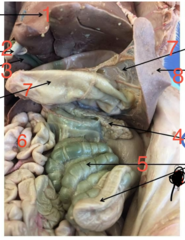
Pancreas
4
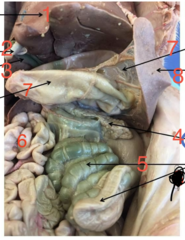
Stomach
7

small intestine
6

large intestine
5

gall bladder
3

liver
1

spleen
8

umbilical vein
2
masseter muscle
1
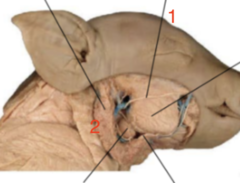
salivary glands
2

thyroid gland
2
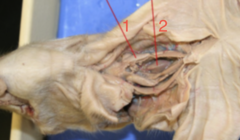
thymus gland
1

larynx
1

esophagus
2

trachea
3

left lung
4

right lung
5

diaphragm
6

Right atrium
Receives deoxygenated blood from the body
tricuspid valve
valve between the right atrium and the right ventricle
right ventricle
pumps deoxygenated blood to the lungs
pulmonary vein
Deliver oxygen rich blood from the lungs to the left atrium
left atrium
receives oxygenated blood from the lungs
bicuspid valve
valve between the left atrium and the left ventricle.
left ventricle
Pumps oxygenated blood into the aorta
aorta
The large arterial trunk that carries blood from the heart to be distributed by branch arteries through the body.
foramen ovale
connects the two atria in the fetal heart
ductus arteriosus
connects the pulmonary artery to the aorta, bypassing the lungs
coronary artery
The artery that supplies heart tissue with blood
vena cava
One of two large vessels (superior and inferior) that return deoxygenated blood to the right atrium of the heart.
subclavian artery
either of the arteries that carry blood into the arms
jugular vein
veins in the neck that return blood from the head
carotid artery
The major artery that supplies blood to the head and brain.
femoral artery
the major artery supplying the leg
great saphenous vein
longest vein in the body, travels along medial leg; empties into the femoral vein
allantoic duct
takes urine from the fetus kidney to the placenta
order of excretory system
kidneys, ureters, bladder, urethra
Kidney
Filters waste from the blood like urea, water, salt and proteins.
Nephron
functional unit of the kidney. Has small tubes to filter.
glomerulus
small network of capillaries encased in the upper end of a nephron; where the filtration of blood takes place
adrenal gland
A pair of endocrine glands that sit just above the kidneys and secrete hormones that help arouse the body in times of stress. triangle shape
adrenal medulla
Inner layer of medulla secretes epinephrine and norepinephrine
adrenal cortex
outer section of each adrenal gland; secretes cortisol, aldosterone, and sex hormones
Ureter
A duct leading from the kidney to the urinary bladder.
order of sperm production
testis, semiferous tubule, vans deferens, urethra
semaphores tubule
site of sperm production
vans deferens
duct that carries sperm from the epididymis to the ejaculatory duct
spermatic cord
bundle of fibrous connective tissue containing the ductus deferens, blood and lymphatic vessels, and testicular nerve
seminal vesicle
male organ that produces seminal fluid for sperm cells. Alkaline fluid to neutralize acidic vagina, nutrients, hormones, coagulating protein
prostate
a male gland that lies under the urinary bladder and surrounds the urethra. Secretes fluids that facilitates capacity of sperm to fertilize sperm
bulbourethral glands
A pair of exocrine glands near the male urethra. Secretes alkaline fluid to clean and lubricate urethra prior to ejaculation
order of egg travel
ovary, oviduct, uterus, vagina
oviduct
Fallopian tube; tube that carries eggs from an ovary to the uterus. Fertilization occurs
uterus
Female organ of reproduction used to house the developing fetus.