Histo Immune System & Lymphoid Organs
 Call Kai
 Learn
 Practice Test
 Spaced Repetition
 Match
 Flashcards
 Knowt Play
1/169

There's no tags or description
Looks like no tags are added yet.
170 Terms
innate immune system
a component of the immune system that is composed of generalized and non-specific defenses and/or responses to pathogens and has no immunological memory; acts fast
adaptive immune system
has immunological memory, specificity, diversity, and the ability to distinguish self from non-self
T lymphocytes
adaptive immune system cells that are responsible for cell-mediated immune responses; assist in developing humoral responses to thymic-dependent antigens
humoral response
The branch of acquired immunity that involves the activation of B cells and that leads to the production of antibodies, which defend against bacteria and viruses in body fluids.
T lymphocytes, B lymphocytes, and antigen-presenting cells
What are the 3 cells of the adaptive immune system?
innate immune system
Toll-like receptors, mast cells, eosinophils, neutrophils, macrophages, and NK cells are all part of which immune system component?
cytokines
In the adaptive immune system, T lymphocytes, B lymphocytes, and APCs communicate with each other by the use of signaling molecules called _____________.
toll-like receptors (TLRs)
a family of at least 14 receptors that can be located in the cytosol of specific innate immune system cells or as integral proteins in their cell membranes; recognize bacterial components once paired
TRC4-TRC4
What TLR pair recognizes lipopolysaccharides of gram-negative bacteria?
TRC2-TRC6
What TLR pair recognizes peptidoglycan of gram-positive bacteria and zymosan of fungi?
TNF-alpha, interleukin 12
Once toll-like receptors bind to their ligand, they cause the release of _____________, ______________, and other cytokines.
clone
a small number of identical cells that can recognize and respond to a single or small group of related antigenic determinants
epitopes
the part of an antigen molecule to which an antibody attaches itself and that stimulates immune responses
T-cell receptors
___________ are present on the surface of T lymphocytes and recognize only protein antigens
protein antigens
What kind(s) of antigens do TCRs recognize?
MHC (major histocompatibility complex)
T lymphocytes recognize only epitopes that are bound to ________________ molecules on the surface of APCs.
thymus
Where does T cell maturation occur?
immunoincompetent
What word describes T cells before they migrate from the bone marrow to the thymus?
thymic cortex
Within the ______ ______, thymocytes undergo gene rearrangements and begin to express antigen-specific TCRs.
-outside of the lymphatic nodules in MALT
-paracortex of lymph nodes
-PALS of the spleen
What are the T-cell regions in secondary lymphoid organs?
lymphoblasts
Pro-T lymphocytes develop into _________ in the thymus.
helper T cells, cytotoxic T cells, regulatory (supressor) T cells
What are the 3 types of T-lymphocytes?
CD4 T cells
T-lymphocytes that are able to recognize and react with antigens presented by cells associated with MHC II
CD8 T cells
T-lymphocytes that are able to recognize and react with antigens presented by cells associated with MHC I
Class I molecules (MHC I)
Which MHC molecules are expressed by nearly all nucleated cells?
Class II molecules (MHC II)
Which MHC molecules are expressed by the various cells that function as APCs?
CD4
What is the surface marker for helper T cells?
CD8
What is the surface marker for cytotoxic T cells?
CD4
What is the surface marker for regulatory (suppressor) T cells?
MHC II
which MHC class is associated with CD4 T cells?
MHC I
Which MHC class is associated with CD8 T cells?
helper T cells
Which type of T-lymphocytes help promote antibody production, stimulate proliferation of eosinophils and mast cells, and indirectly promote and activate other immune cells?
cytotoxic T cells
Which type of T-lymphocytes directly kill target cells (virus-infected cells, tumor cells, and transplanted cells/grafts)?
regulatory (suppressor) T cells
Which type of T-lymphocytes suppress the humoral and cellular immune responses and are involved with immunological tolerance?
cellular immune response
What immune response involves the destruction of infected cells by cytotoxic T cells, or the destruction of intracellular pathogens by macrophages? (doesn't involve antibodies)
plasma cells and memory B cells
What are the 2 types of active B cells?
plasma cells
Which active B cells produce antibodies and participate in the humoral immune response?
memory B cells
Which active B cells have a long life (months to decades) and are capable of differentiating into plasma cells?
IgG
the most abundant type of immunoglobin
IgG
type of immunoglobin that is able to cross the placenta, is a major Ig during the 2nd immune response, and has a high antigen binding specificity
IgA
type of immunoglobin that is the major type in external secretions (milk, saliva, tears, sweat, and mucus) of epithelial and gland epithelium cells; protects mucosal surfaces
IgM
type of immunoglobin that is the principal Ig in the primary immune response; activates macrophages and serves as an antigen receptor on the B cell surfaces
IgE
type of immunoglobin that is found only in a small amount in blood serum; binds to Fc receptors of the mast cells and basophils and plays important role in allergic reactions
IgD
type of immunoglobin that is found in low concentrations in blood serum; serves along with IgM as an antigen receptor on the membranes of mature B cells
immunoglobulins
Ig molecules on B-lymphocyte surface membranes mediate antigen recognition
plasma cells secrete antibodies after B-cell activation
B-lymphocytes
lymphocytes that function by differentiating into antibody-secreting plasma cells and reside in lymphoid nodules
lymphoid nodules
Where do B-lymphocytes reside?
B-lymphocytes
Which type of lymphocytes are associated with the humoral immune response?
T-lymphocytes
lymphocytes that function by differentiating into helper T cells, cytotoxic T cells, and regulatory T cells and reside in T-cell regions
T-lymphocytes
Which type of lymphocytes are associated with the cell-mediated immune response?
T-cell receptor (TCR) and CD4 and CD8 markers
What is antigen recognition mediated by in the surface membranes of T-lymphocytes?
bone marrow, thymus, mucosa-associated lymphoid tissue (MALT), lymph nodes, spleen
List the lymphoid organs
bone marrow and thymus
What are the primary lymphoid organs?
bone marrow
What primary lymphoid organ is associated with B lymphocytes?
MALT, lymph nodes, spleen
What are the secondary lymphoid organs?
HIV
What infection is associated with a decline in CD4+ helper T cells and loss of cell-mediated immunity?
CD4+ helper T cells
What type of cells are affected by HIV/AIDS?
true
T/F: No B cells or lymphatic nodules are present in the thymus.
lymphatic nodules
small, localized clusters of dense tissue formed by lymphocytes and macrophages

Hassall corpuscles
structures in the thymic medulla formed by Type VI epithelial reticular cells with keratinization; increase with age

epithelial reticular cells
cells in the thymus that surround lymphocytes in the cortex, form Hassall corpuscles in the medulla, and maintain the blood-thymus barrier in the cortex

immunocompetent
Thymocytes undergo gene rearrangement and become ___________ thymocytes within the cortex.
effective or memory T cells
What do thymocytes become after migrating from the thymic medulla to the secondary organs?
thymosin, serum thymic factors, and thymopoietin hormone
What 3 things do epithelial reticular cells produce?
blood-thymus barrier
What prevents foreign antigens from entering the thymus?
immunocompetent naive T cells, macrophages, and type V and VI epithelial reticular cels
What cell types are found in the medulla of the thymus?
GALT, BALT, and tonsils
What are the components of the MALT (mucosa-associated lymphoid tissue)?
palatine, pharyngeal, lingual
3 types of tonsils
primary lymphatic nodules
lymphatic nodules that contain mostly small (inactive) B cells and don't have a germinal center
secondary lymphatic nodules
lymphatic nodules that contain mostly large (active) B cells and have a germinal center
appendicitis
common disease involving bacterial and viral infection, hyperplasia of lymphatic nodules, and abdominal pain
lymphatic nodules
What structure(s) in the appendix does appendicitis affect?

M (microfold) cells
specialized cells with short apical folds and no microvilli that transfer foreign antigens to lymphocytes in Peyer's patches; harbor T and B cells and dendritic cells; have a large intracellular pocket at the basal surface

palatine tonsil
one of a pair of almond-shaped masses of lymphatic tissue in the posterolateral walls of the oral cavity, lined by stratified squamous epithelium; has deep, branched crypts and mostly lymphatic nodules

non-keratinized stratified squamous epithelium
What type of epithelium lines the palatine tonsils?
pharyngeal tonsil
epithelial invagination in the posterior roof of the nasopharynx, lined by pseudostratified columnar epithelium; mostly diffuse lymphoid tissue and some lymphatic nodules

pseudostratified columnar epithelium
What type of epithelium lines the pharyngeal tonsil?
B; T
______ cells are located in the cortex of lymph nodes, and _____ cells are located in the paracortex.
medullary cords
___________ ________ in lymph nodes extend inward from cortex and contain B cells, T cells, and plasma cells.

medullary sinuses
___________ _________ in lymph nodes communicate with efferent lymphatics and contain reticular cells and macrophages.

afferent lymphatic vessel
What carries lymph from the peripheral tissues into the lymph node?
efferent lymphatic vessel
Vessel in which lymph and lymphocytes leave a lymph node en route to the blood
HEVs (high endothelial venules)
the site where most lymphocytes enter the lymph node from the blood; specialized post-capillary veins with receptors for antigen-primed lymphocytes; lined by cuboidal cells and contain rich glycoproteins that attract lectinlike receptors

diapedesis
the passage of blood cells through the intact walls of the capillaries, typically accompanying inflammation; HEVs are a major site for this
spleen
HEVs are located in all secondary lymphoid organs except which one?
L selectin
lectin-like receptors expressed in leukocytes, attracted by the glycoproteins in HEVs
paracortex
Where are HEVs located in lymph nodes?
germinal center of lymphatic nodule
What structure is the arrow on the left of the image pointing to?

lymph node
What part of the immune system is this?

Hodgkin lymphoma
malignant lymphoid cancer that causes enlargement of lymph nodes, fever, night sweats, weight loss, and fatigue; associated with Reed-Sternberg cells
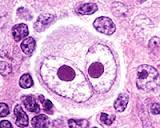
Reed-Sternberg cells
cells associated with Hodgkin lymphoma
white pulp
What part of the spleen contains lymphatic nodules (B cells), a central artery, a periarterial lymphatic sheath (T cells), and an immune component?

red pulp
What part of the spleen contains splenic (Billroth) cords and splenic sinuses, filters antigens, engulfs aged erythrocytes, and is a reservoir for erythrocytes and platelets?

erythrocytes and platelets
The red pulp in the spleen is a reservoir for _______ and __________.
PALS (periarterial lymphatic sheath)
What is the T-cell area of the spleen?
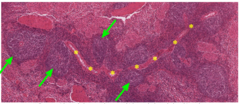
sinusoid
Enlarged capillary that serves as a blood channel; located in red pulp of spleen

GALT (gut associated lymphoid tissue)
What is lymphoid tissue called in the gut?
Peyer's patches
large example of GALT in the ileum
geminal center
Name the structure in the ileum.

mantle
Name the structure in the ileum.
