12 research
 Call Kai
 Learn
 Practice Test
 Spaced Repetition
 Match
 Flashcards
 Knowt Play
1/50

There's no tags or description
Looks like no tags are added yet.
51 Terms
true
Conducting research is not enough; researchers also have a responsibility to share their findings with others ✅❌
true
Disseminating research allows scientific knowledge to grow and enables other researchers to build on previous work. ✅❌
true
In psychology, research is commonly presented using APA style guidelines ✅❌
1. Conference paper presentations.
2. Conference poster presentations.
3. Publishing research.
What are the three common ways to disseminate research?

What are the eight main sections of a typical Psychology Research Paper?
true
APA style is a learned skill that improves with practice ✅❌
true
When preparing a research paper, researchers should use APA Style, 7th edition as a guide for formatting, writing, citations, references, tables, and figures. ✅❌

To provide the basic identifying information about the research paper
Title of the paper.
Author name(s), arranged according to contribution order.
Department and institutional affiliation.
Author note (when applicable; more common in professional papers).
Course name and number.
Instructor’s name.
Due date
What is the purpose of the Title Page?
What information does a Title Page typically include?
What additional information may a student paper's Title Page include?
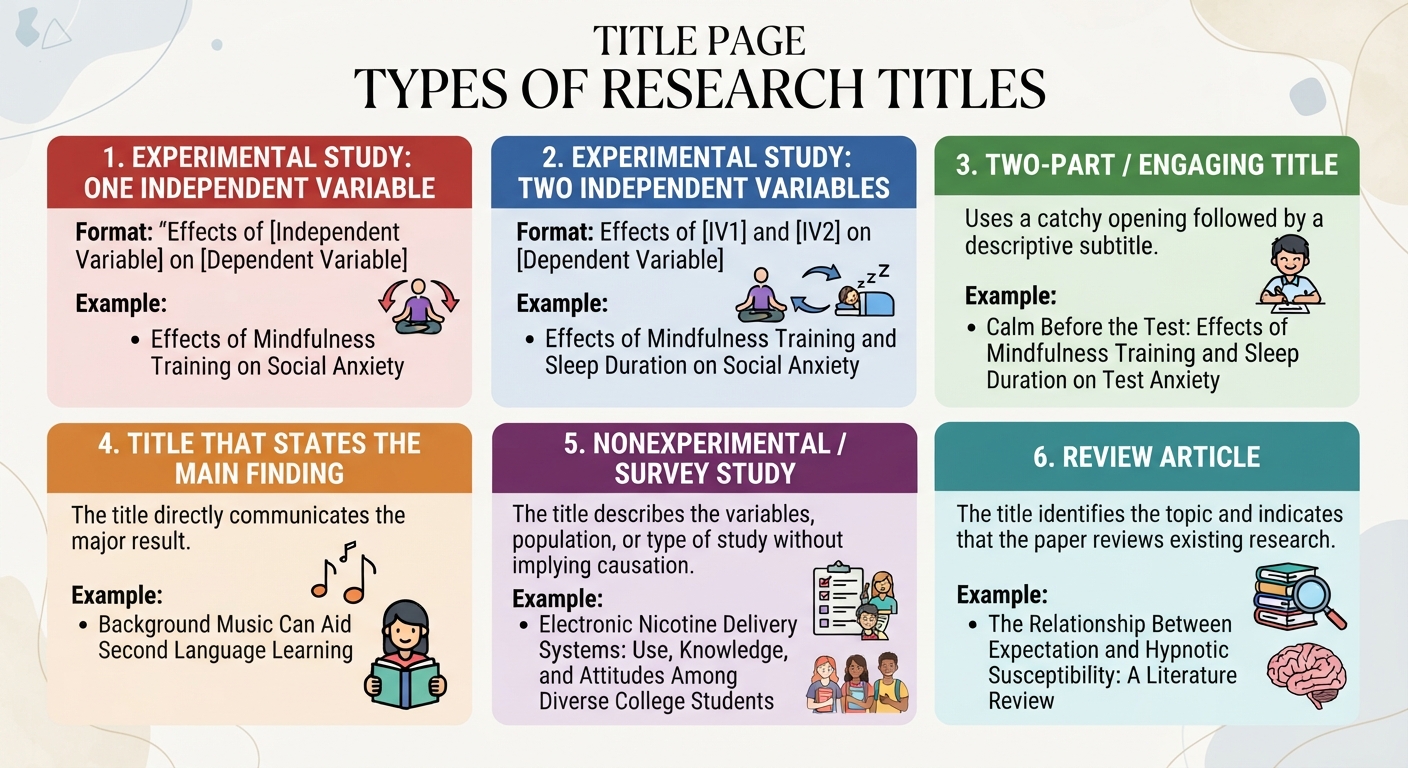
What are the different Types of Research Titles, and what characterizes each type?
Use “Effects of...” only when the design supports experimental manipulation. For nonexperimental research, use wording such as relationship, association, experiences, or attitudes rather than implying causation
When should researchers use “Effects of...” in a research title, and what wording should be used for Nonexperimental Research?

What is an Abstract, what is its purpose, what does it include, and when is it written?
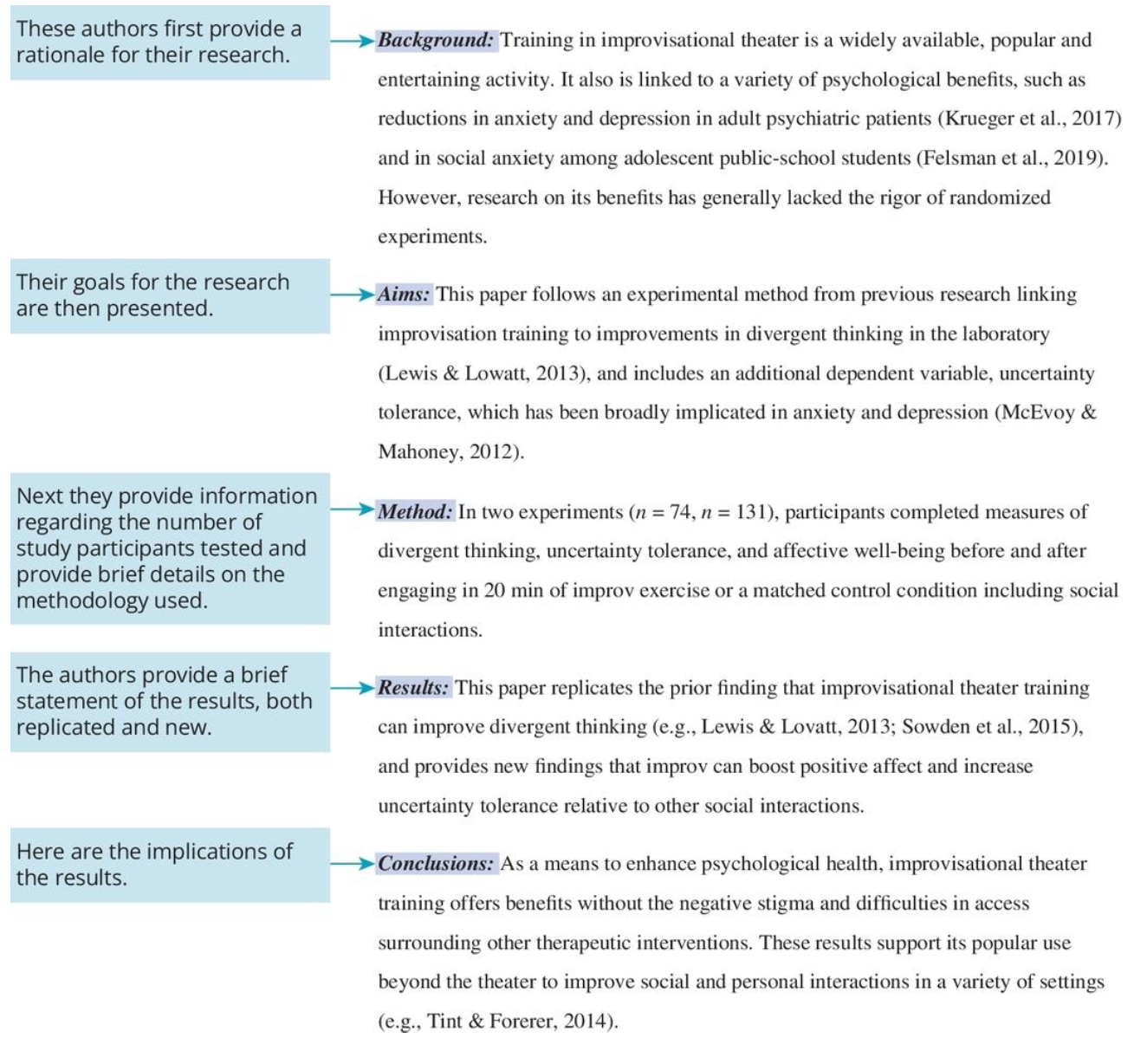
Usually appears on the second page.
"Abstract" is centered and bold at the top.
Often written as one paragraph with no indentation.
How is an Abstract typically formatted according to APA?
false, A structured abstract uses headings to organize its content.
A structured abstract is written as one continuous paragraph without headings. ✅❌
true
The journal determines whether the abstract should be paragraph-style or structured. ✅❌
Keywords represent the main concepts of the study and help readers find the article in literature databases
What are Keywords, and what is their purpose?
Usually 3–5 keywords.
Italicized.
Separated by commas.
Generally not capitalized.
What are the APA formatting rules for Keywords?
Provide background on previous research findings.
Develop a rationale for conducting the present study.
Introduce the current research and its purpose.
What are the three main purposes of the Introduction?
Broad topic.
Relevant literature.
More specific research problem.
Purpose of the present study.
What is the typical Broad-to-Specific structure of a Psychology paper's Introduction?
The purpose of the current research.
What does the final part of the Introduction typically present?
Start with an engaging example or "hook" to introduce the topic and attract the reader's interest.
Start directly with the literature review, beginning broadly and gradually becoming more specific.
What are the two common approaches to writing the first paragraph of the Introduction?
An engaging example used to introduce the topic and attract the reader's interest.
What is a "Hook" in the first paragraph of the Introduction?
It begins broadly with previous research and gradually becomes more specific.
How does the direct Literature Review approach begin the Introduction?
Review the most relevant previous research.
Summarize what is already known, even if no study examined the exact question.
Establish the rationale for the current study.
Show how the present research builds on previous work.
What should the Middle Paragraphs of the Introduction accomplish?
Addressing something that has not yet been studied.
Testing a theory.
Replicating previous research.
Using a different methodology.
Studying a different sample.
What are the five possible bases for the Rationale of a current study?
What previous research has found.
What remains to be examined.
Why the present study is needed.
What three questions should the Literature Review gradually explain?
It should lead logically to the purpose and hypotheses of the current study, usually presented in the final paragraph of the Introduction.
How should the literature reviewed in the Introduction lead to the current study?
Purpose of the study.
Brief description of the general methodology.
Hypothesis or hypotheses.
What should the Last Paragraph of the Introduction usually include?
The current study
What is the main focus of the Last Paragraph of the Introduction?
The independent variable(s)
dependent variable(s),
including the levels of the independent variables
What should the Purpose Statement identify in Experimental Research?
It should clearly identify the variables, behaviors, or experiences being investigated without implying causation.
How should the Purpose Statement be written in Nonexperimental Research?
Experimental research
identifies IV(s) and DV(s),
nonexperimental research
identifies variables, behaviors, or experiences without implying causation.
What is the main difference between Purpose Statements in Experimental and Nonexperimental Research?
To explain how the study was conducted
Understand exactly how the research was carried out.
Evaluate the study procedures.
Replicate the research if needed.
What is the purpose of the Method section?
What three things should the Method section enable readers to do?
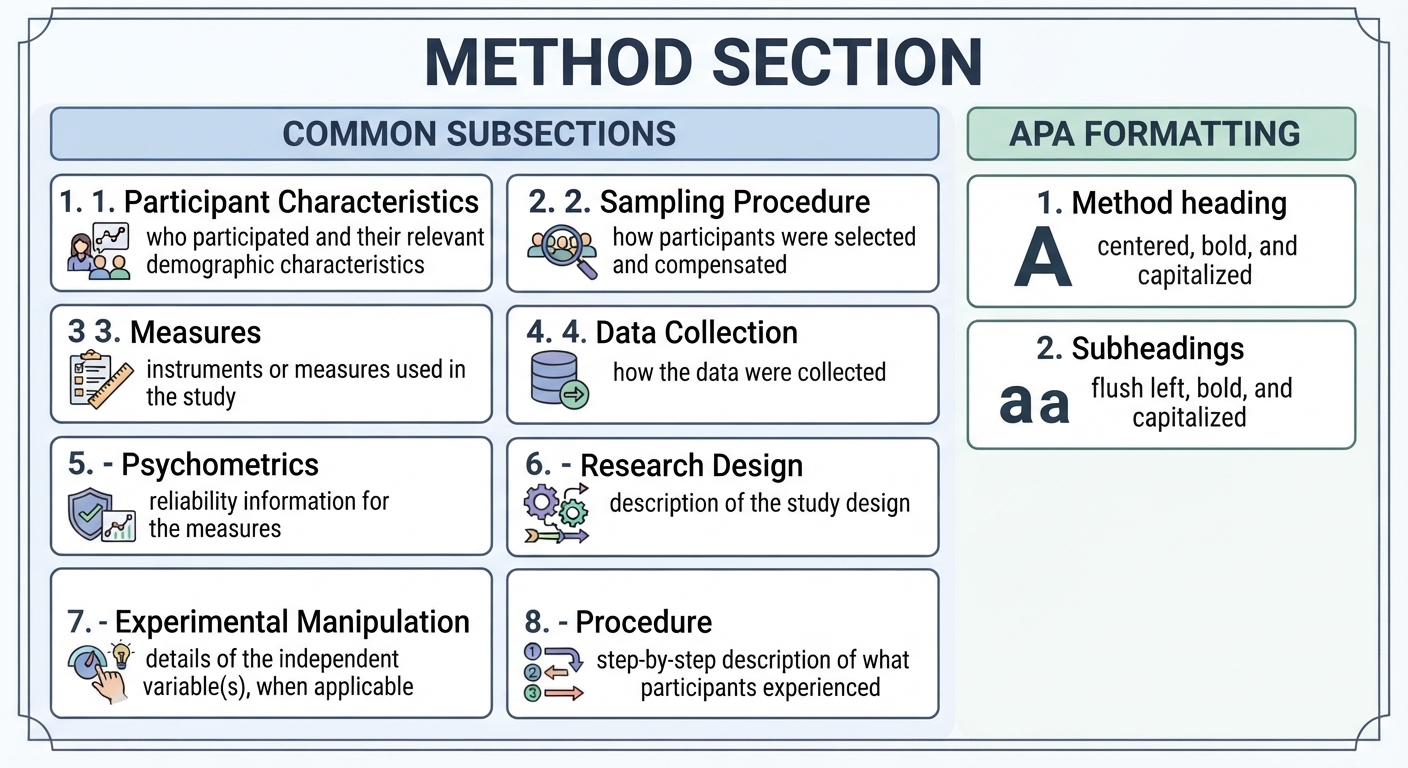
What are the eight common subsections of the Method Section, and what does each describe?
To present the findings of the statistical analyses.
Report the main findings clearly and systematically.
Present results in relation to the research questions or hypotheses.
What is the purpose of the Results Section?
What should the Results Section include?
Descriptive statistics (Mean M and Standard Deviation SD).
Inferential statistics used to test hypotheses.
Exact p values.
Effect size.
What information is commonly reported in the Results Section?
Statistical symbols are usually italicized (M, SD, p).
Numerical results are commonly rounded to two decimal places.
Results may be divided into subsections to improve clarity.
What are the APA reporting guidelines for the Results Section?
Restate the hypothesis.
Indicate whether findings supported or did not support the hypotheses.
Summarize main findings in words rather than statistics.
Avoid repeating statistical values or naming statistical tests.
Mention other important findings not included in the original hypotheses.
What should the First Paragraph of the Discussion include?
Results presents statistical details,
Discussion explains the meaning of findings in words rather than repeating statistics.
What is the main difference between presenting findings in the Results and Discussion sections?

What are the three main parts of the Middle Paragraphs of the Discussion, and what should each include?
Its purpose is to bring the Discussion to a clear close. It may include:
A reminder of why the research topic is important.
Implications of the findings in the real world.
A clear concluding statement.
A statement that more research is needed, when appropriate.
With a clear conclusion that does not leave the reader hanging.
What is the purpose of the Last Paragraph of the Discussion, and what may it include?
How should the Discussion end?

Lists all sources cited in the paper.
Begins on a new page.
Has the heading “References” centered, bold, and capitalized.
Arranges references alphabetically by the last name of the first author.
Includes the DOI when available; a DOI provides a permanent link to a published work.
Uses a hanging indent: the first line is flush left, and subsequent lines are indented.
Follows this general format: Author, A. A. (Year). Title of article. Journal Title, Volume(Issue), pages. DOI.
What are the main guidelines for the References section in an APA-style research paper?
Tables are useful for presenting several numerical results clearly, and they are usually referred to in the Results section.
What are tables useful for, and where are they usually referred to?
true
Researchers should not repeat every number from a table in the text; they should summarize only the most important findings. ✅❌
true
Tables are numbered consecutively (Table 1, Table 2, and so on),The table number is bold, and the table title is italicized and written in title case. ✅❌
A table can appear in the body of the paper after it is first mentioned,
on a separate page after the References section.
Where can a table appear in a research paper?
Figures are often used to illustrate relationships among variables. They should be referred to and briefly explained in the Results section.
What are figures often used for, and where should they be explained?
true
Figures are numbered consecutively (Figure 1, Figure 2, and so on), The figure number is bold, and the figure title is italicized and written in title case. ✅❌
Figures may appear in the body of the paper after they are first mentioned, or at the end of the manuscript.
Where can figures appear in a research paper?

What are the two types of in-text citations in APA style, how is each written, and what is the difference in using "and" and "&" when citing one or two authors?

How should in-text citations be written according to the number of authors, and what does "et al." mean?

What are the two main types of research presentations, and what are the guidelines for each?