1. Aggressive vs NonAggressive (Musculoskeletal Interpretation)
 Call Kai
 Learn
Learn Practice Test
 Spaced Repetition
 Match
Match Flashcards
 Knowt Play
1/73

There's no tags or description
Looks like no tags are added yet.
Name | Mastery | Learn | Test | Matching | Spaced | Call with Kai | Chat |
|---|
No analytics yet
Send a link to your students to track their progress
74 Terms
anatomy and alignment (normal and abnormal)
Interpret MSK radiographs via an ABC...E approach.
What does A stand for?
bones
Interpret MSK radiographs via an ABC...E approach.
What does B stand for?
cartilage
Interpret MSK radiographs via an ABC...E approach.
What does C stand for?
everything else (soft tissue, lymph nodes)
Interpret MSK radiographs via an ABC...E approach.
What does E stand for?
soft tissue
What opacity is cartilage?
no, interpret via bone changes where the cartilage attaches
So... if cartilage is soft tissue opacity... Can I really evaluate it on radiographs?
osteoproliferation
What is the term for "bone production"?
periosteal, periarticular, sclerosis
What are the three types of bone production?
periosteal
Which type of bone production happens around the bone
periarticular
which type of bone production happens around the joints
medullary, subchondral
Sclerosis is new bone formation in the _________ or _________ cavity
osteopenia, metabolic/nutritional disease, disuse
What is generalized bone loss called and what are some things that cause it? (2 causes)
osteolysis, infection, tumor, cyst
What is focal bone loss called, and what are a few causes? (3 causes)
neoplasia, osteomyelitis
What are the two primary diagnosis for aggressive lesions
primary bone tumor, metastatic lesions
What are some aggressive neoplasias in the bone?
fungal, bacterial
What are some examples of an osteomyelitis
bone cyst, degenerative joint disease, fractures (most), juvenile/developmental bone disease
What are some causes of non aggressive bone lesions?
epiphysis
Which part of the bone is indicated by the bracket in blue?
metaphysis
Which part of the bone is indicated by the bracket in pink?
diaphysis
Which part of the bone is indicated by the bracket in green?
size, shape, number, position, opacity, margination
Quick review, what are the six core roentgen signs?
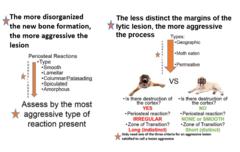
destruction of the cortex, periosteal reactions, zone of transition
What are the three things to look for to determine if a bone lei=sion is aggressive or not?
periosteal reactions
__________________: activity based on appearance of the margin of the periosteal reaction
healing, stimulation, elevation
Periosteal reactions are a _______ response that occurs by _______ or _______ or the periosteum from the cortex of the bone
activity, type
periosteal reactions are classified in terms of _____ and ________
irregular
Periosteal reactions can be smooth or irregular.... ________ indicates that the lesion is more aggressive
smooth, lamellar, collumnar/palisading, spiculated, amorphous
What are the periosteal reaction types from least to most aggressive?
lamellar, cyclic process
Which periosteal reaction has a layered or onion skin appearance?
And what does this indicate?
columnar/palisading
Which type of periosteal reaction has an irregular margin perpendicular to the long axis of the bone?
spiculated
which periosteal reaction has irregular margins that are long, thin, and radiate out at different angles from the cortex
amorphous
which periosteal reaction has no distinct margins, and results from disorganized bone formation often extending far into surrounding soft tissue
spiculated
Which periosteal reaction is this?

amorphous
Which periosteal reaction is this?

smooth
Which periosteal reaction is this?

lamellar
Which periosteal reaction is this?

columnar/palisading
Which periosteal reaction is this?

smooth (upper left), spiculated (centrally)
Which type of periosteal reaction is present here?

codmans triangle
in periosteal reactions, when there is a large disorganized lesion, there are often also areas of smooth solid periosteal reactions at the edges, secondary to the lifting of the periosteum by the more aggressive part oft he lesion.
This is called what?
codmans triangle
What is the abnormality under the main disorganized lesion seen here?

opacity, corticies, trabecular
generalized osteopenia results in a decreased _______, thin _____ and a distinct _______ pattern
less
the [more/less] distinct the margins of a lytic lesion, the more aggressive the process
geographic, moth eaten, permeative
What are three types of focal bone loss, from least to most aggressive?
geographic
What type of bone loss is defined by large areas of distinct/well defined margins?
moth eaten
What type of bone loss is defined by variably sized and shaped areas of lysis?
permeative
which type of bone loss if defined by pinpoint areas of lysis throughout an area of bone?
moth eaten
Which type of lysis?

geographic
Which type of lysis

permeative
which type of bone lysis?

cortical destruction
What has happened here?

discospondylitis
What is this called?
infection (brucella, E coli, staph)
What causes lysis of the endplates adjacent to disc spaces? (discospondylitis)
aggressive; moth eaten, medullary lysis, thinning cortex
Is this aggressive or non aggressive and why?

non aggressive, geographic lesion
Is this aggressive or non aggressive and why?

zone of transition
___________ indicates how distinct the margins are that denote a lytic lesion from normal healthy bone
short
is this a long or short transition zone?

long
is this a long or short zone of transition?
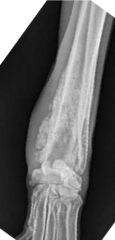
osteosarcoma, chondrosarcoma, fibrosarcoma
what are some primary bone tumors?
monostoic, do not cross joints
Primary bone lesions are typically _______, meaning they ________
metaphysis, away from the elbow and towards the knee (prox humerous, distal radius, distal femur, prox tibia)
Where do you typically see primary bone tumors?
true
true/false: can primary bone tumors be secondary to previous fractures and surgical implants
false; dogs hide a lot of sh*t
true/false: all dogs with primary bone tumors will present with lameness?
genitourinary tumors, pulmonary and primary bone tumors
Which tumors are more likely to metastasize to the bone?
multiple locations (polyostotic) at the diaphysis
Where are metastatic bone tumors usually found?
multiple myeloma
_________: polyostotic lytic lesions that affect flat and long bones and typically look "punched out"
multiple myeloma
What is this?

metaphyseal, joint centric
Where is fungal osteomyelitis usually found?
young/middle aged, large dogs
Who is fungal osteomyelitis usually found in?
histo, blasto, cryptococcus, coccidioides
What typically causes fungal osteomyelitis?
metaphysis or epiphysis in long bones in young patients
Where and who is typically affected by bacterial osteomyelitis
injury or surgery sites
When bacterial osteomyelitis is in adult patients... where is it typically found?
hot, swollen, drainage tract, leukocytosis
What may indicate a bacterial osteomyelitis?
subchondral bone loss
With joint disease, we cant see the cartilage destruction... so where do we look to see if it's aggressive?
neoplasia, septic arthritis, fungal disease
Aggressive lesions in joints can include what? (3 examples)
Right... :,)
Aaaaaaaand here's everything we covered. (I'll save you the trouble of reading her article inside the lecture. It DOES cover everything... but I would only recommend if you just really need it written in a different way)