CHEM 14103: University Chemistry I Practice Material Review
 Call Kai
 Learn
 Practice Test
 Spaced Repetition
 Match
 Flashcards
 Knowt Play
1/32

Earn XP
Description and Tags
Vocabulary practice cards covering periodic trends, electron configurations, Lewis structures, molecular geometry, bond types, and states of matter from CHEM 14103 practice materials.
33 Terms
Cation Ionic Radius
The radius of a positive ion, which is always smaller than that of its corresponding neutral atom due to the loss of electrons.
Anion Ionic Radius
The radius of a negative ion, which is always larger than that of its corresponding neutral atom due to electron-electron repulsion from added electrons.
Isoelectronic Species Radius Trend
Among chemical species that share the same total number of electrons, the species with the greater positive nuclear charge has the smaller ionic radius.
Effective Nuclear Charge (Zeff) of Main-Group Elements
The net positive charge experienced by an electron in an atom, which for main-group elements is approximately equal to the element's main-group number.
Cation Electron Removal Rule
The rule stating that when forming positive ions from transition or post-transition metals, electrons are always removed first from the subshell with the highest principal quantum number (n).
Paramagnetic
The magnetic property of an atom, ion, or molecule containing one or more unpaired electrons in a partially filled subshell, causing it to be attracted to an external magnetic field.
Diamagnetic
The magnetic property of an atom, ion, or molecule in which all electrons are completely paired with no unpaired electrons present.
Ionization Energy (IE)
The endothermic energy change associated with removing an electron from a gaseous atom or ion; it generally increases up and to the right across the periodic table.
Core Electron Ionization Energy Jump
A large and sudden increase in consecutive ionization energies that occurs when shifting from removing valence electrons to removing inner core electrons.
Electron Affinity (EA)
The energy change associated with adding an electron to a gaseous atom (represented as A(g)+e−→A−(g)), which generally becomes more exothermic moving up and to the right on the periodic table (excluding noble gases).
Metallic Character
A periodic trend that increases moving down and to the left across the periodic table.
Chemical Bond Formation Driving Force
The electrostatic principle that chemical bonds form because they decrease the potential energy of the interacting charged particles that compose the atoms.
Covalent Bond
A chemical bond characterized by the sharing of valence electron pairs between atoms, typically forming between two or more nonmetals.
Empirical Formula
The chemical formula showing the simplest whole-number ratio of the elements present in a compound.
Double Bond
A covalent linkage requiring two adjacent atoms to share 4 electrons, which corresponds to 2 pairs of electrons.
Triple Bond
A covalent linkage requiring two adjacent atoms to share 6 electrons, which corresponds to 3 pairs of electrons.
Octet Rule
The principle stating that most nonmetals achieve stability by having 8 valence electrons in their outermost electron shell.
Bonding Pair vs. Lone Pair
Bonding pairs of electrons are shared between and considered to belong to both bonded atoms, whereas lone pairs are nonbonding electrons localized on only one atom.
Electronegativity
The relative tendency of an atom to attract shared electrons toward itself in a chemical bond.
Polar Covalent Bond
A covalent bond where electrons are shared unequally between atoms with differing electronegativities.
Resonance Structure Stability Criteria
Guidelines establishing that the best (most contributing) resonance structure has formal charges closest to zero and places any negative formal charge on the more electronegative atom.
Incomplete Octet
An exception to the octet rule occurring in stable electron-deficient molecules where the central atom is surrounded by fewer than 8 valence electrons (such as boron in BF3).
Expanded Octet
An exception to the octet rule where a central atom accommodates more than 8 valence electrons, which is possible only for elements located in the third row or below of the periodic table.
Carbon-Oxygen Bond Length Ordering
The relationship where bond length decreases with increasing bond order: CO<CH2O<CO32−<CH3OH, reflecting triple, double, intermediate (resonance), and single bonds respectively.
Trigonal Pyramidal Geometry
The molecular geometry observed when a central atom has 3 bonding groups and 1 lone pair of electrons (such as NF3).
Trigonal Bipyramidal Geometry
The molecular geometry observed when a central atom is surrounded by 5 bonding groups and 0 lone pairs of electrons (such as PF5).
T-Shaped Geometry
The molecular geometry observed when a central atom has 3 bonding groups and 2 lone pairs of electrons (such as ClF3).
Square Pyramidal Geometry
The molecular geometry observed when a central atom possesses 5 bonding groups and 1 lone pair of electrons (such as IF5).
Linear Geometry (AX2E3)
The molecular geometry produced when a central atom possesses 2 bonding groups and 3 equatorial lone pairs of electrons (such as XeF2).
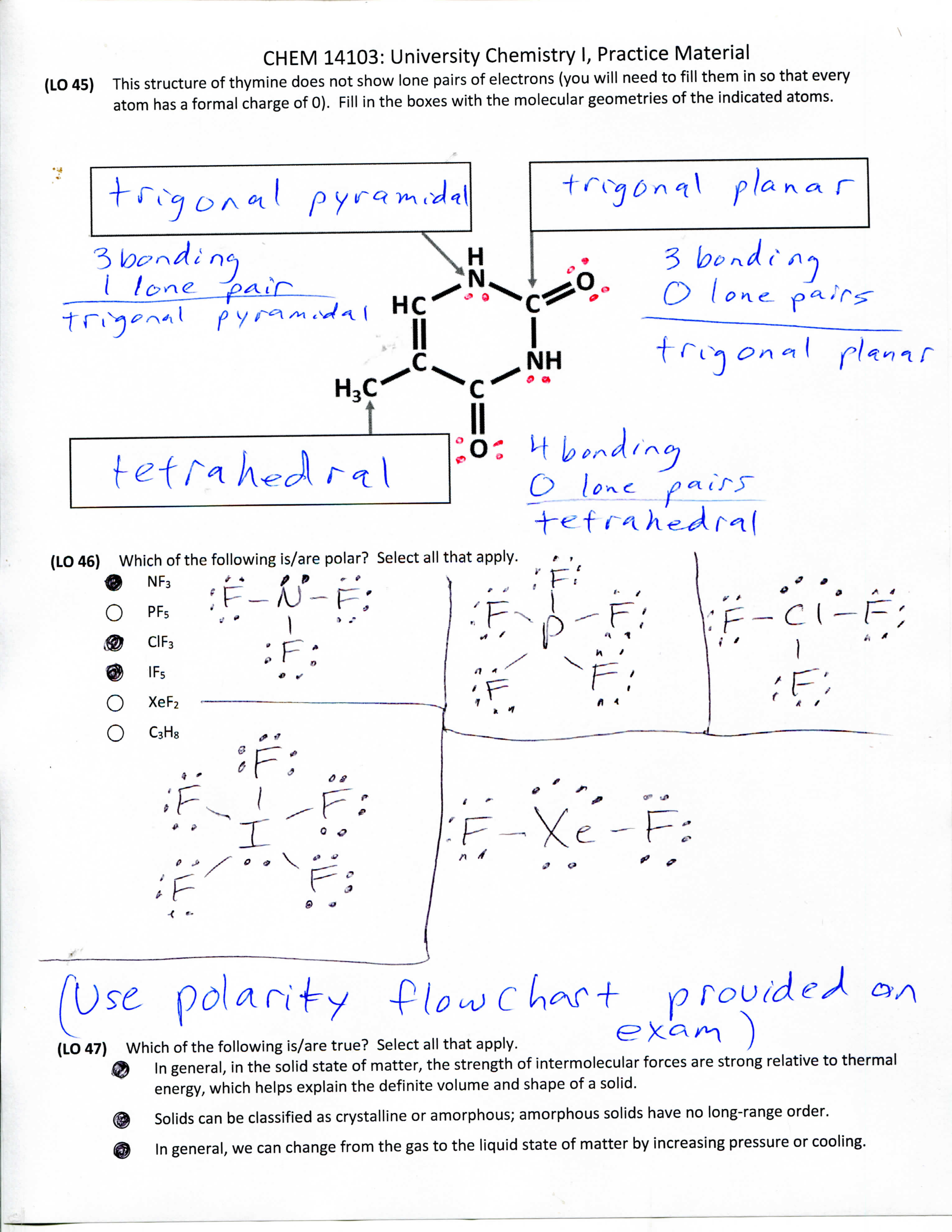
Molecular Geometries of Thymine
In thymine: the ring nitrogen (3 bonding, 1 lone pair) is trigonal pyramidal; the carbonyl ring carbon (3 bonding, 0 lone pairs) is trigonal planar; and the attached methyl group carbon (4 bonding, 0 lone pairs) is tetrahedral.
Amorphous Solid
A solid classification in which the constituent particles lack long-range, repeating structural order.
Solid State Intermolecular Forces
In the solid state of matter, intermolecular forces are strong relative to thermal energy, which explains the characteristic definite shape and definite volume of solids.
Gas to Liquid Phase Transition Conditions
A physical transition from the gas to the liquid state of matter brought about either by increasing pressure or by cooling (decreasing temperature).